Chapter 5 of 14
NCERT Solutions

Current Electricity — NCERT Solutions

Madhya Pradesh Board · Class 12 · Physics

NCERT Solutions for Current Electricity, Madhya Pradesh Board Class 12 Physics: 9 textbook questions solved step by step. Covers Exercises.

87 questions56 flashcards17 formulas & key relations5 concepts

Interactive on Super Tutor

Studying Current Electricity? Get the full interactive chapter.

Quizzes, flashcards, AI doubt-solver and a step-by-step study plan — built for NCERT solutions and more.

Free trial, no card needed.
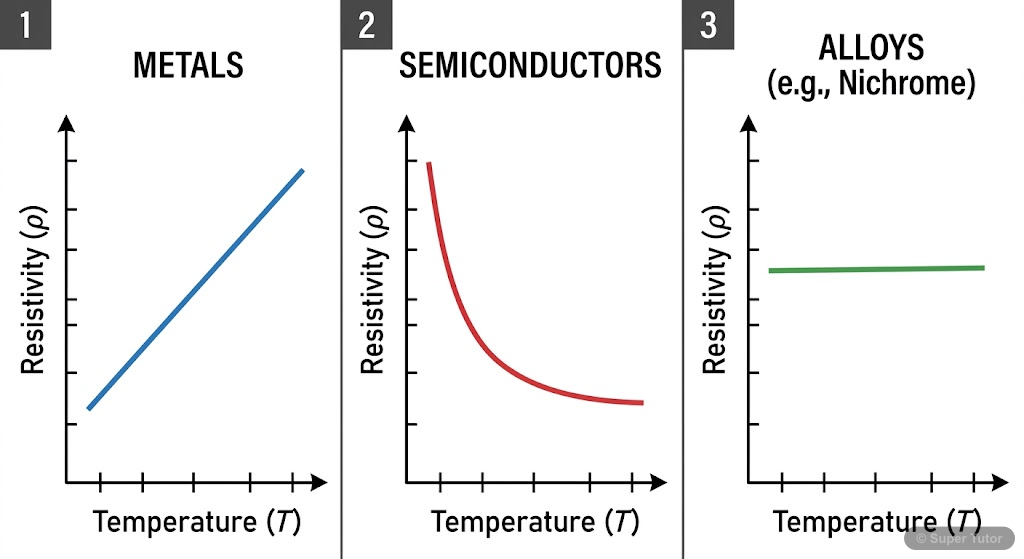
Graphs showing the variation of resistivity with temperature for different types of materials: metals, semiconductors, and alloys.
Super Tutor

One of 13 illustrations for Current Electricity in Super Tutor — alongside flashcards, concept maps and practice questions.

9 Questions Solved · 1 Section

The first 5 solutions are open to read. The other 4 are free with a Super Tutor account.

Exercises

3.1The storage battery of a car has an emf of 12V12\mathrm{V}. If the internal resistance of the battery is 0.4Ω0.4\Omega, what is the maximum current that can be drawn from the battery?Show solution

Given:

  • EMF of battery, ε=12 V\varepsilon = 12\,\mathrm{V}
  • Internal resistance, r=0.4 Ωr = 0.4\,\Omega

Concept: The current drawn from a battery is maximum when the external resistance R=0R = 0 (short circuit condition).

Formula:
Imax⁡=εrI_{\max} = \frac{\varepsilon}{r}

Calculation:
Imax⁡=120.4=30 AI_{\max} = \frac{12}{0.4} = 30\,\mathrm{A}

Answer: The maximum current that can be drawn from the battery is 30 A\boxed{30\,\mathrm{A}}.

3.2A battery of emf 10V10\mathrm{V} and internal resistance 3Ω3\Omega is connected to a resistor. If the current in the circuit is 0.5A0.5\mathrm{A}, what is the resistance of the resistor? What is the terminal voltage of the battery when the circuit is closed?Show solution

Given:

  • EMF, ε=10 V\varepsilon = 10\,\mathrm{V}
  • Internal resistance, r=3 Ωr = 3\,\Omega
  • Current, I=0.5 AI = 0.5\,\mathrm{A}

Part (i): Finding the external resistance RR

Using the formula:
I=εR+rI = \frac{\varepsilon}{R + r}
R+r=εI=100.5=20 ΩR + r = \frac{\varepsilon}{I} = \frac{10}{0.5} = 20\,\Omega
R=20−r=20−3=17 ΩR = 20 - r = 20 - 3 = 17\,\Omega

Part (ii): Terminal voltage of the battery

The terminal voltage is the voltage across the external resistor:
V=ε−Ir=10−(0.5×3)=10−1.5=8.5 VV = \varepsilon - Ir = 10 - (0.5 \times 3) = 10 - 1.5 = 8.5\,\mathrm{V}

Alternatively: V=IR=0.5×17=8.5 VV = IR = 0.5 \times 17 = 8.5\,\mathrm{V} ✓

Answer: Resistance of the resistor R=17 ΩR = 17\,\Omega; Terminal voltage V=8.5 VV = 8.5\,\mathrm{V}.

3.3At room temperature (27.0∘C)(27.0^{\circ}\mathrm{C}) the resistance of a heating element is 100Ω100\Omega. What is the temperature of the element if the resistance is found to be 117Ω117\Omega, given that the temperature coefficient of the material of the resistor is 1.70×10⁻⁴ ∘C−11.70\times 10^{-4}\,^{\circ}\mathrm{C}^{-1}?Show solution

Given:

  • Temperature T1=27.0∘CT_1 = 27.0^{\circ}\mathrm{C}
  • Resistance at T1T_1: R1=100 ΩR_1 = 100\,\Omega
  • Resistance at T2T_2: R2=117 ΩR_2 = 117\,\Omega
  • Temperature coefficient, α=1.70×10⁻⁴ ∘C−1\alpha = 1.70 \times 10^{-4}\,^{\circ}\mathrm{C}^{-1}

Formula:
R2=R1 [1+α(T2−T1)]R_2 = R_1\,[1 + \alpha(T_2 - T_1)]

Calculation:
117=100 [1+1.70×10⁻⁴(T2−27)]117 = 100\,[1 + 1.70 \times 10^{-4}(T_2 - 27)]
117100=1+1.70×10⁻⁴(T2−27)\frac{117}{100} = 1 + 1.70 \times 10^{-4}(T_2 - 27)
1.17−1=1.70×10⁻⁴(T2−27)1.17 - 1 = 1.70 \times 10^{-4}(T_2 - 27)
0.17=1.70×10⁻⁴(T2−27)0.17 = 1.70 \times 10^{-4}(T_2 - 27)
T2−27=0.171.70×10−4=1000∘CT_2 - 27 = \frac{0.17}{1.70 \times 10^{-4}} = 1000^{\circ}\mathrm{C}
T2=1000+27=1027∘CT_2 = 1000 + 27 = 1027^{\circ}\mathrm{C}

Answer: The temperature of the heating element is 1027∘C\boxed{1027^{\circ}\mathrm{C}}.

3.4A negligibly small current is passed through a wire of length 15 m15\,\mathrm{m} and uniform cross-section 6.0×10⁻⁷ m26.0 \times 10^{-7}\,\mathrm{m}^2, and its resistance is measured to be 5.0 Ω5.0\,\Omega. What is the resistivity of the material at the temperature of the experiment?Show solution

Given:

  • Length of wire, l=15 ml = 15\,\mathrm{m}
  • Cross-sectional area, A=6.0×10⁻⁷ m2A = 6.0 \times 10^{-7}\,\mathrm{m}^2
  • Resistance, R=5.0 ΩR = 5.0\,\Omega

Formula:
R=ρlA  ⟹  ρ=RAlR = \frac{\rho l}{A} \implies \rho = \frac{RA}{l}

Calculation:
ρ=5.0×6.0×10−715\rho = \frac{5.0 \times 6.0 \times 10^{-7}}{15}
ρ=30×10−715=2.0×10⁻⁷ Ω m\rho = \frac{30 \times 10^{-7}}{15} = 2.0 \times 10^{-7}\,\Omega\,\mathrm{m}

Answer: The resistivity of the material is 2.0×10⁻⁷ Ω m\boxed{2.0 \times 10^{-7}\,\Omega\,\mathrm{m}}.

3.5A silver wire has a resistance of 2.1 Ω2.1\,\Omega at 27.5 ∘C27.5\,^{\circ}\mathrm{C}, and a resistance of 2.7 Ω2.7\,\Omega at 100 ∘C100\,^{\circ}\mathrm{C}. Determine the temperature coefficient of resistivity of silver.Show solution

Given:

  • R1=2.1 ΩR_1 = 2.1\,\Omega at T1=27.5∘CT_1 = 27.5^{\circ}\mathrm{C}
  • R2=2.7 ΩR_2 = 2.7\,\Omega at T2=100∘CT_2 = 100^{\circ}\mathrm{C}

Formula:
R2=R1[1+α(T2−T1)]R_2 = R_1[1 + \alpha(T_2 - T_1)]

Solving for α\alpha:
α=R2−R1R1(T2−T1)\alpha = \frac{R_2 - R_1}{R_1(T_2 - T_1)}
α=2.7−2.12.1×(100−27.5)\alpha = \frac{2.7 - 2.1}{2.1 \times (100 - 27.5)}
α=0.62.1×72.5\alpha = \frac{0.6}{2.1 \times 72.5}
α=0.6152.25\alpha = \frac{0.6}{152.25}
α≈3.94×10⁻³ ∘C−1\alpha \approx 3.94 \times 10^{-3}\,^{\circ}\mathrm{C}^{-1}

Answer: The temperature coefficient of resistivity of silver is α≈3.94×10⁻³ ∘C−1\alpha \approx 3.94 \times 10^{-3}\,^{\circ}\mathrm{C}^{-1}.

3.6A heating element using nichrome connected to a 230 V230\,\mathrm{V} supply draws an initial current of 3.2 A3.2\,\mathrm{A} which settles after a few seconds to a steady value of 2.8 A2.8\,\mathrm{A}. What is the steady temperature of the heating element if the room temperature is 27.0 ∘C27.0\,^{\circ}\mathrm{C}? Temperature coefficient of resistance of nichrome averaged over the temperature range involved is 1.70×10⁻⁴ ∘C−11.70 \times 10^{-4}\,^{\circ}\mathrm{C}^{-1}.

Free with a Super Tutor account

3.7Determine the current in each branch of the network shown in Fig. 3.20.

Free with a Super Tutor account

3.8A storage battery of emf 8.0 V8.0\,\mathrm{V} and internal resistance 0.5 Ω0.5\,\Omega is being charged by a 120 V120\,\mathrm{V} dc supply using a series resistor of 15.5 Ω15.5\,\Omega. What is the terminal voltage of the battery during charging? What is the purpose of having a series resistor in the charging circuit?

Free with a Super Tutor account

3.9The number density of free electrons in a copper conductor estimated in Example 3.1 is 8.5×1028 m−38.5 \times 10^{28}\,\mathrm{m}^{-3}. How long does an electron take to drift from one end of a wire 3.0 m3.0\,\mathrm{m} long to its other end? The area of cross-section of the wire is 2.0×10⁻⁶ m22.0 \times 10^{-6}\,\mathrm{m}^2 and it is carrying a current of 3.0 A3.0\,\mathrm{A}.

Free with a Super Tutor account

4 more solved questions in Current Electricity

They are free with a Super Tutor account, along with practice quizzes and flashcards for this chapter. Free to start, no card needed.

Frequently Asked Questions

What are the important topics in Current Electricity for Madhya Pradesh Board Class 12 Physics?
Key topics in Current Electricity include Electric Current and Current Density, Ohm's Law, Resistance, Resistivity, and Conductivity, Microscopic Origin of Resistance: Drift Velocity, Relaxation Time, and Mobility, Limits of Ohm's Law and Materials Classification. Study these first, then practise questions on each for the Madhya Pradesh Board Class 12 board exam.
Are these NCERT Solutions for Current Electricity free?
The first 5 of the 9 solutions on this page are open to read. The other 4 are free with a Super Tutor account — signing up is free and needs no card.
How should I revise Current Electricity for the Madhya Pradesh Board Class 12 board exam?
Learn the core ideas first, then work through the 87 practice questions on Current Electricity. Revise definitions regularly and use flashcards for quick recall before the exam.

Sources & Official References

Content is aligned to the official syllabus. Refer to the board website for the latest curriculum.

For serious students

Get the full Current Electricity chapter — start free.

Quizzes, flashcards, an AI doubt solver and a study plan for Madhya Pradesh Board Class 12 Physics. Free to start, no card needed.