Electric Charges and Fields — NCERT Solutions
Madhya Pradesh Board · Class 12 · Physics
NCERT Solutions for Electric Charges and Fields, Madhya Pradesh Board Class 12 Physics: 23 textbook questions solved step by step. Covers Exercises.
Interactive on Super Tutor
Studying Electric Charges and Fields? Get the full interactive chapter.
Quizzes, flashcards, AI doubt-solver and a step-by-step study plan — built for NCERT solutions and more.
Free trial, no card needed.
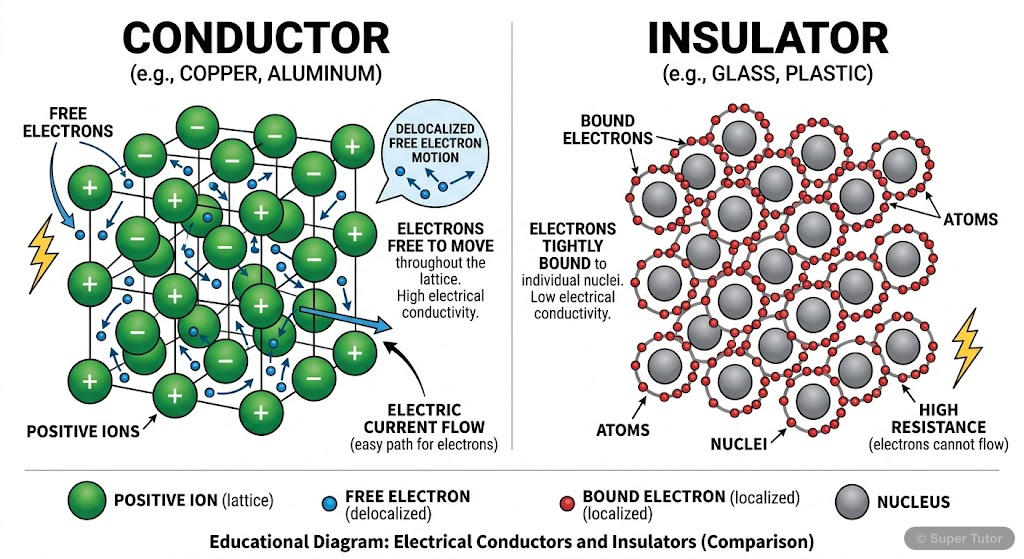
One of 23 illustrations for Electric Charges and Fields in Super Tutor — alongside flashcards, concept maps and practice questions.
The first 12 solutions are open to read. The other 11 are free with a Super Tutor account.
Exercises
1.1What is the force between two small charged spheres having charges of and placed apart in air?Show solution
Using Coulomb’s law,
Given: , , , and .
So the force is repulsive because both charges are positive.
1.2The electrostatic force on a small sphere of charge due to another small sphere of charge in air is . (a) What is the distance between the two spheres? (b) What is the force on the second sphere due to the first?Show solution
By Coulomb’s law,
Given , , .
So,
So the distance is 0.12 m.
For the force on the second sphere, by Newton’s third law, it has the same magnitude and opposite direction. Since the charges are unlike, the force is attractive.
1.3Check that the ratio is dimensionless. Look up a Table of Physical Constants and determine the value of this ratio. What does the ratio signify?Show solution
To check dimensions:
- has units
- has units
- has units
- has units
So the units are
Hence the ratio is dimensionless.
From the chapter, the value is approximately
This ratio signifies the relative strength of electric force to gravitational force between a proton and an electron. The electric force is about times stronger.
1.4(a) Explain the meaning of the statement 'electric charge of a body is quantised'.
(b) Why can one ignore quantisation of electric charge when dealing with macroscopic i.e., large scale charges?Show solution
(a) Electric charge is quantised means the charge on any body is always an integral multiple of the elementary charge :
So charge does not vary continuously at the microscopic level; it exists in discrete units of .
(b) For macroscopic bodies, the total charge contains an extremely large number of electrons or protons. Since is very small, the step size is negligible compared with ordinary charges like microcoulombs. Therefore charge appears continuous and quantisation can be ignored at large scale.
1.5When a glass rod is rubbed with a silk cloth, charges appear on both. A similar phenomenon is observed with many other pairs of bodies. Explain how this observation is consistent with the law of conservation of charge.Show solution
This is consistent with conservation of charge because when two bodies are rubbed, no new charge is created or destroyed. Charges are only transferred from one body to the other. For example, when a glass rod is rubbed with silk, some electrons move from the glass to the silk. So the glass becomes positively charged and the silk negatively charged, but the total charge of the combined system remains the same.
1.6Four point charges , , , and are located at the corners of a square ABCD of side . What is the force on a charge of placed at the centre of the square?Show solution
At the centre of the square, the charges at opposite corners are at equal distances from the centre.
- The two +2 μC charges are at opposite corners, so their forces on the central test charge are equal and opposite.
- The two −5 μC charges are also at opposite corners, so their forces on the central test charge are equal and opposite.
Therefore all forces cancel pairwise, and the net force is zero.
1.7(a) An electrostatic field line is a continuous curve. That is, a field line cannot have sudden breaks. Why not?
(b) Explain why two field lines never cross each other at any point?Show solution
(a) A field line is drawn so that its tangent at every point gives the direction of the electric field. Since the electric field at a point has a definite direction, the field line must be a continuous curve. A sudden break would mean the field has no direction at that point, which is not possible.
(b) Two field lines can never cross because if they did, the electric field at the point of intersection would have two directions at the same time, which is impossible. The field at any point can have only one unique direction.
1.8Two point charges and are located apart in vacuum.
(a) What is the electric field at the midpoint O of the line AB joining the two charges?
(b) If a negative test charge of magnitude is placed at this point, what is the force experienced by the test charge?Show solution
The midpoint is from each charge.
For the positive charge , the field at O is away from the positive charge, i.e. towards B.
For the negative charge , the field at O is towards the negative charge, i.e. also towards B.
So the fields add.
Magnitude due to one charge:
Total field:
directed from the positive charge to the negative charge.
For the test charge ,
Magnitude:
Since the test charge is negative, the force is opposite to the field direction, i.e. towards the positive charge.
1.9A system has two charges and located at points A: (0, 0, -15 cm) and B: (0, 0, +15 cm), respectively. What are the total charge and electric dipole moment of the system?Show solution
Total charge:
Dipole moment is
Here the charges are on the -axis at and , so separation is
Magnitude:
Direction is from negative charge to positive charge, i.e. along +z-axis.
1.10An electric dipole with dipole moment is aligned at with the direction of a uniform electric field of magnitude . Calculate the magnitude of the torque acting on the dipole.Show solution
Torque on a dipole in a uniform field is
Given , , and .
So the torque is N m.
1.11A polythene piece rubbed with wool is found to have a negative charge of .
(a) Estimate the number of electrons transferred (from which to which?)
(b) Is there a transfer of mass from wool to polythene?Show solution
(a) Number of electrons transferred:
Since the polythene becomes negatively charged, it must have gained electrons from the wool.
(b) Yes, there is a transfer of mass because electrons have mass. But the transferred mass is extremely small, so in practice it is negligible.
1.12(a) Two insulated charged copper spheres A and B have their centres separated by a distance of . What is the mutual force of electrostatic repulsion if the charge on each is ? The radii of A and B are negligible compared to the distance of separation.
(b) What is the force of repulsion if each sphere is charged double the above amount, and the distance between them is halved?Show solution
(a) Using Coulomb’s law,
Given and .
So, approximately
(b) If each charge is doubled, force becomes 4 times.
If distance is halved, force becomes 4 times more.
So total increase = times.
So the new force is about N.
Free with a Super Tutor account
Free with a Super Tutor account
Free with a Super Tutor account
Free with a Super Tutor account
Free with a Super Tutor account
Free with a Super Tutor account
Free with a Super Tutor account
Free with a Super Tutor account
Free with a Super Tutor account
Free with a Super Tutor account
Free with a Super Tutor account
11 more solved questions in Electric Charges and Fields
They are free with a Super Tutor account, along with practice quizzes and flashcards for this chapter. Free to start, no card needed.
Frequently Asked Questions
What are the important topics in Electric Charges and Fields for Madhya Pradesh Board Class 12 Physics?
Are these NCERT Solutions for Electric Charges and Fields free?
How should I revise Electric Charges and Fields for the Madhya Pradesh Board Class 12 board exam?
Sources & Official References
Content is aligned to the official syllabus. Refer to the board website for the latest curriculum.
More resources for Electric Charges and Fields
Practice Quiz
Test yourself with a quick quiz
Important Questions
Exam-style questions with answers
Revision Notes
Key points for last-minute revision
Formula Sheet
The chapter's formulas in one place
Chapter Summary
Understand the chapter at a glance
Concept Maps
See how topics connect
Study Plan
Step-by-step plan for this chapter
Flashcards
Quick-fire cards for active recall
Syllabus
What topics to cover
For serious students
Get the full Electric Charges and Fields chapter — start free.
Quizzes, flashcards, an AI doubt solver and a study plan for Madhya Pradesh Board Class 12 Physics. Free to start, no card needed.