Moving Charges and Magnetism — Chapter Summary
Madhya Pradesh Board · Class 12 · Physics
Summary of Moving Charges and Magnetism for Madhya Pradesh Board Class 12 Physics. Part of the Madhya Pradesh Board Class 12 Physics syllabus.
Interactive on Super Tutor
Studying Moving Charges and Magnetism? Get the full interactive chapter.
Quizzes, flashcards, AI doubt-solver and a step-by-step study plan — built for chapter summary and more.
Free trial, no card needed.
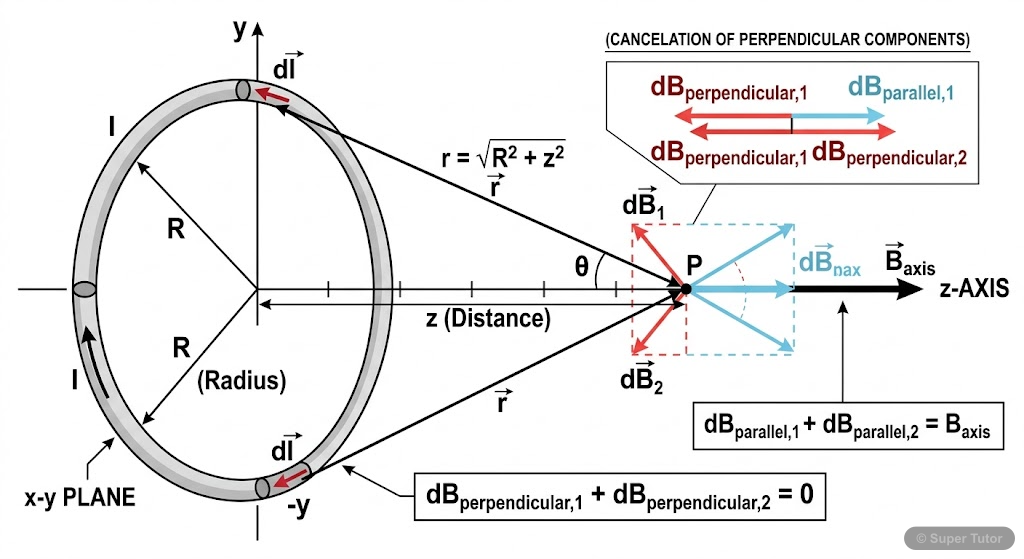
One of 16 illustrations for Moving Charges and Magnetism in Super Tutor — alongside flashcards, concept maps and practice questions.
Overview
Electric current produces magnetic effects, and moving charges experience magnetic force. The chapter links electricity and magnetism through Oersted’s observation, Lorentz force, Biot-Savart law, Ampere’s circuital law, and the behaviour of current loops, solenoids, and galvanometers. It also shows
Key Concepts
A current in a straight wire
A current in a straight wire deflects a nearby compass needle, showing that moving charges or currents produce a magnetic field around them. Magnetic
The electric field is produced by
The electric field is produced by static charge, while the magnetic field is produced by moving charges or currents and by intrinsic magnetic moments.
The force on a charge q
The force on a charge q moving with velocity v in electric and magnetic fields is F = q[E(r) + v × B(r)]. The magnetic part is perpendicular to both v
For a straight conductor in
For a straight conductor in an external magnetic field, the force is F = I l × B. The current I is not a vector; the direction is carried by the lengt
If velocity is perpendicular to
If velocity is perpendicular to the magnetic field, a charge moves in a circle with radius r = mv/qB. If velocity has a component parallel to B, that
Learning Objectives
- Understand how moving charges and currents produce magnetic fields.
- Use the Lorentz force to find the force on a moving charge.
- Find the force on a current-carrying conductor in a magnetic field.
- Describe circular, helical, and cyclotron motion of charged particles.
- Apply the Biot-Savart law to current elements and circular loops.
Frequently Asked Questions
What are the important topics in Moving Charges and Magnetism for Madhya Pradesh Board Class 12 Physics?
How should I revise Moving Charges and Magnetism for the Madhya Pradesh Board Class 12 board exam?
Sources & Official References
Content is aligned to the official syllabus. Refer to the board website for the latest curriculum.
More resources for Moving Charges and Magnetism
Practice Quiz
Test yourself with a quick quiz
Important Questions
Exam-style questions with answers
Revision Notes
Key points for last-minute revision
Formula Sheet
The chapter's formulas in one place
Concept Maps
See how topics connect
Study Plan
Step-by-step plan for this chapter
Flashcards
Quick-fire cards for active recall
Syllabus
What topics to cover
NCERT Solutions
Every textbook question solved step by step
For serious students
Get the full Moving Charges and Magnetism chapter — start free.
Quizzes, flashcards, an AI doubt solver and a study plan for Madhya Pradesh Board Class 12 Physics. Free to start, no card needed.