Contemporary Centers of Power — Chapter Summary
Madhya Pradesh Board · Class 12 · Political Science
Summary of Contemporary Centers of Power for Madhya Pradesh Board Class 12 Political Science. The end of bipolar world politics made room for new centres.
Interactive on Super Tutor
Studying Contemporary Centers of Power? Get the full interactive chapter.
Quizzes, flashcards, AI doubt-solver and a step-by-step study plan — built for chapter summary and more.
Free trial, no card needed.
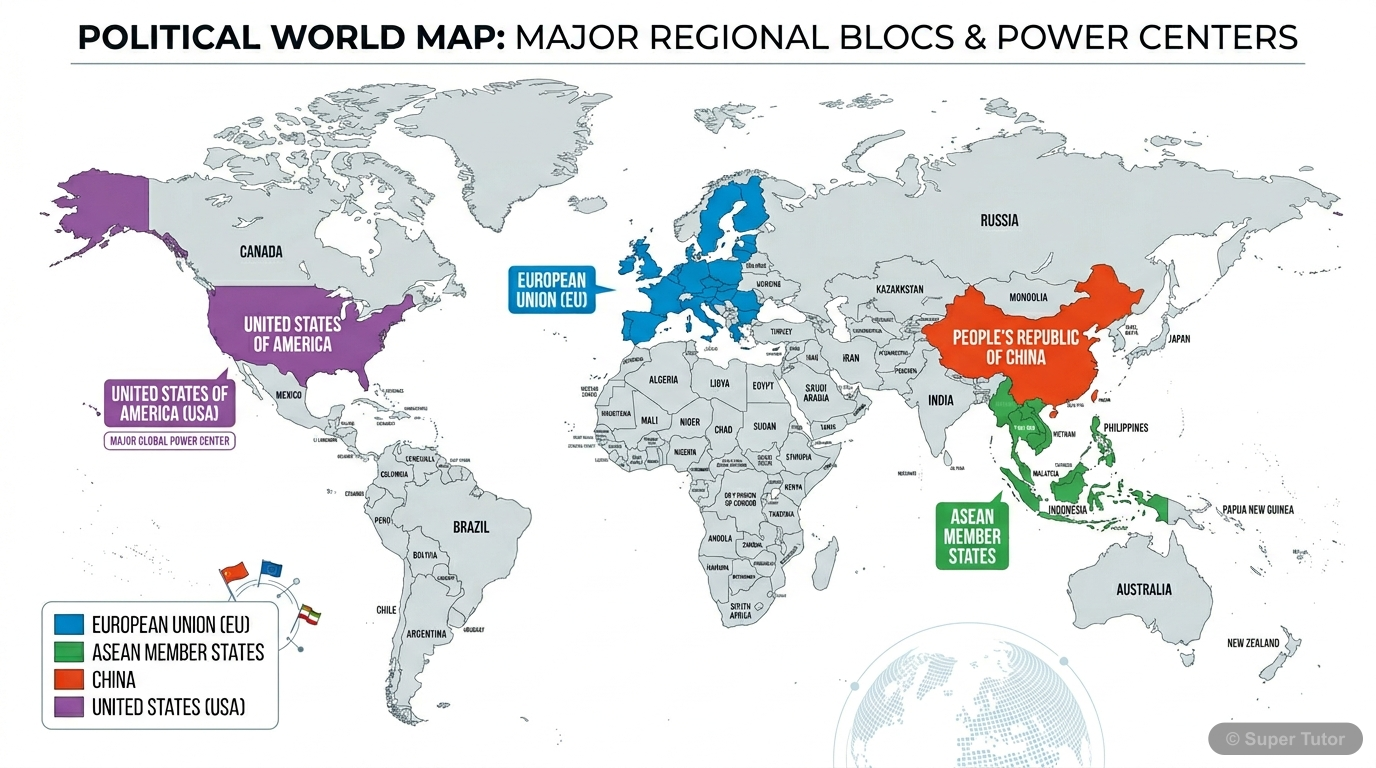
One of 11 illustrations for Contemporary Centers of Power in Super Tutor — alongside flashcards, concept maps and practice questions.
Overview
The end of bipolar world politics made room for new centres of power that could influence global politics and economics without relying only on the United States. Europe, East and Southeast Asia, and China emerged as important alternatives. The European Union built regional integration through share
Key Concepts
The European Union evolved from
The European Union evolved from the European Coal and Steel Community in 1951 to the European Economic Community in 1957 and then to the EU in 1992 th
The Organisation for European Economic Cooperation
The Organisation for European Economic Cooperation was established in 1948 to channel Marshall Plan aid to west European states, and the Council of Eu
The Association of South East Asian
The Association of South East Asian Nations was established in 1967 by five founding countries through the Bangkok Declaration and later expanded to t
In 2003
In 2003, ASEAN agreed to create a community with three pillars: Security, Economic, and Socio-Cultural Communities. The ASEAN Regional Forum, establis
After the communist revolution led by
After the communist revolution led by Mao in 1949, China followed a Soviet-style economy. From 1978, Deng Xiaoping introduced the open door policy and
Learning Objectives
- Understand why the post-Cold War world needed alternative centres of power
- Explain the formation and growth of the European Union
- Describe ASEAN’s origin, expansion, and working style
- Analyse China’s economic rise and its impact on world politics
- Assess Japan and South Korea as major Asian economic powers
Frequently Asked Questions
What are the important topics in Contemporary Centers of Power for Madhya Pradesh Board Class 12 Political Science?
How should I revise Contemporary Centers of Power for the Madhya Pradesh Board Class 12 board exam?
Sources & Official References
Content is aligned to the official syllabus. Refer to the board website for the latest curriculum.
More resources for Contemporary Centers of Power
Practice Quiz
Test yourself with a quick quiz
Important Questions
Exam-style questions with answers
Revision Notes
Key points for last-minute revision
Concept Maps
See how topics connect
Study Plan
Step-by-step plan for this chapter
Flashcards
Quick-fire cards for active recall
Syllabus
What topics to cover
NCERT Solutions
Every textbook question solved step by step
For serious students
Get the full Contemporary Centers of Power chapter — start free.
Quizzes, flashcards, an AI doubt solver and a study plan for Madhya Pradesh Board Class 12 Political Science. Free to start, no card needed.