Era of one-party dominance — Chapter Summary
Madhya Pradesh Board · Class 12 · Political Science
Summary of Era of one-party dominance for Madhya Pradesh Board Class 12 Political Science. India adopted democracy in difficult conditions, yet chose.
Interactive on Super Tutor
Studying Era of one-party dominance? Get the full interactive chapter.
Quizzes, flashcards, AI doubt-solver and a step-by-step study plan — built for chapter summary and more.
Free trial, no card needed.
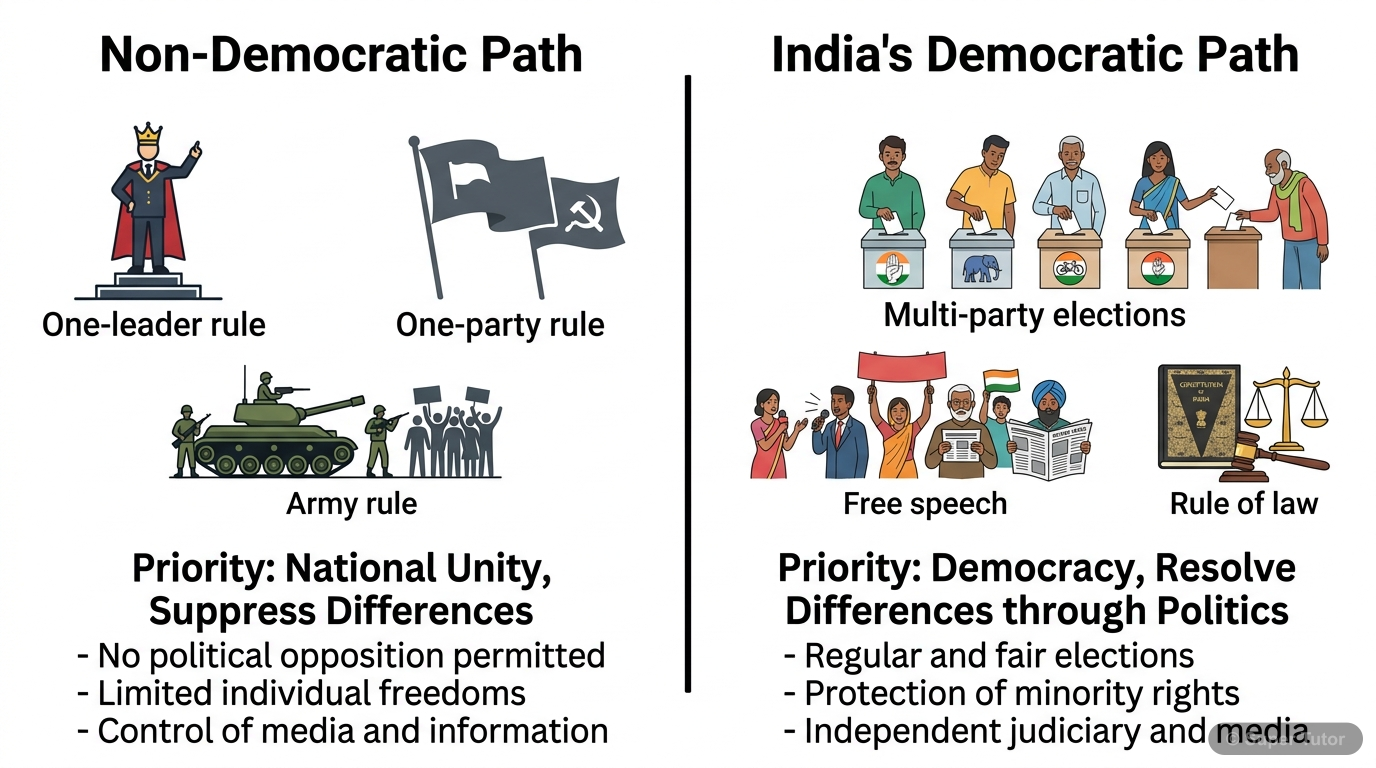
One of 15 illustrations for Era of one-party dominance in Super Tutor — alongside flashcards, concept maps and practice questions.
Overview
India adopted democracy in difficult conditions, yet chose the harder path of free elections and constitutional rule. The Indian National Congress emerged as the dominant party after Independence because of its role in the national movement, its wide organisation, and the popularity of leaders like
Key Concepts
Independent India rejected authoritarian paths
Independent India rejected authoritarian paths and chose elections, constitutional rule and political competition as the way to solve differences in s
The first general election was
The first general election was a massive exercise with 17 crore eligible voters, about 3,200 MLAs and 489 Lok Sabha Members, trained officials, and a
All adult citizens had the right
All adult citizens had the right to vote, even though only 15 per cent of eligible voters were literate and nearly 40 lakh women's names were missing
The Congress won 364 of 489
The Congress won 364 of 489 seats in the first Lok Sabha, 74 per cent of seats in 1952 with only 45 per cent of votes, and about three-fourths of the
The electoral system converted a divided
The electoral system converted a divided opposition into a much smaller seat share, allowing the Congress to win far more seats than its vote share su
Learning Objectives
- Understand why India chose democracy after Independence
- Explain how the first general election was organised and why it was a major democratic experiment
- Describe the rise of Congress dominance in the first three general elections
- Explain the idea of the Congress system as a social and ideological coalition
- Study the emergence of the Communist Party of India, the Socialist Party and the Bharatiya Jana Sangh as opposition forces
Frequently Asked Questions
What are the important topics in Era of one-party dominance for Madhya Pradesh Board Class 12 Political Science?
How should I revise Era of one-party dominance for the Madhya Pradesh Board Class 12 board exam?
Sources & Official References
Content is aligned to the official syllabus. Refer to the board website for the latest curriculum.
More resources for Era of one-party dominance
Practice Quiz
Test yourself with a quick quiz
Important Questions
Exam-style questions with answers
Revision Notes
Key points for last-minute revision
Concept Maps
See how topics connect
Study Plan
Step-by-step plan for this chapter
Flashcards
Quick-fire cards for active recall
Syllabus
What topics to cover
NCERT Solutions
Every textbook question solved step by step
For serious students
Get the full Era of one-party dominance chapter — start free.
Quizzes, flashcards, an AI doubt solver and a study plan for Madhya Pradesh Board Class 12 Political Science. Free to start, no card needed.