Security in the Contemporary World — Chapter Summary
Madhya Pradesh Board · Class 12 · Political Science
Summary of Security in the Contemporary World for Madhya Pradesh Board Class 12 Political Science. Security means freedom from extremely dangerous threats.
Interactive on Super Tutor
Studying Security in the Contemporary World? Get the full interactive chapter.
Quizzes, flashcards, AI doubt-solver and a step-by-step study plan — built for chapter summary and more.
Free trial, no card needed.
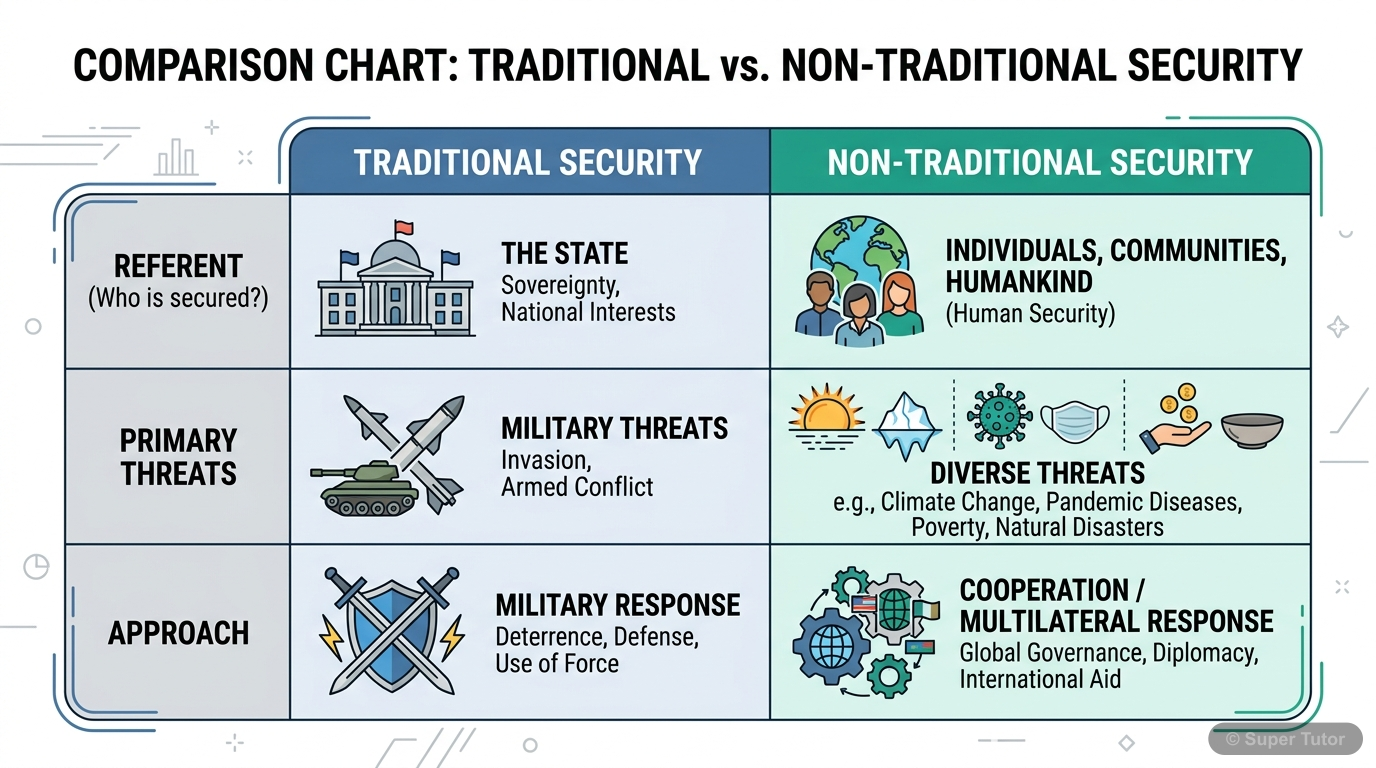
One of 7 illustrations for Security in the Contemporary World in Super Tutor — alongside flashcards, concept maps and practice questions.
Overview
Security means freedom from extremely dangerous threats that can damage core values beyond repair. In world politics, security is not limited to military danger alone. It includes traditional security, which focuses on external and internal threats to the state, and non-traditional security, which f
Key Concepts
Security refers to freedom from threats
Security refers to freedom from threats, but only those threats that are extremely dangerous and can damage core values beyond repair count as securit
Traditional security deals mainly with military
Traditional security deals mainly with military threats to the state from other states, and also includes internal security concerns when violence occ
Deterrence means preventing war by promising
Deterrence means preventing war by promising to raise the cost of attack to an unacceptable level.
Defence means limiting or ending war
Defence means limiting or ending war after it has started by resisting the attack and denying the attacker its goals.
Balance of power means keeping
Balance of power means keeping the military and strategic strength of countries or alliances from becoming dangerously unequal.
Learning Objectives
- Understand the meaning of security and why only severe threats are treated as security issues.
- Differentiate between traditional and non-traditional conceptions of security.
- Explain deterrence, defence, balance of power, alliance building, disarmament, arms control, and confidence building.
- Distinguish between human security and global security.
- Recognise major non-traditional threats such as terrorism, human rights violations, poverty, migration, refugees, epidemics, and climate change.
Frequently Asked Questions
What are the important topics in Security in the Contemporary World for Madhya Pradesh Board Class 12 Political Science?
How should I revise Security in the Contemporary World for the Madhya Pradesh Board Class 12 board exam?
Sources & Official References
Content is aligned to the official syllabus. Refer to the board website for the latest curriculum.
More resources for Security in the Contemporary World
Practice Quiz
Test yourself with a quick quiz
Important Questions
Exam-style questions with answers
Revision Notes
Key points for last-minute revision
Concept Maps
See how topics connect
Study Plan
Step-by-step plan for this chapter
Flashcards
Quick-fire cards for active recall
Syllabus
What topics to cover
NCERT Solutions
Every textbook question solved step by step
For serious students
Get the full Security in the Contemporary World chapter — start free.
Quizzes, flashcards, an AI doubt solver and a study plan for Madhya Pradesh Board Class 12 Political Science. Free to start, no card needed.