Contemporary Centers of Power — NCERT Solutions
Madhya Pradesh Board · Class 12 · Political Science
NCERT Solutions for Contemporary Centers of Power, Madhya Pradesh Board Class 12 Political Science: 14 textbook questions solved step by step.
Interactive on Super Tutor
Studying Contemporary Centers of Power? Get the full interactive chapter.
Quizzes, flashcards, AI doubt-solver and a step-by-step study plan — built for NCERT solutions and more.
Free trial, no card needed.
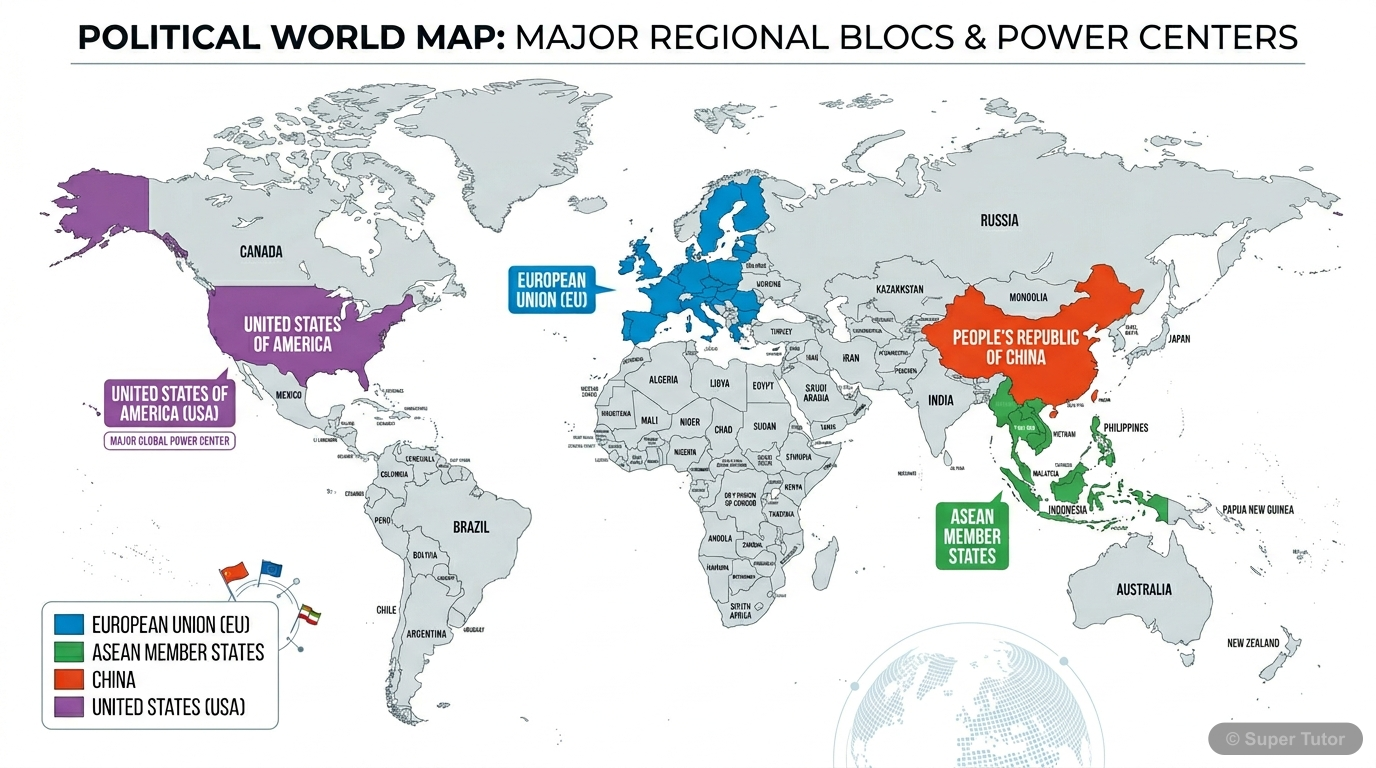
One of 11 illustrations for Contemporary Centers of Power in Super Tutor — alongside flashcards, concept maps and practice questions.
The first 7 solutions are open to read. The other 7 are free with a Super Tutor account.
Exercise Questions
1Arrange the following in chronological order.
a. China's accession to WTO
b. Establishment of the EEC
c. Establishment of the EU
d. Birth of ARFShow solution
Given: Four events related to regional and global organisations.
Concept: Chronological arrangement means ordering events from the earliest to the latest by year.
Working:
- Establishment of the EEC (European Economic Community) — 1957 (Treaty of Rome)
- Birth of ARF (ASEAN Regional Forum) — 1994
- Establishment of the EU (European Union) — 1992/1993 (Maastricht Treaty signed 1992, came into force 1993)
- China's accession to WTO — 2001
Correct Chronological Order:
That is:
- (b) Establishment of the EEC — 1957
- (d) Birth of ARF — 1994
- (c) Establishment of the EU — 1992–93
- (a) China's accession to WTO — 2001
(Note: The EU (c) formally came into force in 1993, while ARF (d) was established in 1994, so the correct order places EU before ARF.)
Final Answer: b → c → d → a
2The 'ASEAN Way'
a. Reflects the life style of ASEAN members
b. A form of interaction among ASEAN members that is informal and cooperative
c. The defence policy followed by the ASEAN members
d. The road that connects all the ASEAN membersShow solution
Correct Option: (b) A form of interaction among ASEAN members that is informal and cooperative.
Justification: The 'ASEAN Way' refers to the style of interaction among ASEAN member nations that is characterised by informality, consensus-building, and non-confrontational bargaining. It emphasises respect for national sovereignty, non-interference in internal affairs, and preference for quiet diplomacy over formal or legalistic procedures. It is not a lifestyle, a defence policy, or a physical road.
3Which of the following nations adopted an 'open door' policy?
a. China
b. South Korea
c. Japan
d. USAShow solution
Correct Option: (a) China.
Justification: China adopted the 'Open Door' policy under the leadership of Deng Xiaoping in 1978. This policy opened China to foreign investment, technology, and global markets, transforming its command economy into a socialist market economy. It led to Special Economic Zones (SEZs) and rapid economic growth, making China one of the largest economies in the world.
4Fill in the blanks:
a. The border conflict between China and India in 1962 was principally over __________ and __________ region.
b. ARF was established in the year __________.
c. China entered into bilateral relations with __________ (a major country) in 1972.
d. __________ Plan influenced the establishment of the Organisation for European Economic Cooperation in 1948.
e. __________ is the organisation of ASEAN that deals with security.Show solution
Given: Statements related to China, India, ASEAN, and European organisations.
Answers:
a. The border conflict between China and India in 1962 was principally over Aksai Chin and Arunachal Pradesh region.
b. ARF (ASEAN Regional Forum) was established in the year 1994.
c. China entered into bilateral relations with USA (United States of America) in 1972. (President Nixon visited China in 1972, normalising Sino-American relations.)
d. Marshall Plan influenced the establishment of the Organisation for European Economic Cooperation (OEEC) in 1948. (The Marshall Plan was the US-sponsored economic recovery programme for post-war Europe.)
e. ARF (ASEAN Regional Forum) is the organisation of ASEAN that deals with security.
5What are the objectives of establishing regional organisations?Show solution
Given: Question about the objectives of regional organisations.
Concept: Regional organisations are formed by geographically proximate countries to achieve common goals through collective effort.
Objectives of Establishing Regional Organisations:
- Economic Development: To promote trade, investment, and economic cooperation among member nations, leading to collective growth and prosperity.
- Political Cooperation: To resolve political disputes peacefully through dialogue and diplomacy, reducing the chances of conflict.
- Security and Peace: To maintain regional peace and stability by creating a platform for collective security arrangements.
- Social and Cultural Exchange: To promote cultural understanding, people-to-people contact, and social development among member nations.
- Collective Bargaining: To strengthen the collective voice of member nations in international forums like the UN, WTO, etc., giving them greater bargaining power.
- Reducing Dependence: To reduce dependence on external powers and superpowers by building self-reliance within the region.
- Addressing Common Problems: To collectively tackle shared challenges such as terrorism, environmental degradation, poverty, and health crises.
Conclusion: Regional organisations serve as platforms for cooperation, enabling member states to achieve goals that would be difficult to accomplish individually.
6How does geographical proximity influence the formation of regional organisations?Show solution
Given: Question on the role of geographical proximity in forming regional organisations.
Concept: Geographical proximity means countries that are located close to each other in the same region.
Influence of Geographical Proximity:
- Shared Interests: Countries in the same region often share common economic, political, and security interests, making cooperation natural and beneficial.
- Common Challenges: Neighbouring countries face similar challenges such as natural disasters, cross-border terrorism, environmental issues, and refugee crises, which require collective responses.
- Trade and Commerce: Geographically close nations can trade more easily due to lower transportation costs, shared infrastructure, and complementary economies, encouraging economic integration.
- Cultural and Historical Ties: Neighbouring countries often share historical, linguistic, and cultural bonds that facilitate trust and cooperation.
- Security Concerns: Countries in the same region face similar security threats. A conflict in one country can spill over into neighbouring states, making collective security arrangements necessary.
- Examples: ASEAN (Southeast Asia), EU (Europe), SAARC (South Asia), and the African Union (Africa) are all examples where geographical proximity played a key role in the formation of regional organisations.
Conclusion: Geographical proximity creates a natural foundation for regional cooperation by generating shared interests, common problems, and mutual interdependence among neighbouring nations.
7What are the components of the ASEAN Vision 2020?Show solution
Given: Question about ASEAN Vision 2020.
Concept: ASEAN Vision 2020 was adopted in 1997 and outlines the long-term goals of ASEAN for the region.
Components of ASEAN Vision 2020:
- Outward-looking Role: ASEAN aims to play an active and outward-looking role in the international community and the Asia-Pacific region, promoting peace, stability, and prosperity.
- A Community of Caring Societies: ASEAN envisions a community where the well-being, livelihood, and welfare of the people are at the centre of the development process.
- Peaceful and Stable Region: The vision emphasises maintaining peace, stability, and security in the region through dialogue, cooperation, and the peaceful settlement of disputes.
- Competitive Economic Region: ASEAN aims to create a highly competitive economic region with equitable economic development, reduced poverty, and socio-economic disparities.
- Zone of Peace, Freedom, and Neutrality (ZOPFAN): The vision reaffirms ASEAN's commitment to making Southeast Asia a zone free from external interference and nuclear weapons.
- Partnership for Dynamic Development: ASEAN seeks to build a partnership based on dynamic development, with emphasis on science, technology, and human resource development.
- Interconnected Region: The vision includes building better connectivity through infrastructure, communication, and transport links among member states.
Conclusion: ASEAN Vision 2020 is a comprehensive blueprint for making Southeast Asia a peaceful, prosperous, and people-centred community by the year 2020.
Free with a Super Tutor account
Free with a Super Tutor account
Free with a Super Tutor account
Free with a Super Tutor account
Free with a Super Tutor account
Free with a Super Tutor account
Free with a Super Tutor account
7 more solved questions in Contemporary Centers of Power
They are free with a Super Tutor account, along with practice quizzes and flashcards for this chapter. Free to start, no card needed.
Frequently Asked Questions
What are the important topics in Contemporary Centers of Power for Madhya Pradesh Board Class 12 Political Science?
Are these NCERT Solutions for Contemporary Centers of Power free?
How should I revise Contemporary Centers of Power for the Madhya Pradesh Board Class 12 board exam?
Sources & Official References
Content is aligned to the official syllabus. Refer to the board website for the latest curriculum.
More resources for Contemporary Centers of Power
Practice Quiz
Test yourself with a quick quiz
Important Questions
Exam-style questions with answers
Revision Notes
Key points for last-minute revision
Chapter Summary
Understand the chapter at a glance
Concept Maps
See how topics connect
Study Plan
Step-by-step plan for this chapter
Flashcards
Quick-fire cards for active recall
Syllabus
What topics to cover
For serious students
Get the full Contemporary Centers of Power chapter — start free.
Quizzes, flashcards, an AI doubt solver and a study plan for Madhya Pradesh Board Class 12 Political Science. Free to start, no card needed.