Chapter 11 of 12
NCERT Solutions

Sound

Madhya Pradesh Board · Class 9 · Science

NCERT Solutions for Sound — Madhya Pradesh Board Class 9 Science.

29 questions25 flashcards5 concepts

Interactive on Super Tutor

Studying Sound? Get the full interactive chapter.

Quizzes, flashcards, AI doubt-solver and a step-by-step study plan — built for ncert solutions and more.

1,000+ Class 9 students started this chapter today

An illustration showing a tuning fork vibrating. One prong is touching a suspended table tennis ball, causing it to move, demonstrating that vibration produces sound.
Super Tutor

This is just one of 16+ visuals inside Super Tutor's Sound chapter

Explore the full set
17 Questions Solved · 1 Section

Exercises

1What is sound and how is it produced?Show solution
Sound:
Sound is a form of energy that produces the sensation of hearing in our ears. It is a mechanical wave that requires a material medium (solid, liquid, or gas) for its propagation.

How sound is produced:
Sound is produced by the vibration of objects. When an object vibrates, it causes the particles of the surrounding medium to vibrate. These vibrations travel through the medium in the form of a wave, which we perceive as sound.

Example: When we pluck a stretched rubber band, it vibrates and produces sound. When a drum is beaten, its membrane vibrates and produces sound. The vibrating object acts as the source of sound.
2Describe with the help of a diagram, how compressions and rarefactions are produced in air near a source of sound.Show solution
Production of Compressions and Rarefactions:

Consider a vibrating tuning fork as the source of sound.

- When the prong of the tuning fork moves outward (forward), it pushes the air particles in front of it. These particles get crowded together, forming a region of high pressure called compression (C).
- When the prong moves inward (backward), it creates a region where air particles are spread apart, forming a region of low pressure called rarefaction (R).
- As the tuning fork continues to vibrate, a series of compressions and rarefactions are produced alternately in the air.

Diagram (description):
SourceCRCRC\text{Source} \rightarrow \underbrace{||||}_{C} \quad \underbrace{\quad\quad}_{R} \quad \underbrace{||||}_{C} \quad \underbrace{\quad\quad}_{R} \quad \underbrace{||||}_{C} \rightarrow

Where CC = Compression (region of high pressure, particles close together) and RR = Rarefaction (region of low pressure, particles spread apart).

These compressions and rarefactions propagate through the air as a longitudinal sound wave.
3Why is sound wave called a longitudinal wave?Show solution
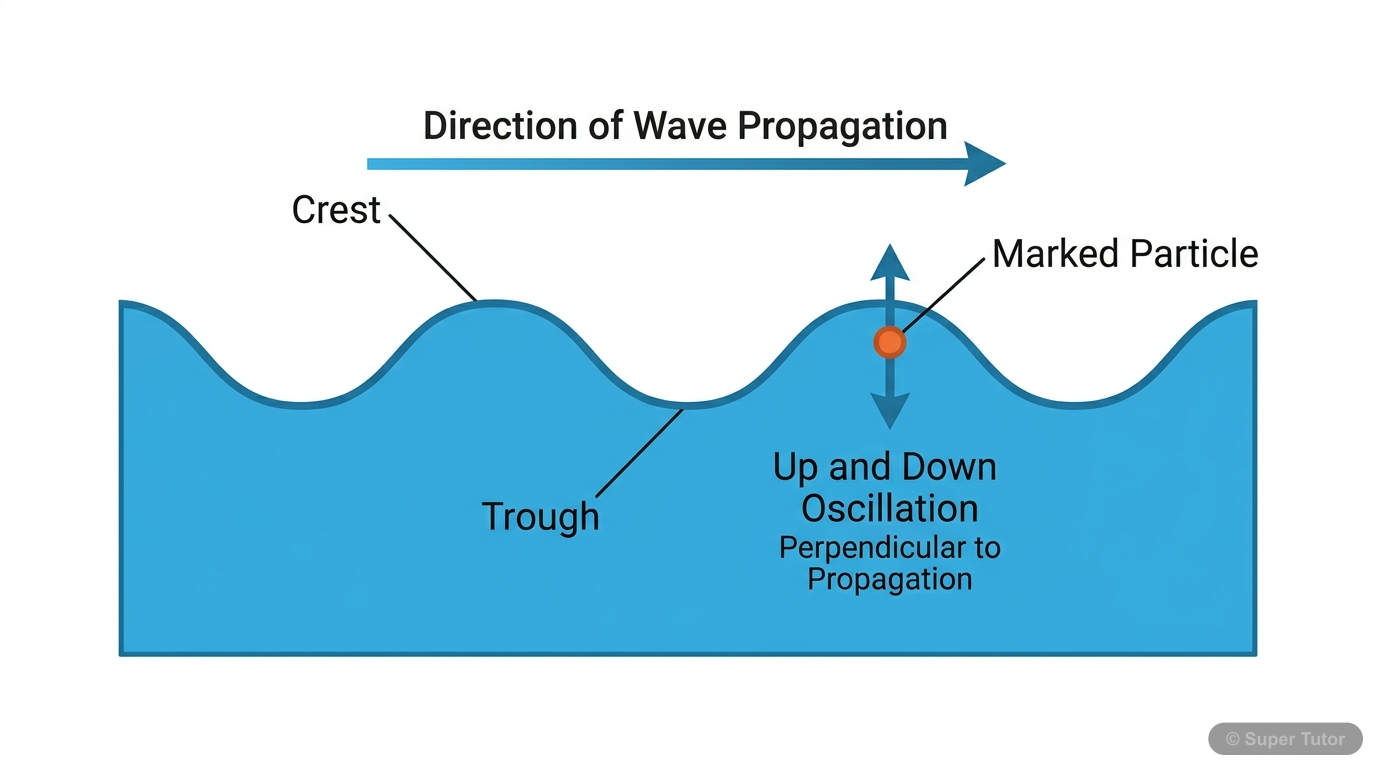
Sound wave is called a longitudinal wave because the particles of the medium vibrate in the same direction as the direction of propagation of the wave.

Explanation:
When a sound wave travels through air, the air particles are displaced back and forth along the direction in which the wave is moving. This creates alternating regions of compressions (high pressure) and rarefactions (low pressure) along the direction of wave propagation.

Since the direction of particle vibration is parallel (along the same line) to the direction of wave propagation, sound waves are classified as longitudinal waves.

This is in contrast to transverse waves (like light waves), where particle vibration is perpendicular to the direction of wave propagation.
4Which characteristic of the sound helps you to identify your friend by his voice while sitting with others in a dark room?Show solution
The characteristic of sound that helps us identify a friend by his voice in a dark room is quality (or timbre) of sound.

Explanation:
Even if two sounds have the same pitch (frequency) and the same loudness (amplitude), they can differ in quality. Quality of sound depends on the waveform of the sound, which is determined by the number and relative intensities of the overtones (harmonics) present in the sound.

Every person has a unique vocal structure, so the sound produced by each person has a unique waveform (quality/timbre). This unique quality allows us to distinguish one person's voice from another even in darkness.
5Flash and thunder are produced simultaneously. But thunder is heard a few seconds after the flash is seen, why?Show solution
Given/Known:
- Flash (light) and thunder (sound) are produced simultaneously during lightning.
- Speed of light =3×10⁸ m s1= 3 \times 10^8 \ \text{m s}^{-1}
- Speed of sound in air 344 m s1\approx 344 \ \text{m s}^{-1}

Reason:
The speed of light is enormously greater than the speed of sound. Light travels at 3×10⁸ m s13 \times 10^8 \ \text{m s}^{-1}, while sound travels at only about 344 m s1344 \ \text{m s}^{-1} in air.

Therefore, light from the flash reaches our eyes almost instantaneously, while sound (thunder) takes a much longer time to travel the same distance. This is why we see the flash first and hear the thunder a few seconds later.

Conclusion: The time gap between seeing the flash and hearing the thunder is due to the vast difference in the speeds of light and sound.
6A person has a hearing range from 20 Hz to 20 kHz. What are the typical wavelengths of sound waves in air corresponding to these two frequencies? Take the speed of sound in air as 344 m s⁻¹.Show solution
Given:
- Speed of sound in air, v=344 m s1v = 344 \ \text{m s}^{-1}
- Frequency f1=20 Hzf_1 = 20 \ \text{Hz}
- Frequency f2=20 kHz=20,000 Hzf_2 = 20 \ \text{kHz} = 20{,}000 \ \text{Hz}

Formula:
λ=vf\lambda = \frac{v}{f}

For f1=20 Hzf_1 = 20 \ \text{Hz}:
λ1=34420=17.2 m\lambda_1 = \frac{344}{20} = 17.2 \ \text{m}

For f2=20,000 Hzf_2 = 20{,}000 \ \text{Hz}:
λ2=34420,000=0.0172 m=1.72 cm\lambda_2 = \frac{344}{20{,}000} = 0.0172 \ \text{m} = 1.72 \ \text{cm}

Result:
- Wavelength corresponding to 20 Hz =17.2 m= 17.2 \ \text{m}
- Wavelength corresponding to 20 kHz =0.0172 m= 0.0172 \ \text{m} (or 1.72 cm1.72 \ \text{cm})
7Two children are at opposite ends of an aluminium rod. One strikes the end of the rod with a stone. Find the ratio of times taken by the sound wave in air and in aluminium to reach the second child.Show solution
Given:
- Speed of sound in air, vair=346 m s1v_{\text{air}} = 346 \ \text{m s}^{-1} (standard value used in NCERT)
- Speed of sound in aluminium, vAl=6420 m s1v_{\text{Al}} = 6420 \ \text{m s}^{-1} (standard value from NCERT table)
- Let the length of the aluminium rod =d= d

Formula:
Time=DistanceSpeed\text{Time} = \frac{\text{Distance}}{\text{Speed}}

Time taken by sound through air:
tair=dvair=d346t_{\text{air}} = \frac{d}{v_{\text{air}}} = \frac{d}{346}

Time taken by sound through aluminium:
tAl=dvAl=d6420t_{\text{Al}} = \frac{d}{v_{\text{Al}}} = \frac{d}{6420}

Ratio:
tairtAl=d/346d/6420=642034618.5518.5\frac{t_{\text{air}}}{t_{\text{Al}}} = \frac{d/346}{d/6420} = \frac{6420}{346} \approx 18.55 \approx 18.5

tairtAl18.5:1\boxed{\frac{t_{\text{air}}}{t_{\text{Al}}} \approx 18.5 : 1}

This means sound takes about 18.5 times longer to travel through air than through aluminium for the same distance.
8The frequency of a source of sound is 100 Hz. How many times does it vibrate in a minute?Show solution
Given:
- Frequency of sound, f=100 Hzf = 100 \ \text{Hz}
- Time =1 minute=60 seconds= 1 \ \text{minute} = 60 \ \text{seconds}

Concept:
Frequency is defined as the number of vibrations (oscillations) per second.
f=Number of vibrationsTime (in seconds)f = \frac{\text{Number of vibrations}}{\text{Time (in seconds)}}

Calculation:
Number of vibrations in 1 minute=f×t=100 Hz×60 s\text{Number of vibrations in 1 minute} = f \times t = 100 \ \text{Hz} \times 60 \ \text{s}
=6000 vibrations= 6000 \ \text{vibrations}

Answer: The source vibrates 6000 times in one minute.
9Does sound follow the same laws of reflection as light does? Explain.Show solution
Yes, sound follows the same laws of reflection as light does.

Laws of Reflection of Sound:

1. First Law: The angle of incidence of the sound wave is equal to the angle of reflection.
i=r\angle i = \angle r

2. Second Law: The incident sound wave, the reflected sound wave, and the normal to the reflecting surface at the point of incidence — all lie in the same plane.

Explanation:
Just like light, when sound waves strike a hard surface (like a wall, cliff, or building), they bounce back. The direction of the reflected sound wave obeys the same geometrical rules as reflected light. This is why we hear echoes — the reflected sound follows the same laws as reflected light.

Practical evidence: The phenomenon of echo and the working of a megaphone, stethoscope, and soundboards all demonstrate that sound obeys the laws of reflection.
10When a sound is reflected from a distant object, an echo is produced. Let the distance between the reflecting surface and the source of sound production remains the same. Do you hear echo sound on a hotter day?Show solution
Yes, the echo will be heard sooner on a hotter day (but it will still be heard).

Explanation:
- The speed of sound increases with an increase in temperature. On a hotter day, the speed of sound in air is greater.
- The minimum distance required to hear an echo is:
d=v×t2d = \frac{v \times t}{2}
where t=0.1 st = 0.1 \ \text{s} (minimum time for the human ear to distinguish two sounds) and vv is the speed of sound.
- On a hotter day, since vv is larger, the minimum distance required to hear an echo also increases.
- However, if the distance between the source and the reflecting surface remains the same and was sufficient to produce an echo at normal temperature, then on a hotter day the echo will return faster (in less time) because sound travels faster.
- If the distance was just barely sufficient at normal temperature, it is possible that on a hotter day the echo returns so quickly (less than 0.1 s) that it may not be distinguishable as a separate echo.

Conclusion: On a hotter day, sound travels faster, so the echo is heard sooner. Whether it is perceived as a distinct echo depends on whether the time gap remains at least 0.1 seconds.
11Give two practical applications of reflection of sound waves.Show solution
Two practical applications of reflection of sound waves:

1. Megaphone / Loudspeaker / Horn:
Megaphones, horns, and musical instruments like trumpets are designed to send sound in a particular direction without spreading it in all directions. The sound is reflected repeatedly from the walls of the horn/tube and directed towards the audience. This is based on the reflection of sound.

2. Stethoscope:
A stethoscope is a medical instrument used by doctors to listen to sounds produced within the body (e.g., heartbeat, breathing). The sound of the heartbeat reaches the doctor's ears by multiple reflections of sound waves through the rubber tube of the stethoscope. This works on the principle of reflection of sound.

*(Other valid applications include: SONAR, soundboards in auditoriums, megaphones, and echoes used in measuring distances.)*
12A stone is dropped from the top of a tower 500 m high into a pond of water at the base of the tower. When is the splash heard at the top? Given, g = 10 m s⁻² and speed of sound = 340 m s⁻¹.Show solution
Given:
- Height of tower, h=500 mh = 500 \ \text{m}
- Acceleration due to gravity, g=10 m s2g = 10 \ \text{m s}^{-2}
- Speed of sound, vs=340 m s1v_s = 340 \ \text{m s}^{-1}
- Initial velocity of stone, u=0u = 0

Step 1: Time taken by the stone to fall to the base (t1t_1)

Using the equation of motion:
h=ut1+12gt12h = ut_1 + \frac{1}{2}g t_1^2
500=0+12×10×t12500 = 0 + \frac{1}{2} \times 10 \times t_1^2
500=5t12500 = 5 t_1^2
t12=100t_1^2 = 100
t1=10 st_1 = 10 \ \text{s}

Step 2: Time taken by sound to travel from base to top (t2t_2)

t2=hvs=5003401.47 st_2 = \frac{h}{v_s} = \frac{500}{340} \approx 1.47 \ \text{s}

Step 3: Total time after which splash is heard at the top

t=t1+t2=10+1.47=11.47 st = t_1 + t_2 = 10 + 1.47 = 11.47 \ \text{s}

Answer: The splash will be heard at the top of the tower after approximately 11.47 s11.47 \ \text{s} of dropping the stone.
13A sound wave travels at a speed of 339 m s⁻¹. If its wavelength is 1.5 cm, what is the frequency of the wave? Will it be audible?Show solution
Given:
- Speed of sound, v=339 m s1v = 339 \ \text{m s}^{-1}
- Wavelength, λ=1.5 cm=1.5×10² m=0.015 m\lambda = 1.5 \ \text{cm} = 1.5 \times 10^{-2} \ \text{m} = 0.015 \ \text{m}

Formula:
v=fλ    f=vλv = f \lambda \implies f = \frac{v}{\lambda}

Calculation:
f=3390.015=22,600 Hz=22.6 kHzf = \frac{339}{0.015} = 22{,}600 \ \text{Hz} = 22.6 \ \text{kHz}

Audibility Check:
The audible range for human beings is 20 Hz20 \ \text{Hz} to 20,000 Hz20{,}000 \ \text{Hz} (20 kHz).

Since f = 22{,}600 \ \text{Hz} > 20{,}000 \ \text{Hz}, this frequency is above the audible range.

Answer: The frequency of the wave is 22,600 Hz22{,}600 \ \text{Hz} (22.6 kHz). It will not be audible to human beings as it falls in the ultrasonic range.
14What is reverberation? How can it be reduced?Show solution
Reverberation:
Reverberation is the persistence of sound in a large enclosed space (like a big hall or auditorium) due to repeated reflections of sound from the walls, ceiling, and floor even after the source of sound has stopped. The sound appears to linger or "echo" within the room.

For reverberation to be perceived, the time gap between the original sound and the reflected sound must be less than 110\frac{1}{10} second (0.1 s), so the sounds overlap and seem to persist.

How to reduce reverberation:

1. Sound-absorbing materials: The walls, ceiling, and floor of auditoriums and concert halls are covered with sound-absorbing materials such as compressed fibreboard, rough plaster, draperies, and carpets. These materials absorb sound energy and reduce reflections.

2. Seats and audience: Seats are often made of materials that absorb sound. The presence of an audience also helps absorb sound.

3. Curtains and soft furnishings: Heavy curtains, carpets, and upholstered furniture in rooms absorb sound and reduce reverberation.

4. Acoustic tiles: Special acoustic tiles are used on walls and ceilings to absorb sound and minimise multiple reflections.
15What is loudness of sound? What factors does it depend on?Show solution
Loudness of Sound:
Loudness is a physiological (subjective) response of the ear to the intensity of sound. It is the measure of the sound energy reaching the ear per unit time. Louder sounds carry more energy.

The unit of loudness is the decibel (dB).

Factors on which loudness depends:

1. Amplitude of vibration: Loudness is directly proportional to the square of the amplitude of the vibrating source.
LoudnessA2\text{Loudness} \propto A^2
Greater the amplitude of vibration, louder is the sound.

2. Distance from the source: As the distance from the source increases, the loudness decreases because the sound energy spreads over a larger area.

3. Surface area of the vibrating body: A larger vibrating surface sets more air particles into vibration, producing a louder sound.

4. Density of the medium: Sound is louder in denser media because more particles vibrate per unit volume.

Summary: Loudness primarily depends on the amplitude of the sound wave — greater amplitude means greater loudness.
16How is ultrasound used for cleaning?Show solution
Ultrasound for Cleaning:

Ultrasound waves are used to clean objects that are in hard-to-reach places, such as spiral tubes, odd-shaped parts, and electronic components.

Process:
1. The objects to be cleaned are placed in a cleaning solution (water or a suitable solvent) in a tank.
2. Ultrasonic waves (high-frequency sound waves, frequency > 20{,}000 \ \text{Hz}) are passed through the solution.
3. The high-frequency vibrations of the ultrasonic waves cause the dirt, grease, and other contaminants attached to the objects to vibrate vigorously.
4. Due to this vigorous vibration, the dirt and grease particles get detached from the surface of the object and fall into the cleaning solution.
5. The object is thus thoroughly cleaned without any physical scrubbing.

Advantage: This method can clean delicate and intricate objects without causing any mechanical damage to them.
17Explain how defects in a metal block can be detected using ultrasound.Show solution
Detection of Defects in Metal Blocks Using Ultrasound:

Metal blocks used in construction and machinery may have internal cracks, holes, or other defects that are not visible from the outside. Ultrasound is used to detect such defects.

Method:
1. Ultrasonic waves (frequency > 20{,}000 \ \text{Hz}) are directed into the metal block from one side using an ultrasonic transmitter.
2. These waves travel through the metal block.
3. If there is no defect, the ultrasonic waves pass straight through the block and are detected by a detector on the other side.
4. If there is a crack, hole, or defect inside the metal block, the ultrasonic waves are reflected back from the defect (because the defect acts as a boundary between two different media).
5. The reflected waves are detected by a detector, and the location and size of the defect can be determined from the time taken and the pattern of the reflected waves.

Principle used: Reflection of ultrasound at the boundary of a defect (crack or cavity).

Advantage: Ultrasound can penetrate deep into metal blocks and detect internal defects without cutting or damaging the metal, making it a non-destructive testing (NDT) method.

Stuck on a step?

Ask Super Tutor AI to explain any solution on this page in a simpler way — free, 24x7.

Ask a Doubt Free

Frequently Asked Questions

What are the important topics in Sound for Madhya Pradesh Board Class 9 Science?
Sound covers several key topics that are frequently asked in Madhya Pradesh Board Class 9 board exams. Focus on the core concepts listed on this page and practise related questions to build confidence.
How to score full marks in Sound — Madhya Pradesh Board Class 9 Science?
Understand the core concepts first, then work through the 29 practice questions available for this chapter. Revise formulas and definitions regularly, and use flashcards for quick recall before the exam.
Where can I get free NCERT Solutions for Sound Class 9 Science?
This page has free step-by-step NCERT Solutions for every exercise question in Sound (Madhya Pradesh Board Class 9 Science) — written the way examiners award marks: given, formula, working, answer.

Sources & Official References

Content is aligned to the official syllabus. Refer to the board website for the latest curriculum.

For serious students

Get the full Sound chapter — for free.

Quizzes, flashcards, AI doubt-solver and a step-by-step study plan for Madhya Pradesh Board Class 9 Science.