Gravitation — NCERT Solutions
Madhya Pradesh Board · Class 9 · Science
NCERT Solutions for Gravitation, Madhya Pradesh Board Class 9 Science: 22 textbook questions solved step by step.
Interactive on Super Tutor
Studying Gravitation? Get the full interactive chapter.
Quizzes, flashcards, AI doubt-solver and a step-by-step study plan — built for NCERT solutions and more.
Free trial, no card needed.
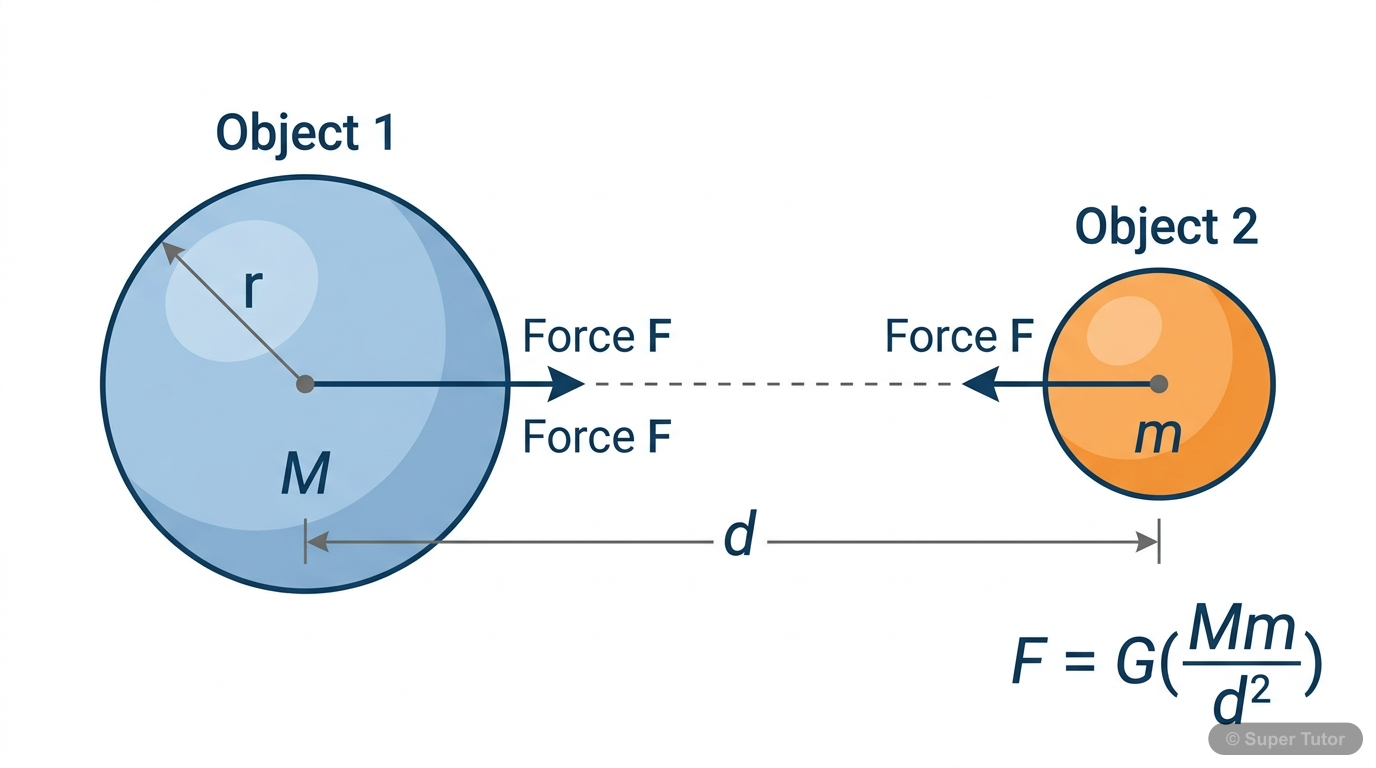
Learn better with visuals Super Tutor pairs illustrations like this with notes and quizzes for Gravitation.
The first 11 solutions are open to read. The other 11 are free with a Super Tutor account.
Exercises — Chapter: Gravitation (Class 9 Science)
1How does the force of gravitation between two objects change when the distance between them is reduced to half?Show solution
Given: Distance between two objects is reduced to half, i.e., new distance .
Formula used (Newton's Law of Gravitation):
Working:
Original force:
New force when distance is halved:
Conclusion: When the distance between two objects is reduced to half, the gravitational force between them becomes four times the original force.
2Gravitational force acts on all objects in proportion to their masses. Why then, a heavy object does not fall faster than a light object?Show solution
Concept: Although the gravitational force on a heavier object is greater (since ), the acceleration produced depends on the mass of the object.
Explanation:
For a freely falling object, applying Newton's second law:
The acceleration is independent of the mass of the object. Although a heavier object experiences a greater gravitational force, it also has greater inertia (resistance to motion). These two effects exactly cancel each other.
Conclusion: All objects, regardless of their mass, fall with the same acceleration (in the absence of air resistance). Hence, a heavy object does not fall faster than a light object.
3What is the magnitude of the gravitational force between the earth and a object on its surface? (Mass of the earth is and radius of the earth is .)Show solution
Given:
- Mass of object,
- Mass of Earth,
- Radius of Earth,
- Universal gravitational constant,
Formula:
Calculation:
Answer: The gravitational force between the Earth and the 1 kg object is approximately .
4The earth and the moon are attracted to each other by gravitational force. Does the earth attract the moon with a force that is greater or smaller or the same as the force with which the moon attracts the earth? Why?Show solution
Answer: The Earth attracts the Moon with a force that is equal to the force with which the Moon attracts the Earth.
Reason: According to Newton's Third Law of Motion, every action has an equal and opposite reaction. The gravitational force is a mutual force between two bodies. By Newton's Law of Gravitation:
This formula gives a single value of force for the pair. The force exerted by the Earth on the Moon and the force exerted by the Moon on the Earth are equal in magnitude but opposite in direction. Hence, both forces are the same.
5If the moon attracts the earth, why does the earth not move towards the moon?Show solution
Explanation:
The Moon does attract the Earth with a gravitational force, and in fact the Earth does accelerate slightly towards the Moon. However, the Earth also has a very large mass compared to the Moon.
Using Newton's Second Law:
Since the mass of the Earth () is very large, the acceleration produced in the Earth by the Moon's gravitational pull is extremely small (negligible).
Additionally, both the Earth and the Moon are in a state of continuous revolution around their common centre of mass (barycentre). The gravitational force between them provides the centripetal force needed for this orbital motion.
Conclusion: The Earth does experience a force due to the Moon, but because of its enormous mass, the acceleration is negligibly small. The system is in orbital equilibrium, so the Earth does not visibly move towards the Moon.
6What happens to the force between two objects, if (i) the mass of one object is doubled? (ii) the distance between the objects is doubled and tripled? (iii) the masses of both objects are doubled?Show solution
Formula:
(i) Mass of one object is doubled ():
The force becomes twice (doubles).
(ii) Distance is doubled ():
The force becomes one-fourth.
Distance is tripled ():
The force becomes one-ninth.
(iii) Masses of both objects are doubled (, ):
The force becomes four times the original force.
7What is the importance of universal law of gravitation?Show solution
The Universal Law of Gravitation is important because it:
- Explains planetary motion: It explains why planets revolve around the Sun and moons revolve around planets.
- Explains tides: The gravitational force of the Moon (and Sun) on the Earth's oceans causes tides.
- Explains free fall: It explains why all objects fall towards the Earth when released.
- Predicts motion of celestial bodies: It helps in predicting the positions and motions of planets, comets, and other celestial objects.
- Explains the binding of the atmosphere: The gravitational force of the Earth holds the atmosphere around it.
- Space exploration: It is used to calculate the trajectories of spacecraft and satellites.
In summary, the universal law of gravitation unified terrestrial and celestial mechanics under one single law, making it one of the most significant achievements in science.
8What is the acceleration of free fall?Show solution
Definition: The acceleration with which an object falls freely towards the Earth (under the influence of Earth's gravitational force alone, with no air resistance) is called the acceleration due to gravity or acceleration of free fall.
Symbol:
Value:
This means that the velocity of a freely falling object increases by every second.
Formula:
where is the universal gravitational constant, is the mass of the Earth, and is the radius of the Earth.
9What do we call the gravitational force between the earth and an object?Show solution
The gravitational force between the Earth and an object is called the weight of the object.
Formula:
where:
- = weight of the object (in Newtons, N)
- = mass of the object (in kg)
- = acceleration due to gravity ()
Weight is a vector quantity directed towards the centre of the Earth. It varies from place to place (e.g., it is slightly less at the equator than at the poles), unlike mass which remains constant.
10Amit buys few grams of gold at the poles as per the instruction of one of his friends. He hands over the same when he meets him at the equator. Will the friend agree with the weight of gold bought? If not, why? [Hint: The value of is greater at the poles than at the equator.]Show solution
Answer: No, the friend will not agree with the weight of the gold.
Reason:
Weight is given by .
The value of is greater at the poles than at the equator because:
- The Earth is slightly flattened at the poles and bulges at the equator.
- The distance from the centre of the Earth to the surface is less at the poles than at the equator.
- Since , a smaller at the poles gives a larger .
Since , the weight of the gold at the poles will be more than its weight at the equator.
When Amit buys gold at the poles (where is higher), the balance shows a certain weight. When the same gold is weighed at the equator (where is lower), it will show a lesser weight.
Conclusion: The friend will find the gold to weigh less at the equator than what Amit paid for at the poles. The mass of the gold remains the same, but the weight changes.
11Why will a sheet of paper fall slower than one that is crumpled into a ball?Show solution
Reason: A flat sheet of paper has a larger surface area compared to a crumpled ball of the same paper.
When an object falls through air, it experiences air resistance (drag force) which acts upward, opposing the motion.
- A flat sheet of paper has a large surface area, so it experiences greater air resistance, which slows it down significantly.
- A crumpled ball has a smaller surface area, so it experiences less air resistance and falls faster.
In the absence of air, both the flat sheet and the crumpled ball would fall at the same rate (same acceleration ), as demonstrated by Galileo's experiment.
Conclusion: The flat sheet of paper falls slower because of greater air resistance due to its larger surface area.
Free with a Super Tutor account
Free with a Super Tutor account
Free with a Super Tutor account
Free with a Super Tutor account
Free with a Super Tutor account
Free with a Super Tutor account
Free with a Super Tutor account
Free with a Super Tutor account
Free with a Super Tutor account
Free with a Super Tutor account
Free with a Super Tutor account
11 more solved questions in Gravitation
They are free with a Super Tutor account, along with practice quizzes and flashcards for this chapter. Free to start, no card needed.
Frequently Asked Questions
What are the important topics in Gravitation for Madhya Pradesh Board Class 9 Science?
Are these NCERT Solutions for Gravitation free?
How should I revise Gravitation for Class 9 exams?
Sources & Official References
Content is aligned to the official syllabus. Refer to the board website for the latest curriculum.
More resources for Gravitation
Practice Quiz
Test yourself with a quick quiz
Important Questions
Exam-style questions with answers
Revision Notes
Key points for last-minute revision
Formula Sheet
The chapter's formulas in one place
Chapter Summary
Understand the chapter at a glance
Concept Maps
See how topics connect
Study Plan
Step-by-step plan for this chapter
Flashcards
Quick-fire cards for active recall
Syllabus
What topics to cover
For serious students
Get the full Gravitation chapter — start free.
Quizzes, flashcards, an AI doubt solver and a study plan for Madhya Pradesh Board Class 9 Science. Free to start, no card needed.