Work and Energy — NCERT Solutions
Madhya Pradesh Board · Class 9 · Science
NCERT Solutions for Work and Energy, Madhya Pradesh Board Class 9 Science: 21 textbook questions solved step by step. Covers Exercises.
Interactive on Super Tutor
Studying Work and Energy? Get the full interactive chapter.
Quizzes, flashcards, AI doubt-solver and a step-by-step study plan — built for NCERT solutions and more.
Free trial, no card needed.
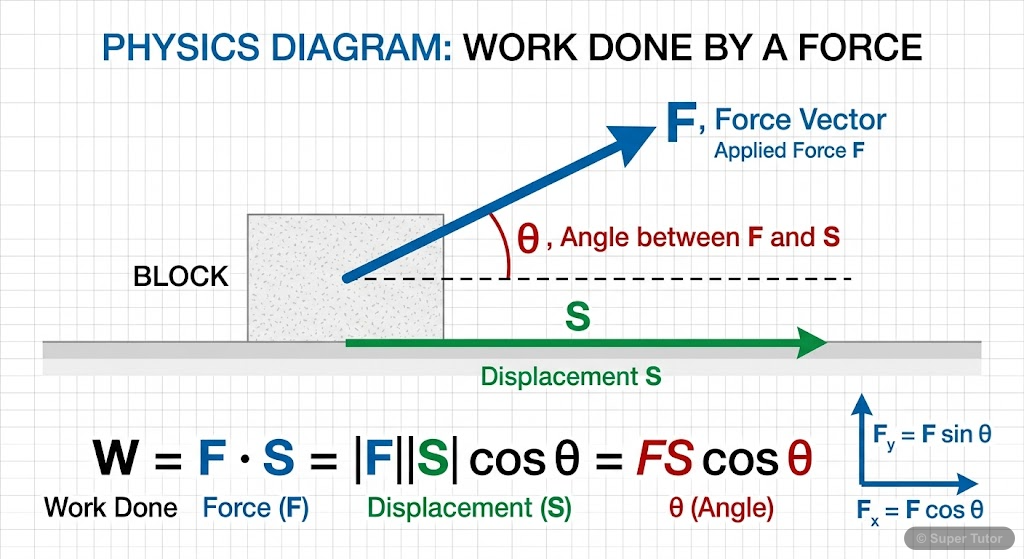
One of 5 illustrations for Work and Energy in Super Tutor — alongside flashcards, concept maps and practice questions.
The first 11 solutions are open to read. The other 10 are free with a Super Tutor account.
Exercises
1Look at the activities listed below. Reason out whether or not work is done in the light of your understanding of the term 'work'.
- Suma is swimming in a pond.
- A donkey is carrying a load on its back.
- A wind-mill is lifting water from a well.
- A green plant is carrying out photosynthesis.
- An engine is pulling a train.
- Food grains are getting dried in the sun.
- A sailboat is moving due to wind energy.Show solution
Concept: Work is done when a force acts on an object AND the object is displaced in the direction of (or having a component along) the applied force. W = F × d × cos θ.
- Suma is swimming in a pond.
Suma applies force on water with her arms and legs, and her body moves forward (displacement occurs in the direction of applied force). Work is done.
- A donkey is carrying a load on its back.
The donkey exerts an upward force (normal reaction) to support the load, but the displacement of the load is horizontal. The angle between force (vertical) and displacement (horizontal) is 90°, so W = F × d × cos 90° = 0. Work is NOT done by the donkey on the load (in the scientific sense).
- A wind-mill is lifting water from a well.
The windmill applies force on water and the water is displaced upward (in the direction of force). Work is done.
- A green plant is carrying out photosynthesis.
Photosynthesis is a biochemical process. There is no mechanical force causing displacement of an object. Work is NOT done (in the mechanical sense).
- An engine is pulling a train.
The engine applies force on the train and the train moves in the direction of the force. Work is done.
- Food grains are getting dried in the sun.
Drying is a physical/chemical process involving heat energy. No mechanical force causes displacement of the grains. Work is NOT done (in the mechanical sense).
- A sailboat is moving due to wind energy.
Wind exerts force on the sail and the boat is displaced in the direction of the force. Work is done.
2An object thrown at a certain angle to the ground moves in a curved path and falls back to the ground. The initial and the final points of the path of the object lie on the same horizontal line. What is the work done by the force of gravity on the object?Show solution
Given:
- Object is thrown at an angle and returns to the same horizontal level.
- Initial point and final point are on the same horizontal line.
Concept: Work done by gravity = , where is the vertical displacement (change in height).
Working:
Since the initial and final points lie on the same horizontal line, the net vertical displacement of the object is:
Therefore, work done by gravity:
Answer: The work done by the force of gravity on the object is zero.
3A battery lights a bulb. Describe the energy changes involved in the process.Show solution
Energy transformations when a battery lights a bulb:
Step 1: The battery contains stored chemical energy.
Step 2: When the circuit is complete, chemical energy of the battery is converted into electrical energy (electric current flows through the circuit).
Step 3: When electric current passes through the filament of the bulb, electrical energy is converted into heat energy and light energy.
Summary of transformation:
4Certain force acting on a 20 kg mass changes its velocity from 5 m/s to 2 m/s. Calculate the work done by the force.Show solution
Given:
- Mass, kg
- Initial velocity, m s
- Final velocity, m s
Concept: By the work-energy theorem, the work done by a force equals the change in kinetic energy of the object.
Calculation:
Answer: The work done by the force is J. The negative sign indicates that the force acts opposite to the direction of motion (it decelerates the object).
5A mass of 10 kg is at a point A on a table. It is moved to a point B. If the line joining A and B is horizontal, what is the work done on the object by the gravitational force? Explain your answer.Show solution
Given:
- Mass of object, kg
- The object is moved from point A to point B on a horizontal surface.
- The line AB is horizontal.
Concept: Work done by gravity = , where is the vertical displacement.
Explanation:
Gravitational force acts vertically downward. When the object moves horizontally from A to B, there is no change in its height, i.e., the vertical displacement .
The angle between the gravitational force (downward) and the displacement (horizontal) is 90°.
Answer: The work done on the object by the gravitational force is zero, because the displacement is perpendicular to the direction of gravitational force (there is no vertical displacement).
6The potential energy of a freely falling object decreases progressively. Does this violate the law of conservation of energy? Why?Show solution
Answer: No, this does not violate the law of conservation of energy.
Explanation:
When an object falls freely from a height, its potential energy decreases. However, as it falls, its velocity increases, so its kinetic energy increases progressively.
According to the law of conservation of energy, energy can neither be created nor destroyed; it can only be transformed from one form to another.
During free fall:
- The potential energy (= ) decreases as height decreases.
- The kinetic energy (= ) increases as velocity increases.
- The total mechanical energy (KE + PE) remains constant at every point.
Thus, the decrease in potential energy is exactly equal to the increase in kinetic energy. The law of conservation of energy is fully obeyed.
7What are the various energy transformations that occur when you are riding a bicycle?Show solution
Energy transformations while riding a bicycle:
Step 1: The rider's body uses chemical energy (stored in food/muscles).
Step 2: The rider's muscles convert chemical energy into mechanical energy (muscular effort applied to the pedals).
Step 3: The mechanical energy of the pedals is transferred to the wheels through the chain, causing the bicycle to move — this is kinetic energy of the bicycle.
Step 4: Some energy is also lost as heat energy due to friction between the tyres and the road, and in the chain and bearings.
Summary:
8Does the transfer of energy take place when you push a huge rock with all your might and fail to move it? Where is the energy you spend going?Show solution
Answer: In the scientific sense, no work is done on the rock because the rock does not move (displacement = 0). Therefore, no energy is transferred to the rock.
However, the person does spend energy. This energy is used by the muscles of the body. When we push the rock, our muscle fibres undergo repeated contraction and relaxation. The chemical energy stored in the body (from food) is used up and converted into heat energy, which causes the body to feel warm and tired.
Conclusion: The energy spent by the person is converted into heat energy within the body (muscles). No mechanical work is done on the rock since there is no displacement.
9A certain household has consumed 250 units of energy during a month. How much energy is this in joules?Show solution
Given:
- Energy consumed = 250 units
Concept: 1 unit of electrical energy = 1 kilowatt-hour (kWh)
Calculation:
Answer: The energy consumed is J.
10An object of mass 40 kg is raised to a height of 5 m above the ground. What is its potential energy? If the object is allowed to fall, find its kinetic energy when it is half-way down.Show solution
Given:
- Mass, kg
- Height, m
- m s
Part (i): Potential Energy at height 5 m
Part (ii): Kinetic Energy at half-way down (i.e., at height = 2.5 m)
At half-way down, height = m
Using the law of conservation of energy:
Potential energy at half-way point:
Therefore, kinetic energy at half-way point:
Answer:
- Potential energy at height 5 m = 2000 J
- Kinetic energy at half-way down = 1000 J
11What is the work done by the force of gravity on a satellite moving round the earth? Justify your answer.Show solution
Answer: The work done by the force of gravity on a satellite moving around the earth is zero.
Justification:
For a satellite in a circular orbit around the earth, the gravitational force acts towards the centre of the earth (centripetal direction), which is always perpendicular to the direction of motion (displacement) of the satellite at every point.
Since the angle between the gravitational force and the displacement is always 90°:
Also, in a circular orbit, the satellite returns to the same point after one revolution, so the net displacement in the direction of gravity is zero.
Therefore, the work done by gravity on the satellite is zero.
Free with a Super Tutor account
Free with a Super Tutor account
Free with a Super Tutor account
Free with a Super Tutor account
Free with a Super Tutor account
Free with a Super Tutor account
Free with a Super Tutor account
Free with a Super Tutor account
Free with a Super Tutor account
Free with a Super Tutor account
10 more solved questions in Work and Energy
They are free with a Super Tutor account, along with practice quizzes and flashcards for this chapter. Free to start, no card needed.
Frequently Asked Questions
What are the important topics in Work and Energy for Madhya Pradesh Board Class 9 Science?
Are these NCERT Solutions for Work and Energy free?
How should I revise Work and Energy for Class 9 exams?
Sources & Official References
Content is aligned to the official syllabus. Refer to the board website for the latest curriculum.
More resources for Work and Energy
Practice Quiz
Test yourself with a quick quiz
Important Questions
Exam-style questions with answers
Revision Notes
Key points for last-minute revision
Formula Sheet
The chapter's formulas in one place
Chapter Summary
Understand the chapter at a glance
Flashcards
Quick-fire cards for active recall
Syllabus
What topics to cover
For serious students
Get the full Work and Energy chapter — start free.
Quizzes, flashcards, an AI doubt solver and a study plan for Madhya Pradesh Board Class 9 Science. Free to start, no card needed.