Exponents And Radicals — Chapter Summary
NIOS · Class 10 · Maths
Summary of Exponents And Radicals for NIOS Class 10 Maths. Key concepts: The notation for writing, The main laws and The expression a^(1/q) is.
Interactive on Super Tutor
Studying Exponents And Radicals? Get the full interactive chapter.
Quizzes, flashcards, AI doubt-solver and a step-by-step study plan — built for chapter summary and more.
Free trial, no card needed.
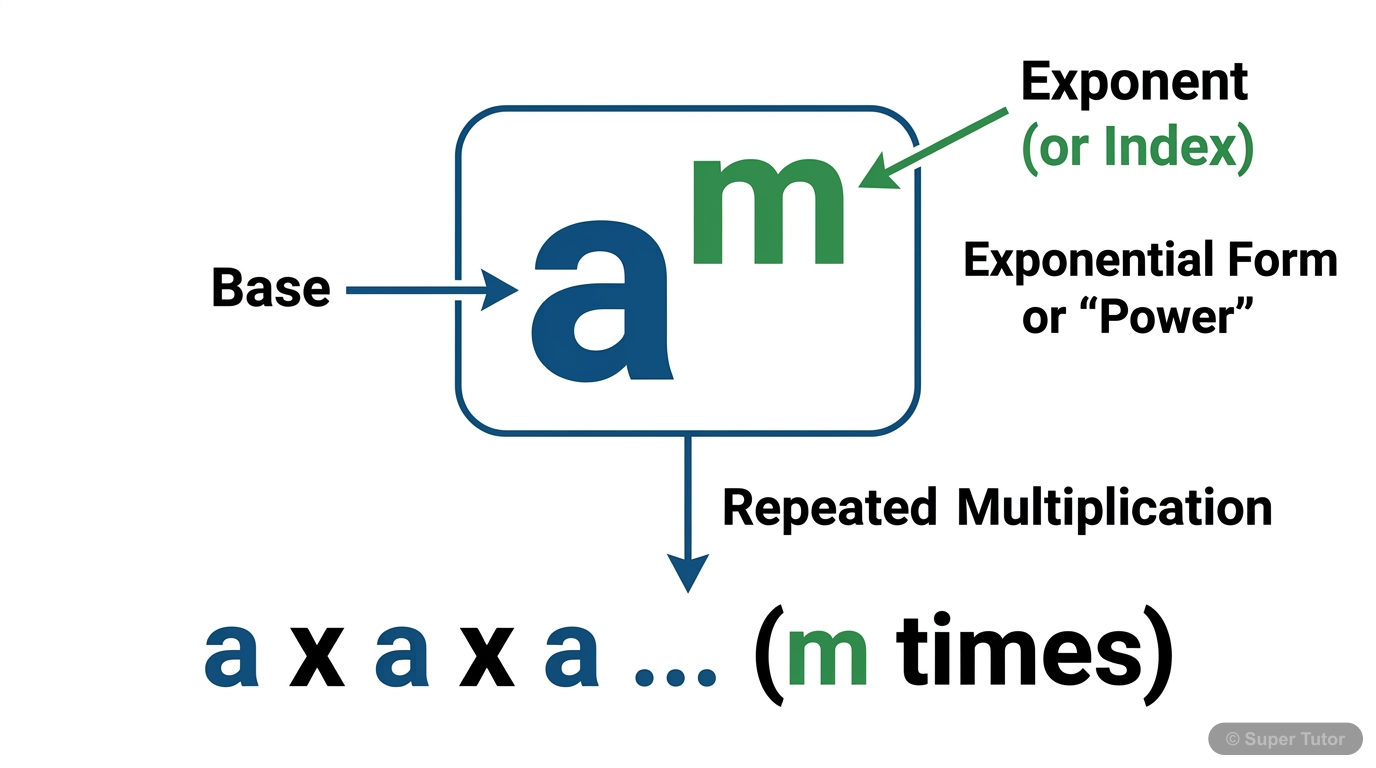
Learn better with visuals Super Tutor pairs illustrations like this with notes and quizzes for Exponents And Radicals.
Overview
Exponential notation gives a short way to write repeated multiplication. Exponents describe how many times a base is multiplied by itself. Prime factorisation rewrites a natural number greater than 1 as a unique product of prime powers. Radicals, also called surds, represent certain positive irratio
Key Concepts
The notation for writing the product
The notation for writing the product of a number by itself several times is called exponential notation or exponential form. In a number such as 7^2,
The main laws
The main laws are: a^m × a^n = a^(m+n), a^m ÷ a^n = a^(m-n) when m > n, a^m ÷ a^n = 1/a^(n-m) when n > m, (a^m)^n = a^(mn), a^0 = 1 for any non-zero r
The expression a^(1/q) is defined as
The expression a^(1/q) is defined as the qth root of a. More generally, a^(p/q) = qth root of a^p, where a is positive. This connects powers and roots
Any natural number other than 1
Any natural number other than 1 can be expressed uniquely, apart from order, as a product of powers of prime numbers.
A surd is a positive irrational
A surd is a positive irrational number of the form nth root of x, where x is a positive rational number and the nth root cannot be found exactly. When
Learning Objectives
- Write repeated multiplication in exponential form and identify the base and exponent.
- Use the laws of exponents to simplify expressions with positive, zero, negative, and rational exponents.
- Express natural numbers as products of powers of prime numbers.
- Understand the meaning of radicals, surds, index, and radicand.
- Classify surds as pure, mixed, similar, and conjugate surds.
Frequently Asked Questions
What are the important topics in Exponents And Radicals for NIOS Class 10 Maths?
How should I revise Exponents And Radicals for the NIOS Class 10 board exam?
Sources & Official References
Content is aligned to the official syllabus. Refer to the board website for the latest curriculum.
More resources for Exponents And Radicals
Practice Quiz
Test yourself with a quick quiz
Important Questions
Exam-style questions with answers
Revision Notes
Key points for last-minute revision
Formula Sheet
The chapter's formulas in one place
Concept Maps
See how topics connect
Study Plan
Step-by-step plan for this chapter
Flashcards
Quick-fire cards for active recall
Syllabus
What topics to cover
For serious students
Get the full Exponents And Radicals chapter — start free.
Quizzes, flashcards, an AI doubt solver and a study plan for NIOS Class 10 Maths. Free to start, no card needed.