Data And Their Representations — Chapter Summary
NIOS · Class 10 · Maths
Summary of Data And Their Representations for NIOS Class 10 Maths. Part of the NIOS Class 10 Maths syllabus. Statistics deals with the collection.
Interactive on Super Tutor
Studying Data And Their Representations? Get the full interactive chapter.
Quizzes, flashcards, AI doubt-solver and a step-by-step study plan — built for chapter summary and more.
Free trial, no card needed.
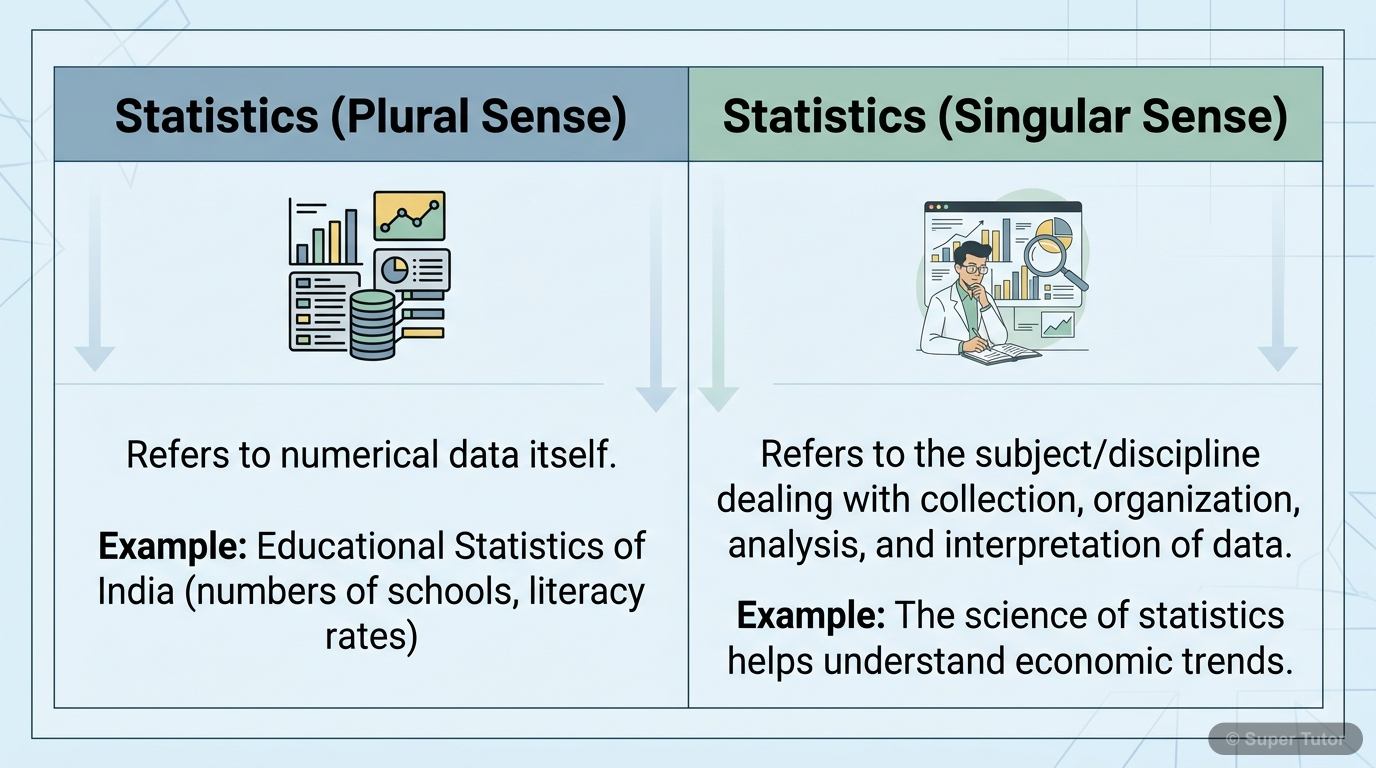
One of 11 illustrations for Data And Their Representations in Super Tutor — alongside flashcards, concept maps and practice questions.
Overview
Statistics deals with the collection, organisation, analysis, and interpretation of numerical data. Data may be raw or arranged, collected directly or taken from other agencies, and presented in tables or graphs for easy understanding. The chapter builds the basic tools of data handling: frequency t
Key Concepts
Statistics has two meanings
Statistics has two meanings: in the plural sense it means numerical data, and in the singular sense it means the branch of mathematics dealing with co
Primary data is collected directly by
Primary data is collected directly by the investigator. Examples include voters' lists and data collected in a census-questionnaire.
Secondary data is collected by other
Secondary data is collected by other governmental or private agencies and used later by another investigator. It must be used with great care because
Raw data is data in its
Raw data is data in its original unorganised form. Arrayed data is raw data arranged in ascending or descending order.
An ungrouped frequency distribution lists each
An ungrouped frequency distribution lists each distinct value and its frequency. A grouped frequency distribution divides the data into class interval
Learning Objectives
- Understand statistics in both singular and plural senses
- Differentiate between primary data and secondary data
- Organise raw data into arrayed data and frequency tables
- Construct grouped and ungrouped frequency distributions
- Find cumulative frequency for grouped data
Frequently Asked Questions
What are the important topics in Data And Their Representations for NIOS Class 10 Maths?
How should I revise Data And Their Representations for the NIOS Class 10 board exam?
Sources & Official References
Content is aligned to the official syllabus. Refer to the board website for the latest curriculum.
More resources for Data And Their Representations
Practice Quiz
Test yourself with a quick quiz
Important Questions
Exam-style questions with answers
Revision Notes
Key points for last-minute revision
Formula Sheet
The chapter's formulas in one place
Concept Maps
See how topics connect
Study Plan
Step-by-step plan for this chapter
Flashcards
Quick-fire cards for active recall
Syllabus
What topics to cover
For serious students
Get the full Data And Their Representations chapter — start free.
Quizzes, flashcards, an AI doubt solver and a study plan for NIOS Class 10 Maths. Free to start, no card needed.