Introduction To Probability — Chapter Summary
NIOS · Class 10 · Maths
Summary of Introduction To Probability for NIOS Class 10 Maths. Part of the NIOS Class 10 Maths syllabus. Probability studies situations involving.
Interactive on Super Tutor
Studying Introduction To Probability? Get the full interactive chapter.
Quizzes, flashcards, AI doubt-solver and a step-by-step study plan — built for chapter summary and more.
Free trial, no card needed.
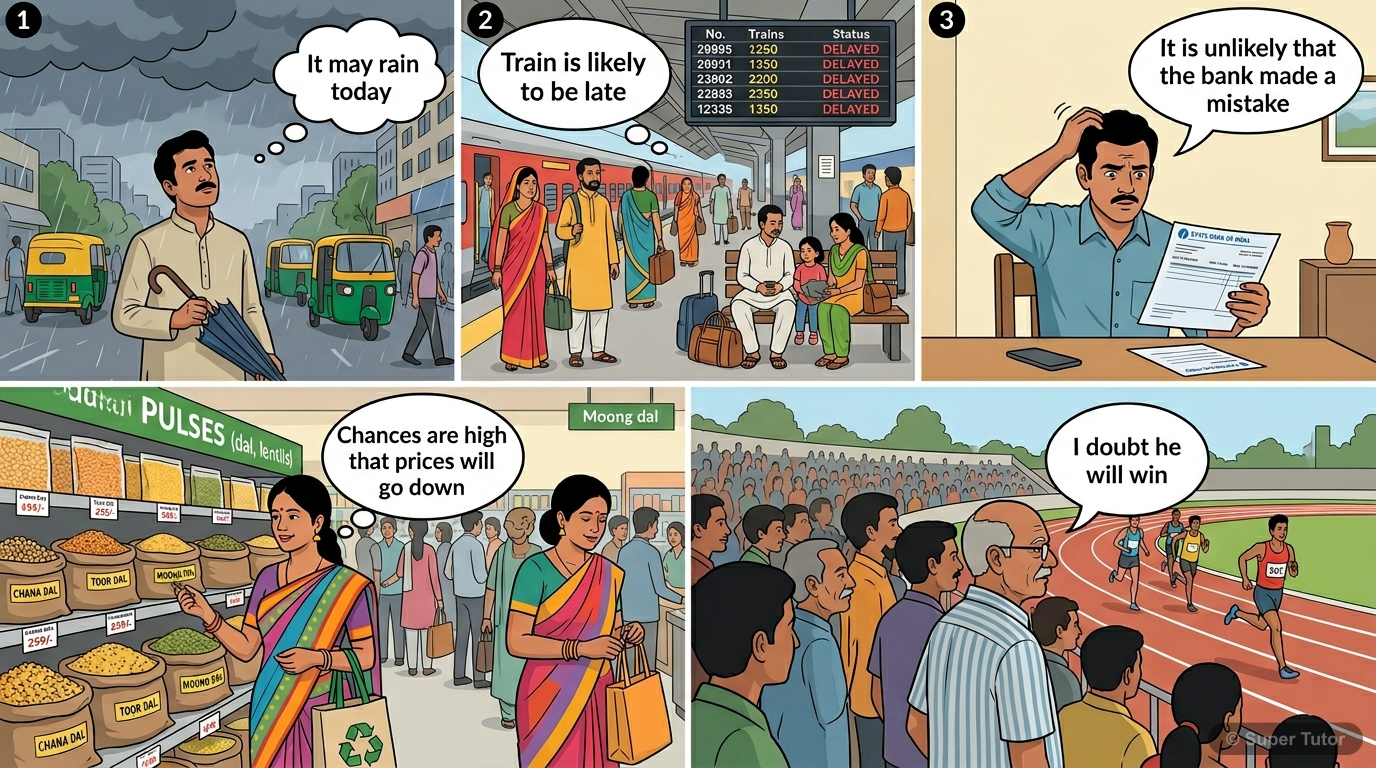
One of 7 illustrations for Introduction To Probability in Super Tutor — alongside flashcards, concept maps and practice questions.
Overview
Probability studies situations involving uncertainty. A random experiment has more than one possible outcome, but the exact result cannot be predicted in advance. The chapter builds the basic language of probability: experiment, outcome, event, elementary event, sure event, impossible event, and com
Key Concepts
An experiment with more than one
An experiment with more than one possible outcome whose result cannot be predicted in advance. Tossing a coin, throwing a die, planting seeds, drawing
A possible result of a random
A possible result of a random experiment. For a coin, the outcomes are Head and Tail; for a die, the outcomes are 1, 2, 3, 4, 5, and 6.
One or more outcomes of
One or more outcomes of an experiment constitute an event. For example, 'the die shows an even number' is an event because it includes 2, 4, and 6.
An event having only one outcome
An event having only one outcome of the experiment.
For equally likely outcomes
For equally likely outcomes, probability is found by dividing the number of favourable outcomes by the number of all possible outcomes. The formula is
Learning Objectives
- Understand the meaning of a random experiment
- Differentiate between outcomes and events
- Identify elementary, sure, impossible, and complementary events
- Use the probability formula for equally likely outcomes
- Find probabilities in common situations involving coins, dice, cards, and balls
Frequently Asked Questions
What are the important topics in Introduction To Probability for NIOS Class 10 Maths?
How should I revise Introduction To Probability for the NIOS Class 10 board exam?
Sources & Official References
Content is aligned to the official syllabus. Refer to the board website for the latest curriculum.
More resources for Introduction To Probability
Practice Quiz
Test yourself with a quick quiz
Important Questions
Exam-style questions with answers
Revision Notes
Key points for last-minute revision
Formula Sheet
The chapter's formulas in one place
Concept Maps
See how topics connect
Study Plan
Step-by-step plan for this chapter
Flashcards
Quick-fire cards for active recall
Syllabus
What topics to cover
For serious students
Get the full Introduction To Probability chapter — start free.
Quizzes, flashcards, an AI doubt solver and a study plan for NIOS Class 10 Maths. Free to start, no card needed.