Introduction To Trigonometry — Chapter Summary
NIOS · Class 10 · Maths
Summary of Introduction To Trigonometry for NIOS Class 10 Maths. Part of the NIOS Class 10 Maths syllabus. Trigonometry means measurement of sides.
Interactive on Super Tutor
Studying Introduction To Trigonometry? Get the full interactive chapter.
Quizzes, flashcards, AI doubt-solver and a step-by-step study plan — built for chapter summary and more.
Free trial, no card needed.
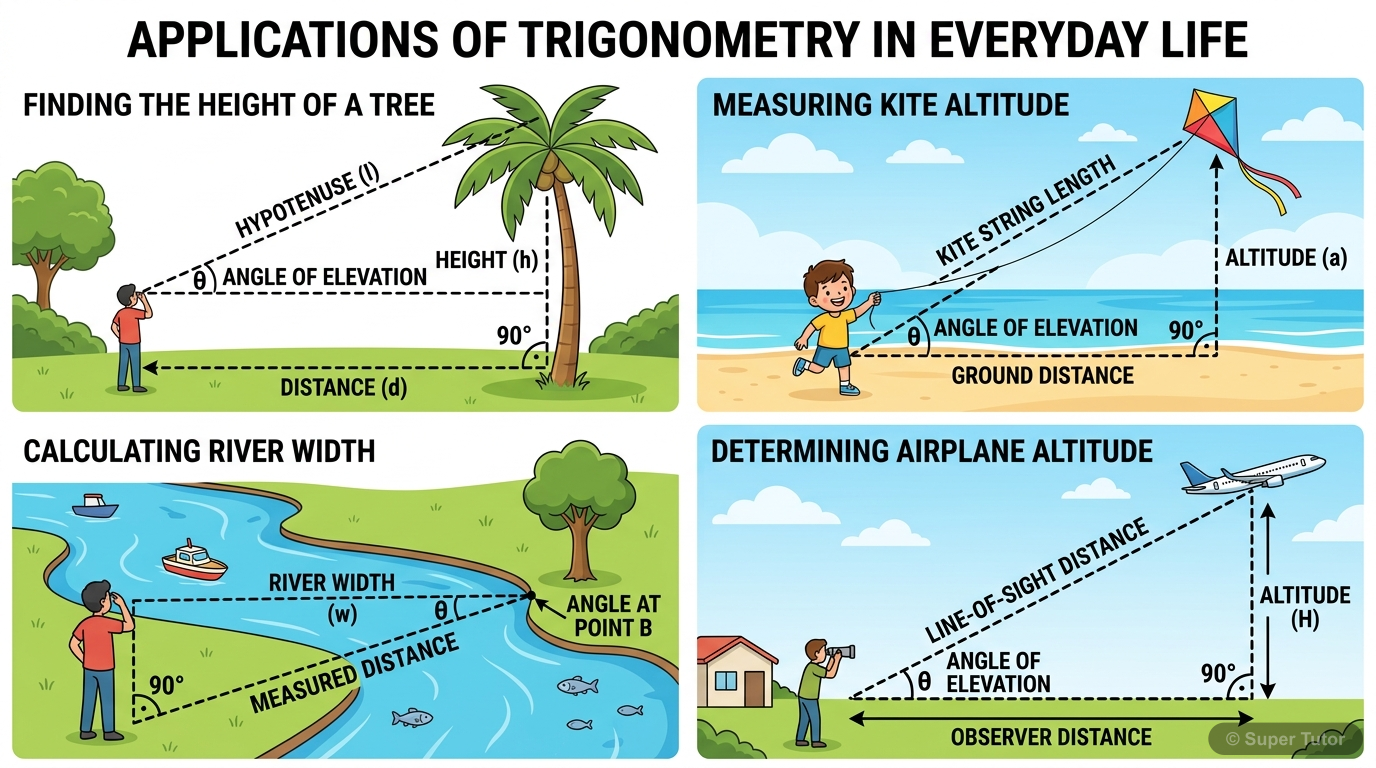
Learn better with visuals Super Tutor pairs illustrations like this with notes and quizzes for Introduction To Trigonometry.
Overview
Trigonometry means measurement of sides and angles of a triangle. It is built from three Greek words: Tri, Gon, and Metron. The chapter defines six trigonometric ratios for an acute angle in a right-angled triangle, shows how they are connected, derives three fundamental identities, and explains com
Key Concepts
In a right triangle
In a right triangle, the side opposite the right angle is the hypotenuse. For angle A = theta in triangle ABC right-angled at B, BC is opposite, AB is
The six ratios are sin theta
The six ratios are sin theta = BC/AC, cos theta = AB/AC, tan theta = BC/AB, cosec theta = AC/BC, sec theta = AC/AB, and cot theta = AB/BC.
Every trigonometric ratio is a real
Every trigonometric ratio is a real number. The value of a t-ratio depends only on the angle, not on the size of the right triangle. The notation sin
sin theta and cosec theta
sin theta and cosec theta are reciprocals, cos theta and sec theta are reciprocals, and tan theta and cot theta are reciprocals. Also, tan theta = sin
In a right triangle with sides
In a right triangle with sides 3, 4, and 5, for angle theta, sin theta = 3/5 and cos theta = 4/5. For the complementary angle alpha, the values swap:
Learning Objectives
- Define trigonometry as the measurement of sides and angles of a triangle
- Identify the hypotenuse, opposite side, and adjacent side in a right triangle
- Write and use the six trigonometric ratios: sin, cos, tan, cosec, sec, and cot
- Understand that t-ratios depend only on the angle, not on the size of the triangle
- Use Pythagoras Theorem to find the third side when two sides are known
Frequently Asked Questions
What are the important topics in Introduction To Trigonometry for NIOS Class 10 Maths?
How should I revise Introduction To Trigonometry for the NIOS Class 10 board exam?
Sources & Official References
Content is aligned to the official syllabus. Refer to the board website for the latest curriculum.
More resources for Introduction To Trigonometry
Practice Quiz
Test yourself with a quick quiz
Important Questions
Exam-style questions with answers
Revision Notes
Key points for last-minute revision
Formula Sheet
The chapter's formulas in one place
Concept Maps
See how topics connect
Study Plan
Step-by-step plan for this chapter
Flashcards
Quick-fire cards for active recall
Syllabus
What topics to cover
For serious students
Get the full Introduction To Trigonometry chapter — start free.
Quizzes, flashcards, an AI doubt solver and a study plan for NIOS Class 10 Maths. Free to start, no card needed.