Number System — Chapter Summary
NIOS · Class 10 · Maths
Summary of Number System for NIOS Class 10 Maths. Key concepts: Natural numbers are, Whole numbers are natural and Integers extend whole numbers.
Interactive on Super Tutor
Studying Number System? Get the full interactive chapter.
Quizzes, flashcards, AI doubt-solver and a step-by-step study plan — built for chapter summary and more.
Free trial, no card needed.
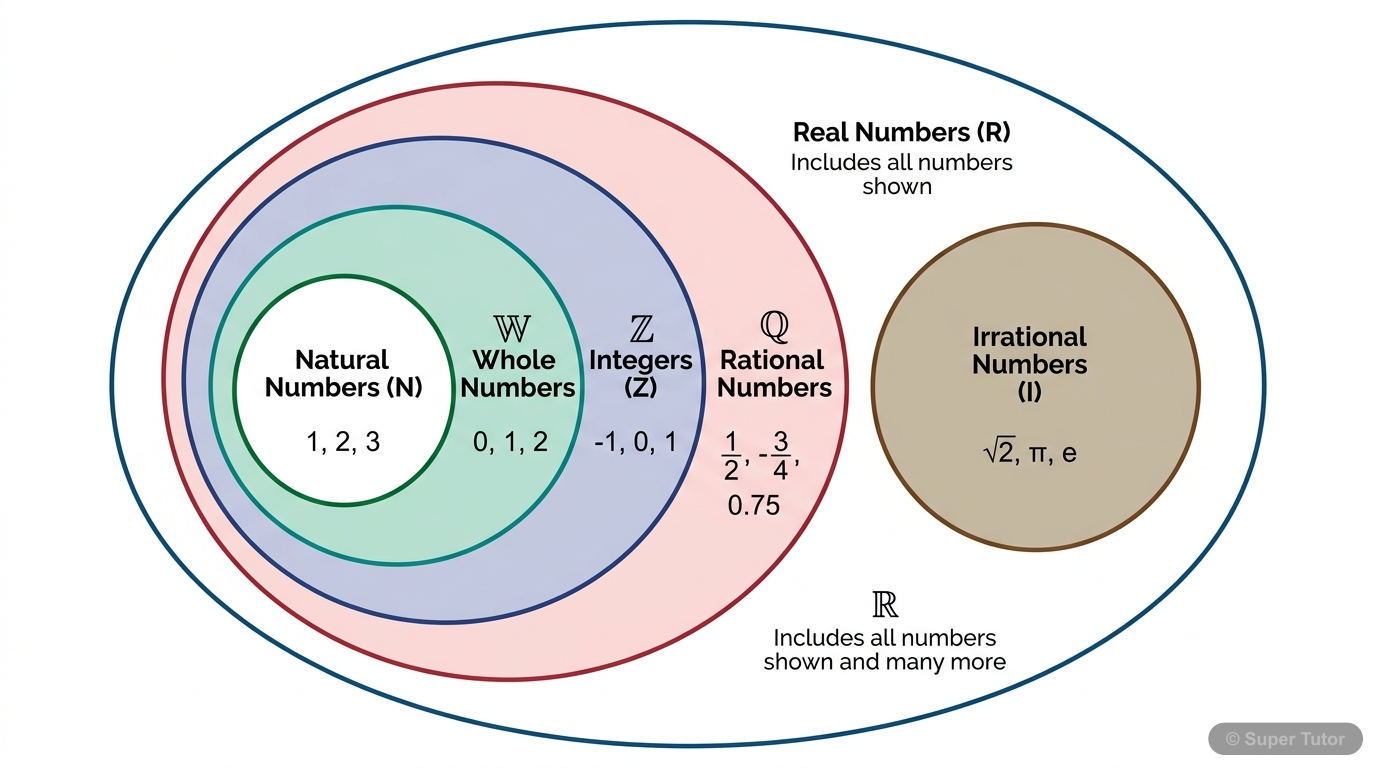
Learn better with visuals Super Tutor pairs illustrations like this with notes and quizzes for Number System.
Overview
The number system grew from counting numbers to whole numbers, integers, rational numbers, irrational numbers, and finally real numbers. Natural numbers begin with 1 and are used for counting. Whole numbers add 0. Integers extend further to include negative numbers. Rational numbers are numbers of t
Key Concepts
Natural numbers are the counting numbers
Natural numbers are the counting numbers 1, 2, 3, ... . There is no greatest natural number. Addition and multiplication of natural numbers always giv
Whole numbers are natural numbers extended
Whole numbers are natural numbers extended by 0, so they are 0, 1, 2, 3, ... . There is no greatest whole number. Division by zero is not defined.
Integers extend whole numbers by including
Integers extend whole numbers by including negative numbers such as -1, -2, -3, ... . They are ..., -3, -2, -1, 0, 1, 2, 3, ... . Integers make subtra
A rational number is any number
A rational number is any number that can be written in the form p/q, where p and q are integers and q ≠ 0. Every natural number, whole number, and int
A rational number is in standard
A rational number is in standard form when its denominator is positive and the numerator and denominator are co-prime. Standard form is also called lo
Learning Objectives
- Identify natural numbers, whole numbers, integers, rational numbers, irrational numbers, and real numbers
- Write rational numbers in standard form or lowest form
- Compare rational numbers using common denominators and the number line
- Perform addition, subtraction, multiplication, and division of rational numbers
- Convert rational numbers between fraction form and decimal form
Frequently Asked Questions
What are the important topics in Number System for NIOS Class 10 Maths?
How should I revise Number System for the NIOS Class 10 board exam?
Sources & Official References
Content is aligned to the official syllabus. Refer to the board website for the latest curriculum.
More resources for Number System
Practice Quiz
Test yourself with a quick quiz
Important Questions
Exam-style questions with answers
Revision Notes
Key points for last-minute revision
Formula Sheet
The chapter's formulas in one place
Concept Maps
See how topics connect
Study Plan
Step-by-step plan for this chapter
Flashcards
Quick-fire cards for active recall
Syllabus
What topics to cover
For serious students
Get the full Number System chapter — start free.
Quizzes, flashcards, an AI doubt solver and a study plan for NIOS Class 10 Maths. Free to start, no card needed.