Electric Charge and Electric Field — Concept Maps
NIOS · Class 12 · Physics
4 concept maps of Electric Charge and Electric Field for NIOS Class 12 Physics, each also written out as a text outline.
Interactive on Super Tutor
Studying Electric Charge and Electric Field? Get the full interactive chapter.
Quizzes, flashcards, AI doubt-solver and a step-by-step study plan — built for concept maps and more.
Free trial, no card needed.
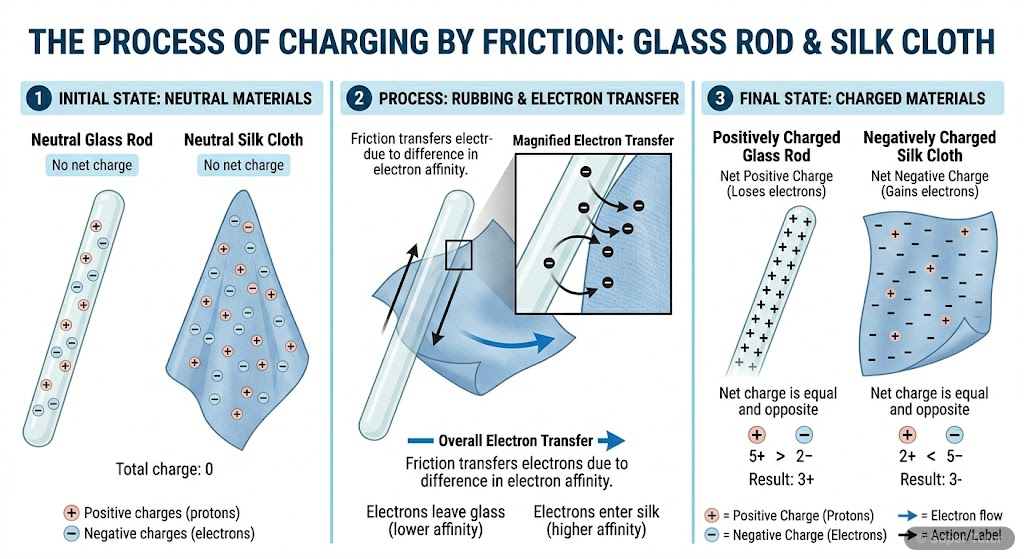
Learn better with visuals Super Tutor pairs illustrations like this with notes and quizzes for Electric Charge and Electric Field.
Chapter Overview: Electric Charge and Electric Field — Complete Mind Map
The map in words
- Electric Charge and Electric Field
- Electric Charge
- Two Types
- Positive Charge
- Negative Charge
- Properties
- Like charges repel
- Unlike charges attract
- Charge is scalar
- Conservation of Charge
- Total charge is constant
- Transfer not creation
- Quantisation of Charge
- Q = Ne
- e = 1.6e-19 C
- Methods of Charging
- Friction
- Conduction
- Induction
- Two Types
- Coulombs Law
- Formula F = kq1q2 divide r squared
- k = 9e9 Nm2 per C2
- Vector Form
- F12 = k q1q2 r-hat divide r2
- Action Reaction Pair
- In Medium
- Force reduced by Er
- Superposition Principle
- Vector sum of all forces
- Electric Field
- Definition E = F divide q0
- Point Charge
- E = kq divide r squared
- Direction
- Away from positive charge
- Towards negative charge
- Superposition
- E = E1 + E2 + E3
- Electric Dipole
- Two equal opposite charges
- Dipole Moment p = q times 2l
- Direction neg to pos
- Unit Coulomb metre
- Axial Field
- E = 2p divide 4 pi e0 r cubed
- Equatorial Field
- E = p divide 4 pi e0 r cubed
- Opposite to p direction
- In Uniform Field
- Torque tau = pE sin theta
- No net force
- Electric Field Lines
- Properties
- Start from positive charge
- End on negative charge
- Never intersect
- Density shows strength
- Properties
- Gauss Law
- Flux phi = E dot A
- phi = q enclosed divide e0
- Applications
- Point charge E = kq divide r2
- Line charge E = sigma-l divide 2 pi e0 r
- Spherical shell
- Outside E = Q divide 4 pi e0 r2
- Inside E = zero
- Plane sheet E = sigma divide 2 e0
- Van de Graaff Generator
- High voltage up to 20 MV
- Charge to outer surface
- Used in particle accelerators
- Electric Charge
Chapter Overview — Electric Charge and Electric Field
The map in words
- root((Electric Charge
- and Field))
- Electric Charge
- Two Types
- Positive Charge
- Negative Charge
- Properties
- Conservation
- Quantisation Q=ne
- Like repels Like
- Methods of Charging
- Friction
- Conduction
- Induction
- Two Types
- Coulombs Law
- F = kq1q2 over r squared
- k = 9x10 to 9 Nm2C-2
- Vector Form
- Superposition Principle
- Electric Field
- Definition E = F over q0
- Due to Point Charge
- Due to Dipole
- End-on E = 2kp over r cubed
- Broad-on E = kp over r cubed
- Field Lines
- Start from positive
- End on negative
- Never cross
- Electric Dipole
- p = q times 2l
- Torque = pE sinθ
- Uniform Field
- Non-uniform Field
- Gauss Law
- Flux = q over epsilon0
- Point Charge
- Line Charge E = sigma over 2pi epsilon0 r
- Spherical Shell
- Outside E = kQ over r squared
- Inside E = 0
- Plane Sheet
- Van de Graaff
- High Voltage Generator
- Corona Discharge
- Nuclear Research
- Electric Charge
Chapter Overview: Electric Charge and Electric Field
The map in words
- Electric Charge and Electric Field
- Electric Charge
- Types of Charge
- Positive Charge
- Negative Charge
- Properties
- Like Charges Repel
- Unlike Charges Attract
- Conservation of Charge
- Charge Neither Created Nor Destroyed
- Only Transferred
- Quantisation of Charge
- Q equals Ne
- e equals 1.6 x 10 minus 19 C
- Types of Charge
- Coulombs Law
- F equals kq1q2 divided by r squared
- k equals 9 x 10 power 9 Nm2 per C2
- Vector Form
- Repulsion for Like Charges
- Attraction for Unlike Charges
- Superposition Principle
- Vector Sum of Forces
- Electric Field
- Definition E equals F divided by q0
- Formula E equals kq divided by r squared
- Due to Dipole
- Axial Position
- Equatorial Position
- Field Lines
- Properties
- Never Cross Each Other
- Electric Dipole
- Dipole Moment p equals 2ql
- Torque tau equals pE sin theta
- In Uniform Field
- Torque but No Net Force
- Gauss Law
- Electric Flux phi equals E dot A
- phi equals Q enclosed divided by epsilon0
- Applications
- Point Charge
- Line Charge
- Spherical Shell
- Plane Sheet
- Van de Graaff Generator
- Corona Discharge
- Belt Carries Charge
- Millions of Volts
- Electric Charge
Electric Charge and Electric Field
The map in words
- Electric Charge and Electric Field
- Electric Charge
- Coulomb's Law
- Electric Field
- Electric Dipole
- Electric Field Lines
- Electric Flux and Gauss Law
- Van de Graaff Generator
Explore these maps interactively
Explore DiagramsFrequently Asked Questions
What are the important topics in Electric Charge and Electric Field for NIOS Class 12 Physics?
What do the concept maps for Electric Charge and Electric Field show?
How should I revise Electric Charge and Electric Field for the NIOS Class 12 board exam?
Sources & Official References
Content is aligned to the official syllabus. Refer to the board website for the latest curriculum.
More resources for Electric Charge and Electric Field
Practice Quiz
Test yourself with a quick quiz
Important Questions
Exam-style questions with answers
Revision Notes
Key points for last-minute revision
Formula Sheet
The chapter's formulas in one place
Chapter Summary
Understand the chapter at a glance
Study Plan
Step-by-step plan for this chapter
Flashcards
Quick-fire cards for active recall
Syllabus
What topics to cover
For serious students
Get the full Electric Charge and Electric Field chapter — start free.
Quizzes, flashcards, an AI doubt solver and a study plan for NIOS Class 12 Physics. Free to start, no card needed.