Electric Charge and Electric Field — Revision Notes
NIOS · Class 12 · Physics
Electric Charge and Electric Field revision notes for NIOS Class 12 Physics: 4 topics in quick points. Part of the NIOS Class 12 Physics syllabus.
Interactive on Super Tutor
Studying Electric Charge and Electric Field? Get the full interactive chapter.
Quizzes, flashcards, AI doubt-solver and a step-by-step study plan — built for revision notes and more.
Free trial, no card needed.
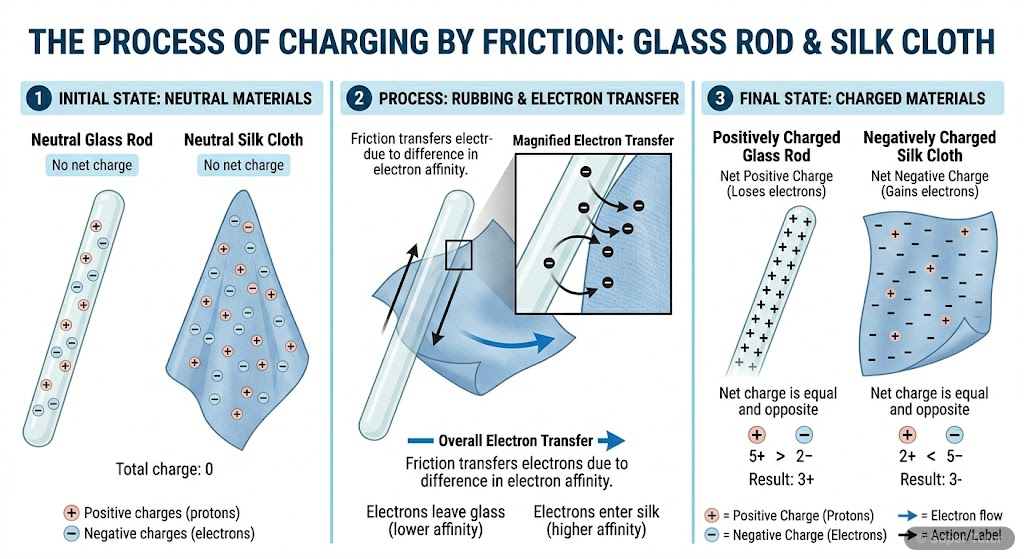
Learn better with visuals Super Tutor pairs illustrations like this with notes and quizzes for Electric Charge and Electric Field.
Key Topics to Revise
Electric Charge — Basic Properties
- Electric charge is a fundamental property of matter that causes it to experience a force when placed in an electric or magnetic field.
- There are only TWO types of charges in nature: Positive charge (on glass rod rubbed with silk) and Negative charge (on rubber rod rubbed with fur/wool).
- Like charges REPEL each other; Unlike charges ATTRACT each other.
Coulomb's Law
- Coulomb's Law (1785) gives the electrostatic force between two POINT CHARGES at rest.
- The force is directly proportional to the product of the two charges and inversely proportional to the square of the distance between them.
- This is an INVERSE SQUARE LAW — same as Newton's Law of Gravitation.
Electric Field
- Electric field (E) at a point is the force experienced by a unit positive test charge placed at that point.
- The test charge q₀ must be INFINITESIMALLY SMALL so that it does not disturb the original charge distribution.
- Electric field is a VECTOR quantity — its direction is the same as the direction of force on a POSITIVE test charge.
Electric Dipole and Dipole Moment
- An ELECTRIC DIPOLE consists of two equal and opposite charges (+q and -q) separated by a small distance 2l.
- Real-life examples: water molecule (H₂O), HCl molecule — they are permanent electric dipoles.
- DIPOLE MOMENT (p) = q × 2l (product of charge magnitude and separation between charges).
Get complete notes with diagrams and examples
Full NotesKey Concepts
Frequently Asked Questions
What are the important topics in Electric Charge and Electric Field for NIOS Class 12 Physics?
How should I revise Electric Charge and Electric Field for the NIOS Class 12 board exam?
Sources & Official References
Content is aligned to the official syllabus. Refer to the board website for the latest curriculum.
More resources for Electric Charge and Electric Field
Practice Quiz
Test yourself with a quick quiz
Important Questions
Exam-style questions with answers
Formula Sheet
The chapter's formulas in one place
Chapter Summary
Understand the chapter at a glance
Concept Maps
See how topics connect
Study Plan
Step-by-step plan for this chapter
Flashcards
Quick-fire cards for active recall
Syllabus
What topics to cover
For serious students
Get the full Electric Charge and Electric Field chapter — start free.
Quizzes, flashcards, an AI doubt solver and a study plan for NIOS Class 12 Physics. Free to start, no card needed.