Electric Charge and Electric Field — Practice Quiz
NIOS · Class 12 · Physics
Try a 4-question quiz on Electric Charge and Electric Field for NIOS Class 12 Physics: tap an answer to check it and see why.
Interactive on Super Tutor
Studying Electric Charge and Electric Field? Get the full interactive chapter.
Quizzes, flashcards, AI doubt-solver and a step-by-step study plan — built for practice quiz and more.
Free trial, no card needed.
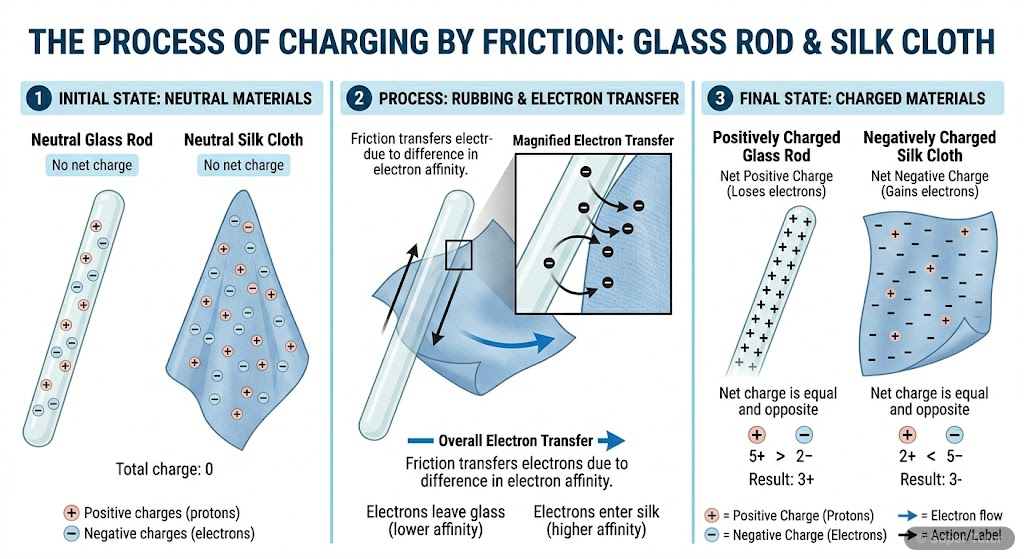
Learn better with visuals Super Tutor pairs illustrations like this with notes and quizzes for Electric Charge and Electric Field.
Quick Quiz: Electric Charge and Electric Field
0/4Tap an answer to check it instantly. No sign-up needed for these 4.
Two point charges q₁ = 6 μC and q₂ = 4 μC are separated by a distance of 3 m in free space. What is the magnitude of the electrostatic force between them? (k = 9 × 10⁹ N m² C⁻²)
A charge of Q = 4.8 × 10⁻¹⁸ C is placed on a metallic sphere. How many excess electrons does the sphere carry? (e = 1.6 × 10⁻¹⁹ C)
The electric field at a point P due to a point charge q is E. If the distance of P from the charge is doubled, what is the new electric field at P?
An electric dipole has charges +q and −q separated by distance 2l. The dipole moment vector p points from:
Sample Questions
A dipole with moment p = 2 × 10⁻⁶ C·m is placed in a uniform electric field E = 5 × 10⁴ N/C. The angle between p and E is 30°. What is the torque acting on the dipole?
Show answer
0.05 N·m
Step 1: Formula for torque on a dipole: τ = pE sin θ. Step 2: Substitute values: τ = (2 × 10⁻⁶) × (5 × 10⁴) × sin 30°. Step 3: sin 30° = 0.5. So τ = (2 × 10⁻⁶) × (5 × 10⁴) × 0.5. Step 4: τ = 10⁻¹ × 0.5 = 0.05 N·m. Wrong options: 0.10 N·m results from forgetting sin 30° (using sin 90°); 0.025 N·m uses sin 15° or halves incorrectly; 1.0 N·m ignores the power-of-10 conversion.
Using Gauss's Law, the electric field due to an infinitely long straight wire with linear charge density σᵢ (C/m) at a perpendicular distance r from it is:
Show answer
σᵢ / (2πε₀r)
Step 1: Choose a cylindrical Gaussian surface of radius r and length l coaxial with the wire. Step 2: The charge enclosed = σᵢl. Flux through flat ends is zero (E ⊥ area vector at ends). Step 3: Flux through curved surface = E × 2πrl. Step 4: Gauss's Law: E × 2πrl = σᵢl / ε₀, so E = σᵢ / (2πε₀r). Wrong options: σᵢ/(4πε₀r²) is Coulomb's law for a point charge; σᵢ/(ε₀r) misses the 2π factor; σᵢ/(2ε₀) is the result for a plane sheet of charge.
A uniformly charged spherical shell of radius R carries total charge Q. What is the electric field at a point inside the shell at distance r < R from the centre?
Show answer
Zero
Step 1: Apply Gauss's Law: draw a spherical Gaussian surface of radius r < R inside the shell. Step 2: The charge enclosed by this Gaussian surface is zero (all charge Q is on the shell at radius R, outside the Gaussian surface). Step 3: By Gauss's Law: E × 4πr² = Q_enclosed / ε₀ = 0. Step 4: Therefore E = 0 everywhere inside a uniformly charged spherical shell. Wrong options: kQ/R² is the field on the surface of the shell; kQ/r² is the external field; kQr/R³ applies to a solid uniformly charged sphere's internal field.
The electric field due to an infinite plane sheet of surface charge density σ (C/m²) at any point near it is:
Show answer
σ / (2ε₀), independent of distance
Step 1: Use a cylindrical Gaussian surface (pill-box) with its axis perpendicular to the sheet. Step 2: Let the cross-sectional area of the cylinder be Δs. Charge enclosed = σΔs. Step 3: Flux through both flat caps = 2EΔs; curved surface contributes zero flux. Step 4: Gauss's Law: 2EΔs = σΔs/ε₀ → E = σ/(2ε₀). Key point: The field is uniform (constant) – it does NOT depend on the distance from the sheet. Wrong options: The 1/r² and 1/r dependencies apply to point charges and line charges, respectively; σ/(4ε₀) has an incorrect numerical factor.
+39 more questions on Electric Charge and Electric Field (NIOS Class 12 Physics)
Practise AllFrequently Asked Questions
What are the important topics in Electric Charge and Electric Field for NIOS Class 12 Physics?
How many practice questions are there for Electric Charge and Electric Field?
Sources & Official References
Content is aligned to the official syllabus. Refer to the board website for the latest curriculum.
More resources for Electric Charge and Electric Field
Important Questions
Exam-style questions with answers
Revision Notes
Key points for last-minute revision
Formula Sheet
The chapter's formulas in one place
Chapter Summary
Understand the chapter at a glance
Concept Maps
See how topics connect
Study Plan
Step-by-step plan for this chapter
Flashcards
Quick-fire cards for active recall
Syllabus
What topics to cover
For serious students
Get the full Electric Charge and Electric Field chapter — start free.
Quizzes, flashcards, an AI doubt solver and a study plan for NIOS Class 12 Physics. Free to start, no card needed.