Communication Systems — Concept Maps
NIOS · Class 12 · Physics
4 concept maps of Communication Systems for NIOS Class 12 Physics, each also written out as a text outline. Part of the NIOS Class 12 Physics syllabus.
Interactive on Super Tutor
Studying Communication Systems? Get the full interactive chapter.
Quizzes, flashcards, AI doubt-solver and a step-by-step study plan — built for concept maps and more.
Free trial, no card needed.
Learn better with visuals Super Tutor pairs illustrations like this with notes and quizzes for Communication Systems.
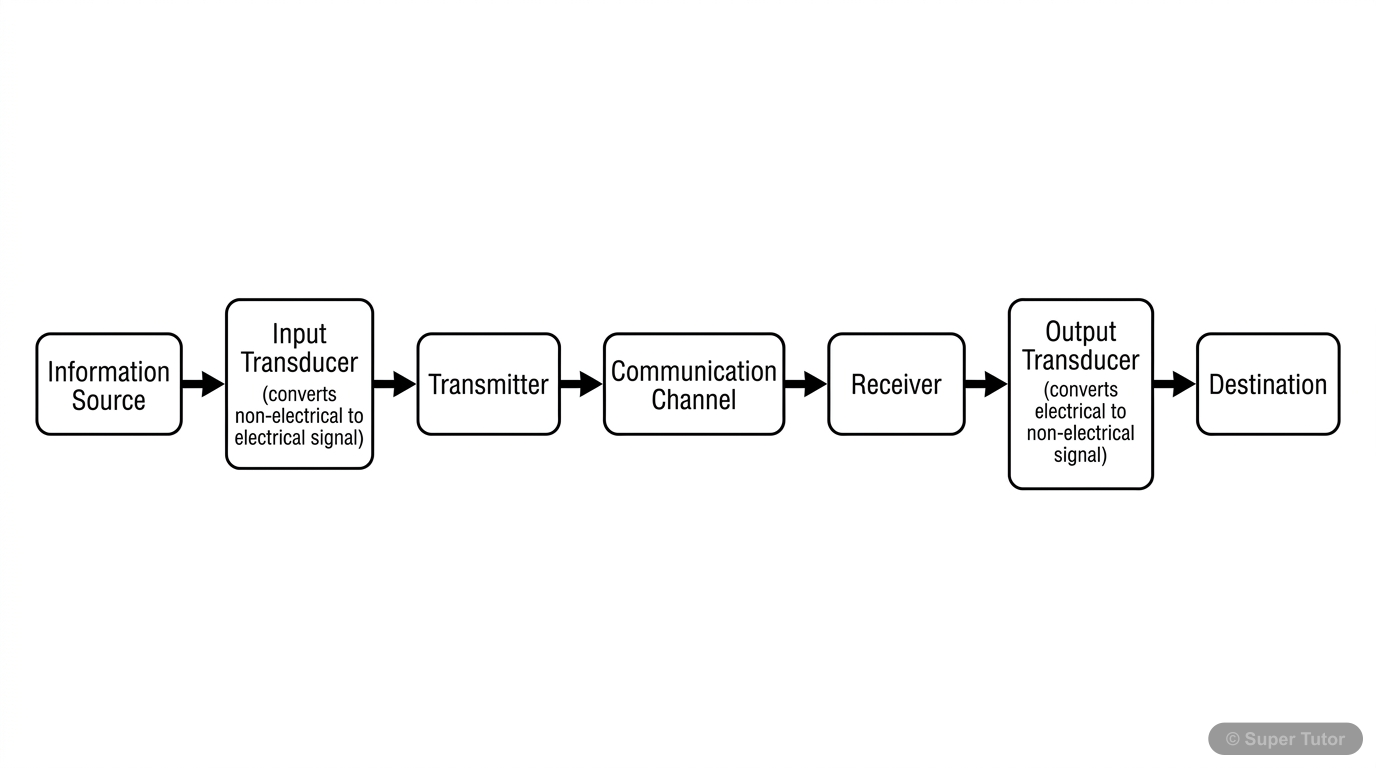
Block diagram of a complete communication system showing the flow from information source through transmitter, transmission medium, receiver to the final output, with noise interference shown separately.
The map in words
- Information Source
- Transmitter
- Transmission Medium
- Receiver
- Output/Information
- Receiver
- Transmission Medium
- Transmitter
- Noise
Classification of signal types showing the characteristics and examples of both analog and digital signals.
The map in words
- Signals
- Analog Signals
- Continuous with Time
- Infinite Values
- Examples: Voice, Audio
- Digital Signals
- Discrete Pulses
- Binary 0 and 1
- Examples: Data, Text
- Analog Signals
Comparison of bandwidth requirements for different communication applications showing the relative frequency ranges needed.
The map in words
- Telephone (3 kHz): 3
- AM Radio (10 kHz): 10
- FM Radio (15 kHz): 15
- TV Video (4200 kHz): 4200
Communication Systems
The map in words
- Communication Systems
- Elements of Communication System
- Types of Signals
- Electromagnetic Waves
- Communication Media
- Wave Propagation
- Modulation
- Demodulation
- Communication Applications
Explore these maps interactively
Explore DiagramsFrequently Asked Questions
What are the important topics in Communication Systems for NIOS Class 12 Physics?
What do the concept maps for Communication Systems show?
How should I revise Communication Systems for the NIOS Class 12 board exam?
Sources & Official References
Content is aligned to the official syllabus. Refer to the board website for the latest curriculum.
More resources for Communication Systems
Practice Quiz
Test yourself with a quick quiz
Important Questions
Exam-style questions with answers
Revision Notes
Key points for last-minute revision
Formula Sheet
The chapter's formulas in one place
Chapter Summary
Understand the chapter at a glance
Study Plan
Step-by-step plan for this chapter
Flashcards
Quick-fire cards for active recall
Syllabus
What topics to cover
For serious students
Get the full Communication Systems chapter — start free.
Quizzes, flashcards, an AI doubt solver and a study plan for NIOS Class 12 Physics. Free to start, no card needed.