Nuclear Fission and Fusion — Concept Maps
NIOS · Class 12 · Physics
4 concept maps of Nuclear Fission and Fusion for NIOS Class 12 Physics, each also written out as a text outline.
Interactive on Super Tutor
Studying Nuclear Fission and Fusion? Get the full interactive chapter.
Quizzes, flashcards, AI doubt-solver and a step-by-step study plan — built for concept maps and more.
Free trial, no card needed.
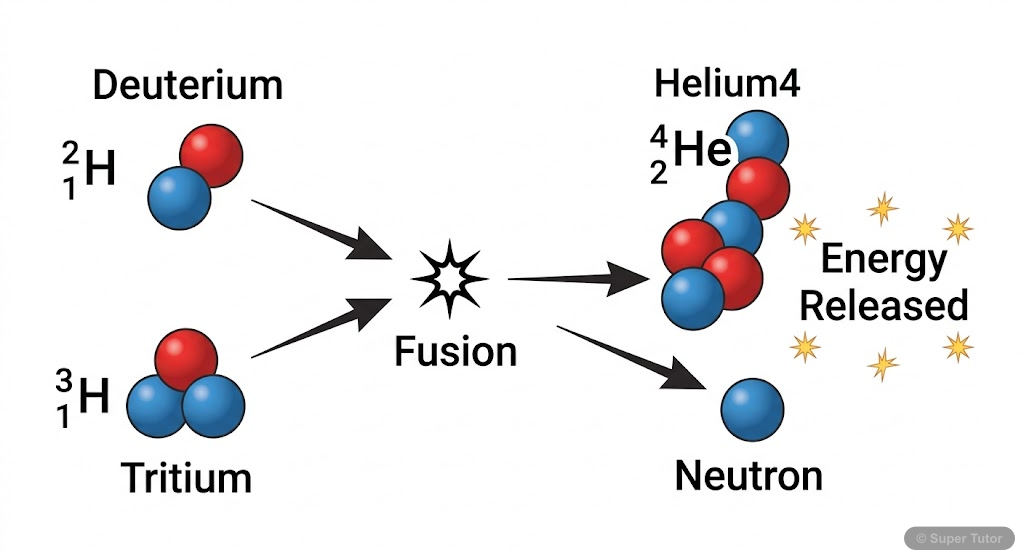
Learn better with visuals Super Tutor pairs illustrations like this with notes and quizzes for Nuclear Fission and Fusion.
Nuclear Fission and Fusion - Complete Chapter Overview
The map in words
- Nuclear Reactions
- Chemical vs Nuclear
- Chemical
- Valence electrons
- Energy in eV
- Mass conserved
- Nuclear
- Nuclei interact
- Energy in MeV
- Transmutation
- Chemical
- Conservation Laws
- Mass Number A
- Atomic Number Z
- Mass-Energy
- Momentum
- Nuclear Fission
- Discovery 1938
- Hahn and Strassmann
- Meitner and Frisch
- Mechanism
- Liquid Drop Model
- Neutron capture
- Coulomb vs Surface tension
- Products
- Two fragments
- 2 to 3 neutrons
- 200 MeV energy
- Fissile Materials
- U-235
- Pu-239
- U-233
- Th-233
- Discovery 1938
- Chain Reaction
- Sub-critical k less than 1
- Critical k equals 1
- Super-critical k more than 1
- Nuclear Reactor
- Fuel rods
- Moderator
- Control rods
- Coolant
- Reflector
- Pressure vessel
- Radiation shield
- Nuclear Fusion
- Light nuclei combine
- Heavier nucleus formed
- 24 MeV per reaction
- 6 MeV per nucleon
- Requires millions of K
- Thermonuclear reaction
- Deuterium fuel
- Energy in Stars
- Proton-proton chain
- 4H to He plus 26.8 MeV
- 20 million K at Sun core
- Gravitational confinement
- Hazards and Safety
- RBE factors
- Biological effects
- Safety measures
- Waste disposal
- Chemical vs Nuclear
Nuclear Fission and Fusion — Complete Chapter Mind Map
The map in words
- Nuclear Fission and Fusion
- Nuclear Reactions
- Conservation Laws
- Mass Number A
- Atomic Number Z
- Energy
- Chemical vs Nuclear
- Chemical involves electrons
- Nuclear involves nucleons
- MeV vs eV scale
- Conservation Laws
- Nuclear Fission
- Definition
- Heavy nucleus splits
- By slow neutron
- Releases 200 MeV
- Liquid Drop Model
- Bohr and Wheeler
- Neutron capture
- Deformation
- Dumbbell shape
- Fission occurs
- Fissile Materials
- U-235
- U-233
- Pu-239
- Chain Reaction
- Controlled
- Nuclear Reactor
- 1 neutron per fission
- Uncontrolled
- Atom Bomb
- Exponential growth
- Controlled
- Definition
- Nuclear Reactor
- Fuel Rods U-235
- Moderator
- Heavy water
- Graphite
- Control Rods
- Cadmium
- Boron
- Coolant
- Heavy water
- Shielding
- Thick concrete
- Heat Exchanger
- Produces steam
- Drives turbine
- Nuclear Fusion
- Definition
- Light nuclei combine
- Form heavier nucleus
- High temperature needed
- Condition
- 10 million K
- Overcome Coulomb barrier
- Solar Energy
- 4 protons to Helium-4
- Releases 26.8 MeV
- 2 positrons released
- Future Energy
- Deuterium from ocean
- Thermonuclear reactor
- Definition
- Hazards and Safety
- Radiation Hazards
- Cancer
- Genetic mutation
- 5 generations
- Safety Measures
- No nuclear tests
- Safe waste disposal
- Radiation shielding
- Radiation Hazards
- Nuclear Reactions
Nuclear Fission and Fusion — Complete Concept Map
The map in words
- Nuclear Energy
- Nuclear Fission
- Definition
- Heavy nucleus splits
- Two lighter fragments
- Condition
- Slow thermal neutrons
- Room temperature
- Energy Released
- 200 MeV per event
- 0.83 MeV per nucleon
- Fissile Materials
- U-235
- U-233
- Pu-239
- Th-233
- Chain Reaction
- Controlled in reactor
- Uncontrolled in bomb
- Liquid Drop Model
- Bohr and Wheeler
- Sphere to dumbbell shape
- Definition
- Nuclear Reactor
- Components
- Fuel rods
- Moderator
- Control rods
- Coolant
- Reflector
- Pressure vessel
- Shield
- Purpose
- Generate electricity
- Research reactor
- India Plants
- Tarapur
- Narora Kota Kaiga
- Kalpakkam Kakrapar
- Components
- Nuclear Fusion
- Definition
- Light nuclei combine
- Heavier nucleus formed
- Condition
- 10 to 20 million Kelvin
- Coulomb barrier overcome
- Energy Released
- 24 MeV per event
- 6 MeV per nucleon
- Source of Sun Energy
- 4 protons to Helium
- 26.8 MeV released
- Fuel
- Deuterium from seawater
- Definition
- Conservation Laws
- Mass number conserved
- Atomic number conserved
- Energy conserved
- Momentum conserved
- Nuclear Fission
Nuclear Reactions: Fission and Fusion
The map in words
- Nuclear Reactions: Fission and Fusion
- Chemical vs Nuclear Reactions
- Conservation Laws in Nuclear Reactions
- Nuclear Fission
- Nuclear Chain Reaction
- Nuclear Reactor
- Nuclear Fusion
- Energy in Stars
- Nuclear Energy Applications
Explore these maps interactively
Explore DiagramsFrequently Asked Questions
What are the important topics in Nuclear Fission and Fusion for NIOS Class 12 Physics?
What do the concept maps for Nuclear Fission and Fusion show?
How should I revise Nuclear Fission and Fusion for the NIOS Class 12 board exam?
Sources & Official References
Content is aligned to the official syllabus. Refer to the board website for the latest curriculum.
More resources for Nuclear Fission and Fusion
Practice Quiz
Test yourself with a quick quiz
Important Questions
Exam-style questions with answers
Revision Notes
Key points for last-minute revision
Formula Sheet
The chapter's formulas in one place
Chapter Summary
Understand the chapter at a glance
Study Plan
Step-by-step plan for this chapter
Flashcards
Quick-fire cards for active recall
Syllabus
What topics to cover
For serious students
Get the full Nuclear Fission and Fusion chapter — start free.
Quizzes, flashcards, an AI doubt solver and a study plan for NIOS Class 12 Physics. Free to start, no card needed.