Microbial Culture — Revision Notes
CBSE · Class 12 · Biotechnology
Microbial Culture revision notes for CBSE Class 12 Biotechnology: 4 topics in quick points. Part of the CBSE Class 12 Biotechnology syllabus.
Interactive on Super Tutor
Studying Microbial Culture? Get the full interactive chapter.
Quizzes, flashcards, AI doubt-solver and a step-by-step study plan — built for revision notes and more.
Free trial, no card needed.
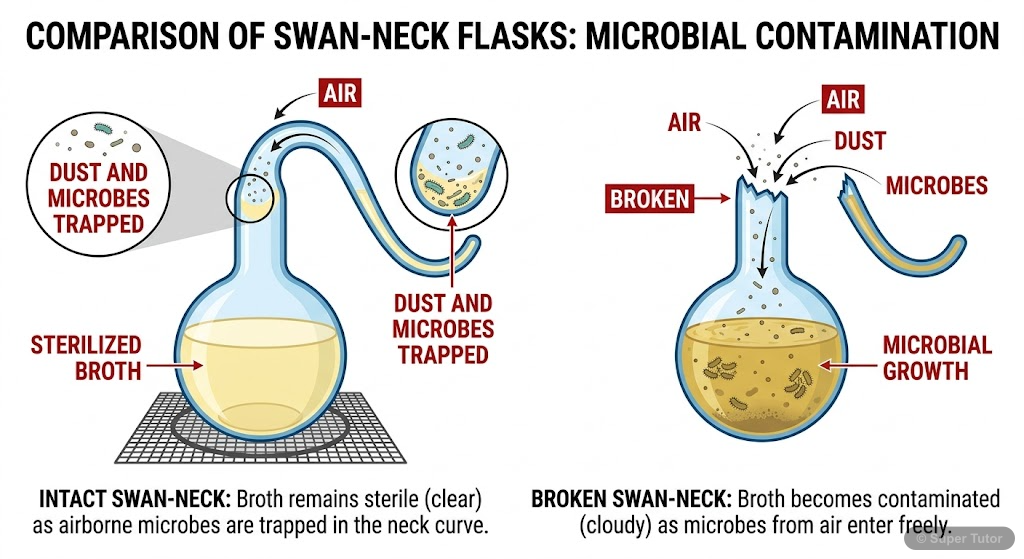
One of 14 illustrations for Microbial Culture in Super Tutor — alongside flashcards, concept maps and practice questions.
See them allKey Topics to Revise
Historical Perspective
- Antonie van Leeuwenhoek developed the microscope in the 1670s to 1680s and observed microscopic organisms, which he called animalcules.
- Lazzaro Spallanzani found no microscopic life in boiled broth, which challenged spontaneous generation.
- Louis Pasteur used swan-neck flask experiments and disproved spontaneous generation.
Nutritional Requirements and Types of Media
- Microorganisms need carbon, oxygen, hydrogen, nitrogen, sulfur, phosphorus, potassium, calcium, magnesium, iron, water, and growth factors for growth and multiplication.
- Carbon, oxygen, hydrogen, nitrogen, sulfur, phosphorus, potassium, calcium, magnesium, and iron are macronutrients and are needed in relatively large amounts.
- Heterotrophs obtain carbon from organic molecules.
Sterilisation Methods
- Sterilisation means removing or killing all living microorganisms, including bacterial spores.
- Sterilisation can be achieved by physical methods and chemical methods.
- Physical methods include heat, radiation, and filtration.
Pure Culture Techniques
- A pure culture consists of entirely one strain of organism.
- Pure culture is important for studying a specific microbe.
- Solid media are especially useful for isolating bacteria and for long-term storage.
Get complete notes with diagrams and examples
Full NotesKey Concepts
Frequently Asked Questions
What are the important topics in Microbial Culture for CBSE Class 12 Biotechnology?
How should I revise Microbial Culture for the CBSE Class 12 board exam?
Sources & Official References
- NCERT Official — ncert.nic.in
- CBSE Academic — cbseacademic.nic.in
- CBSE Official — cbse.gov.in
- National Education Policy 2020 — education.gov.in
Content is aligned to the official syllabus. Refer to the board website for the latest curriculum.
More resources for Microbial Culture
Practice Quiz
Test yourself with a quick quiz
Important Questions
Exam-style questions with answers
Chapter Summary
Understand the chapter at a glance
Concept Maps
See how topics connect
Study Plan
Step-by-step plan for this chapter
Flashcards
Quick-fire cards for active recall
Syllabus
What topics to cover
NCERT Solutions
Every textbook question solved step by step
For serious students
Get the full Microbial Culture chapter — start free.
Quizzes, flashcards, an AI doubt solver and a study plan for CBSE Class 12 Biotechnology. Free to start, no card needed.