Microbial Culture — NCERT Solutions
CBSE · Class 12 · Biotechnology
NCERT Solutions for Microbial Culture, CBSE Class 12 Biotechnology: 15 textbook questions solved step by step. Covers Exercises.
Interactive on Super Tutor
Studying Microbial Culture? Get the full interactive chapter.
Quizzes, flashcards, AI doubt-solver and a step-by-step study plan — built for NCERT solutions and more.
Free trial, no card needed.
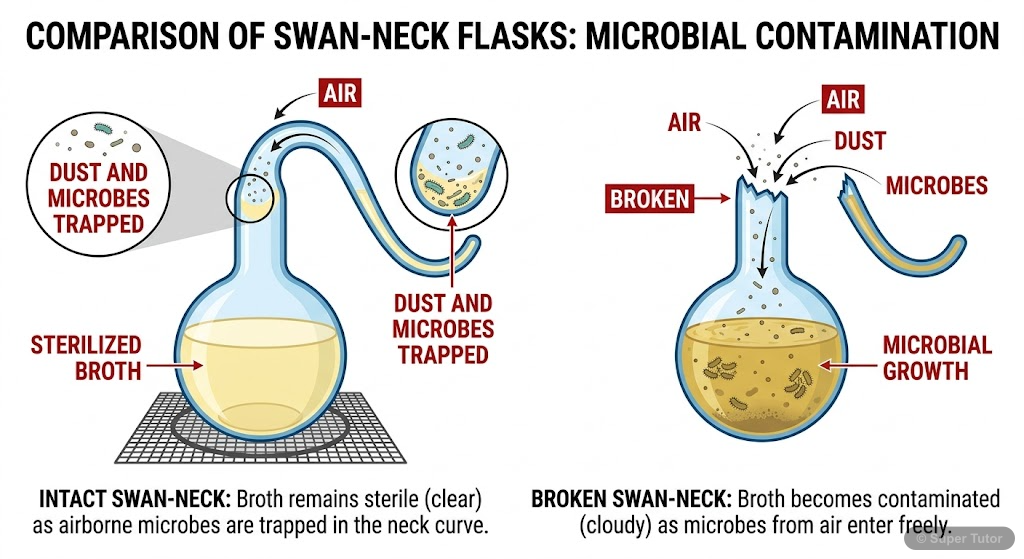
One of 14 illustrations for Microbial Culture in Super Tutor — alongside flashcards, concept maps and practice questions.
See them allThe first 8 solutions are open to read. The other 7 are free with a Super Tutor account. Unlock all 15 free in Super Tutor
Exercises
1Describe the nutritional requirements of microorganisms.Show solution
Microorganisms need nutrients for energy production, growth, and multiplication. The main requirements are:
- Macronutrients in large amounts: carbon, oxygen, hydrogen, nitrogen, sulfur, phosphorus, potassium, calcium, magnesium, and iron.
- Carbon, oxygen, hydrogen, nitrogen, sulfur and phosphorus are needed for the synthesis of carbohydrates, lipids, proteins, and nucleic acids.
- K, Ca, Mg, and Fe act in various roles, especially as enzyme cofactors.
- Micronutrients/trace elements in small amounts: Mn, Zn, Co, Mo, Ni, and Cu.
- Growth factors such as certain amino acids, purines, pyrimidines, and vitamins are needed when the organism cannot synthesise them.
- Water is essential as the base of the culture medium.
- Some media also include anti-foaming agents like olive oil, sunflower oil, and silicones, though these are not nutrients.
The exact nutritional requirement depends on the species and its natural habitat.
Not sure why a step works? check your working in Super Tutor
2What is culture media? Classify the culture media.Show solution
A culture medium is a material that contains all the nutrients, growth factors, energy source, and water needed to support the growth of microorganisms.
Culture media are classified as follows:
1. On the basis of chemical composition
- Synthetic or chemically defined media: all chemical components are known.
- Complex media: contain some constituents with unknown chemical composition.
2. On the basis of consistency
- Liquid media or broth
- Solid media
- Semi-solid agar media
3. On the basis of application and function
- Selective media
- Differential media
- Enrichment media
Not sure why a step works? check your working in Super Tutor
3Write an account of the growth curve analysis of a microorganism.Show solution
The growth curve of a microorganism is obtained by plotting the logarithm of the number of viable cells against incubation time. It shows four distinct phases:
1. Lag phase
- After inoculation into fresh medium, there is usually no immediate increase in cell number.
- Cells are adapting and synthesising components needed for division.
- The lag phase may be long if the inoculum comes from an old or refrigerated culture, and short or absent if it comes from a young, active culture.
2. Exponential or log phase
- Cells divide at the maximum rate.
- Population size increases exponentially.
- The growth rate is constant and the cells are most uniform chemically and physiologically.
- Generation time or doubling time is the time required for the population to double.
3. Stationary phase
- Growth becomes horizontal because cell division and cell death are balanced.
- The total number of viable cells remains approximately constant.
- A major cause is nutrient limitation.
4. Death or decline phase
- The number of viable cells decreases.
- This happens due to nutrient deprivation, accumulation of toxic wastes, and other unfavourable conditions.
Thus, the microbial growth curve helps to understand the pattern of population increase and decline under laboratory conditions.
Not sure why a step works? check your working in Super Tutor
4Discuss any two methods to isolate a pure culture.Show solution
Two methods to isolate a pure culture are:
1. Streak plate method
- An inoculating loop is used to streak a drop of bacterial suspension on a solid agar plate.
- The streaking makes the cells progressively more dilute.
- After incubation, isolated colonies appear near the end of the streak.
- Each colony arises from a single cell or clump of cells, so it can be used to obtain a pure culture.
2. Pour plate method
- The original sample is diluted several times.
- A small volume of the dilution is placed in a Petri plate.
- Melted agar is poured in and mixed gently.
- After incubation, the cells grow into separate colonies within the medium and on its surface.
- These colonies are then used to establish a pure culture.
These methods are used because a pure culture contains only one strain of microorganism.
Not sure why a step works? check your working in Super Tutor
5Define sterilisation, disinfection, and sanitisation.Show solution
- Sterilisation: the process by which all living microorganisms, including bacterial spores, are killed or removed.
- Disinfection: the process of destroying or removing harmful microorganisms on non-living surfaces by chemical or physical means; it does not necessarily kill all spores.
- Sanitisation: the process of reducing microbial load to a safe level by cleaning and treatment, usually on surfaces or equipment.
Not sure why a step works? check your working in Super Tutor
6Give a detailed account on the various methods of sterilisation.Show solution
Various methods of sterilisation are grouped into physical and chemical methods.
1. Sterilisation by heat
Heat is the most effective and rapid method for heat-resistant articles. It kills cells by denaturation, coagulation of proteins, oxidative action, and interference with metabolism.
(a) Boiling
- Performed at 100°C for 30 minutes in a boiling water bath.
- Used for syringes, rubber goods, and surgical instruments.
(b) Autoclaving
- Steam sterilisation under pressure.
- At 15 psi, the temperature reaches 121°C.
- Articles are exposed to steam in an airtight chamber.
- The holding time depends on the load and generally exceeds 30 minutes.
- Used widely in laboratories.
(c) Pasteurisation
- Used in food and dairy industry, especially milk.
- It kills pathogenic microorganisms but does not fully sterilise milk.
- Methods:
- LTLT (holder method): 63°C for 30 min
- HTST (flash method): 72°C for 15 sec
- UHT: 140–150°C for 1–3 sec
(d) Heating and flaming
- Used for dry sterilisation of objects like inoculation loops, straight wires, forceps tips, and spatulas.
- Glass tube mouths, flasks, and slides are passed through flame.
- Hot air oven is used for glassware.
2. Sterilisation by radiation
Radiation sterilisation is called cold sterilisation.
(a) Non-ionizing radiation
- UV rays are germicidal in the range 200–280 nm, most effective at 260 nm.
- They cause thymine-thymine dimers, blocking DNA replication.
- Used for surface disinfection.
(b) Ionizing radiation
- Types: electron beams and gamma rays.
- They damage nucleic acids.
- Used for syringes, gloves, dressing packs, foods, pharmaceuticals, Petri dishes, plastic syringes, antibiotics, vitamins, hormones, glassware, and fabrics.
3. Sterilisation by filtration
- Used for heat-labile solutions such as serum, antibiotics, sugars, and urea.
- Membrane filters with pore size 0.2–0.45 µm remove microbes.
- HEPA filters are used for air filtration and are 99.97% efficient for particles >0.3 µm.
4. Sterilisation by chemicals
- Chemicals used include alcohols, aldehydes, heavy metals, and hydrogen peroxide.
- 70% ethyl alcohol: antiseptic for skin.
- Isopropyl alcohol: disinfects surfaces and clinical thermometers.
- 40% formaldehyde: surface disinfection and fumigation.
- Heavy metals like mercury, silver, arsenic, zinc, and copper act as germicides by protein precipitation.
- Hydrogen peroxide: used for wound disinfection.
Thus, sterilisation can be achieved by heat, radiation, filtration, or chemicals depending on the material to be treated.
Not sure why a step works? check your working in Super Tutor
7Bacterial strains that do not require any organic supplement are called:- (a) Auxotroph
- (b) Prototroph
- (c) Heterotroph
- (d) Chemotroph
Show solution
- (a) Auxotroph
- (b) Prototroph
- (c) Heterotroph
- (d) Chemotroph
Bacterial strains that do not require any organic supplement are called prototrophs. They can grow on a minimal medium without added growth factors. So the correct option is (b) Prototroph.
Not sure why a step works? check your working in Super Tutor
8Who was the first to develop the process of colony purification on solid media?- (a) Louis Pasteur
- (b) Robert Koch
- (c) Fannie Hesse
- (d) Richard Petri
Show solution
- (a) Louis Pasteur
- (b) Robert Koch
- (c) Fannie Hesse
- (d) Richard Petri
The chapter states that Robert Koch recognised the difficulties of broth media for isolation of pure cultures and developed the use of solid media for colony purification. So the correct answer is Robert Koch.
Not sure why a step works? check your working in Super Tutor
- (a) Pasteurisation
- (b) Isolation of pure culture
- (c) Staining of bacteria
- (d) Culture of bacteria
Free with a Super Tutor account
- (a) Francesco Redi
- (b) Lazzaro Spallanzani
- (c) Robert Koch
- (d) Louis Pasteur
Free with a Super Tutor account
- (a) Francesco Redi
- (b) Lazzaro Spallanzani
- (c) Robert Koch
- (d) Louis Pasteur
Free with a Super Tutor account
(Ans: μ = 1.72 hrs⁻¹, t_d = 0.4 h or 24 min)
Free with a Super Tutor account
Reason: Alcohol concentration of around 13% is toxic for yeast cells.
- (a) Both assertion and reason are true and the reason is correct explanation of the assertion.
- (b) Both assertion and reason are true but reason is not the correct explanation of the assertion.
- (c) Assertion is true but reason is false.
- (d) Both assertion and reason are false.
Free with a Super Tutor account
Reason: To inhibit the growth of amp microbe ampicillin should not have been autoclaved but sterilised by using micro-filters before adding to the medium.
- (a) Both assertion and reason are true and reason is correct explanation of the assertion.
- (b) Both assertion and reason are true but reason is not the correct explanation of the assertion.
- (c) Assertion is true but reason is false.
- (d) Both assertion and reason are false.
Free with a Super Tutor account
Reason: Extreme thermophiles can tolerate temperatures of above 100°C.
(a) Both assertion and reason are true and reason is the correct explanation of the assertion.
(b) Both assertion and reason are true but reason is not the correct explanation of the assertion.
(c) Assertion is true but reason is false.
(d) Both assertion and reason are false.
- (a) Both assertion and reason are true and reason is the correct explanation of the assertion.
- (b) Both assertion and reason are true but reason is not the correct explanation of the assertion.
- (c) Assertion is true but reason is false.
- (d) Both assertion and reason are false.
Free with a Super Tutor account
7 more solved questions in Microbial Culture
They are free with a Super Tutor account, along with practice quizzes and flashcards for this chapter. Free to start, no card needed.
Frequently Asked Questions
What are the important topics in Microbial Culture for CBSE Class 12 Biotechnology?
Are these NCERT Solutions for Microbial Culture free?
How should I revise Microbial Culture for the CBSE Class 12 board exam?
Sources & Official References
- NCERT Official — ncert.nic.in
- CBSE Academic — cbseacademic.nic.in
- CBSE Official — cbse.gov.in
- National Education Policy 2020 — education.gov.in
Content is aligned to the official syllabus. Refer to the board website for the latest curriculum.
More resources for Microbial Culture
Practice Quiz
Test yourself with a quick quiz
Important Questions
Exam-style questions with answers
Revision Notes
Key points for last-minute revision
Chapter Summary
Understand the chapter at a glance
Concept Maps
See how topics connect
Study Plan
Step-by-step plan for this chapter
Flashcards
Quick-fire cards for active recall
Syllabus
What topics to cover
For serious students
Get the full Microbial Culture chapter — start free.
Quizzes, flashcards, an AI doubt solver and a study plan for CBSE Class 12 Biotechnology. Free to start, no card needed.