Microbial Culture — Syllabus
CBSE · Class 12 · Biotechnology
What Microbial Culture covers in CBSE Class 12 Biotechnology: 4 topics, for the 2026-27 session. Part of the CBSE Class 12 Biotechnology syllabus.
Interactive on Super Tutor
Studying Microbial Culture? Get the full interactive chapter.
Quizzes, flashcards, AI doubt-solver and a step-by-step study plan — built for syllabus and more.
Free trial, no card needed.
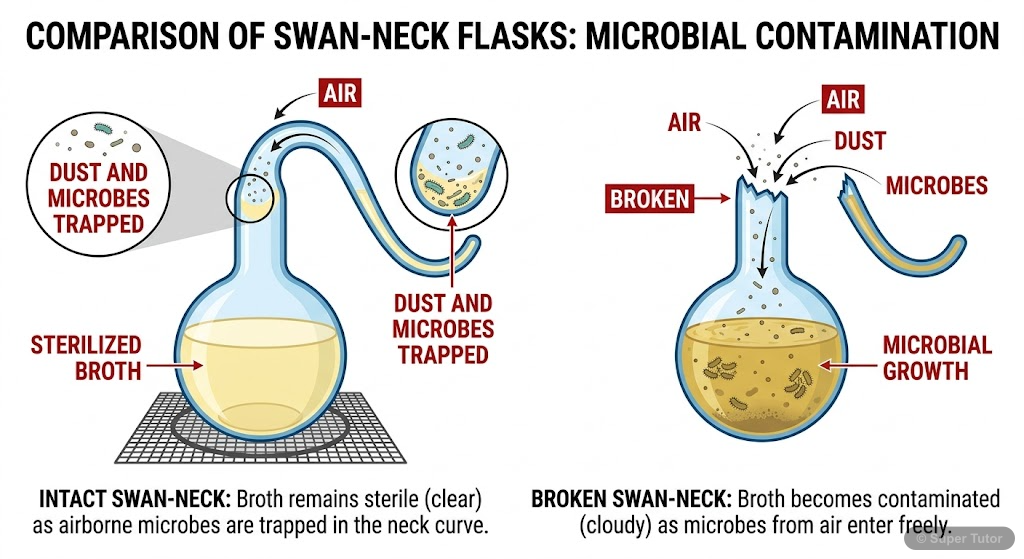
One of 14 illustrations for Microbial Culture in Super Tutor — alongside flashcards, concept maps and practice questions.
See them allTopics in Microbial Culture
Historical Perspective
- Antonie van Leeuwenhoek developed the microscope in the 1670s to 1680s and observed microscopic organisms, which he called animalcules.
- Lazzaro Spallanzani found no microscopic life in boiled broth, which challenged spontaneous generation.
- Louis Pasteur used swan-neck flask experiments and disproved spontaneous generation.
Nutritional Requirements and Types of Media
- Microorganisms need carbon, oxygen, hydrogen, nitrogen, sulfur, phosphorus, potassium, calcium, magnesium, iron, water, and growth factors for growth and multiplication.
- Carbon, oxygen, hydrogen, nitrogen, sulfur, phosphorus, potassium, calcium, magnesium, and iron are macronutrients and are needed in relatively large amounts.
- Heterotrophs obtain carbon from organic molecules.
Sterilisation Methods
- Sterilisation means removing or killing all living microorganisms, including bacterial spores.
- Sterilisation can be achieved by physical methods and chemical methods.
- Physical methods include heat, radiation, and filtration.
Pure Culture Techniques
- A pure culture consists of entirely one strain of organism.
- Pure culture is important for studying a specific microbe.
- Solid media are especially useful for isolating bacteria and for long-term storage.
Key Concepts
Central concept: Microbial culture as the study of microbial nutrition, media, sterilisation, pure culture techniques, growth factors, and growth curve analysis
Work through every topic in Microbial Culture with notes and quizzes
Start This ChapterFrequently Asked Questions
What are the important topics in Microbial Culture for CBSE Class 12 Biotechnology?
How should I revise Microbial Culture for the CBSE Class 12 board exam?
Sources & Official References
- NCERT Official — ncert.nic.in
- CBSE Academic — cbseacademic.nic.in
- CBSE Official — cbse.gov.in
- National Education Policy 2020 — education.gov.in
Content is aligned to the official syllabus. Refer to the board website for the latest curriculum.
More resources for Microbial Culture
Practice Quiz
Test yourself with a quick quiz
Important Questions
Exam-style questions with answers
Revision Notes
Key points for last-minute revision
Chapter Summary
Understand the chapter at a glance
Concept Maps
See how topics connect
Study Plan
Step-by-step plan for this chapter
Flashcards
Quick-fire cards for active recall
NCERT Solutions
Every textbook question solved step by step
For serious students
Get the full Microbial Culture chapter — start free.
Quizzes, flashcards, an AI doubt solver and a study plan for CBSE Class 12 Biotechnology. Free to start, no card needed.