Transpiration — Flashcards
ICSE · Class 10 · Biology
40 flashcards for Transpiration (ICSE Class 10 Biology) to test yourself on key terms and facts. Sample: "What is transpiration?"
Interactive on Super Tutor
Studying Transpiration? Get the full interactive chapter.
Quizzes, flashcards, AI doubt-solver and a step-by-step study plan — built for flashcards and more.
Free trial, no card needed.
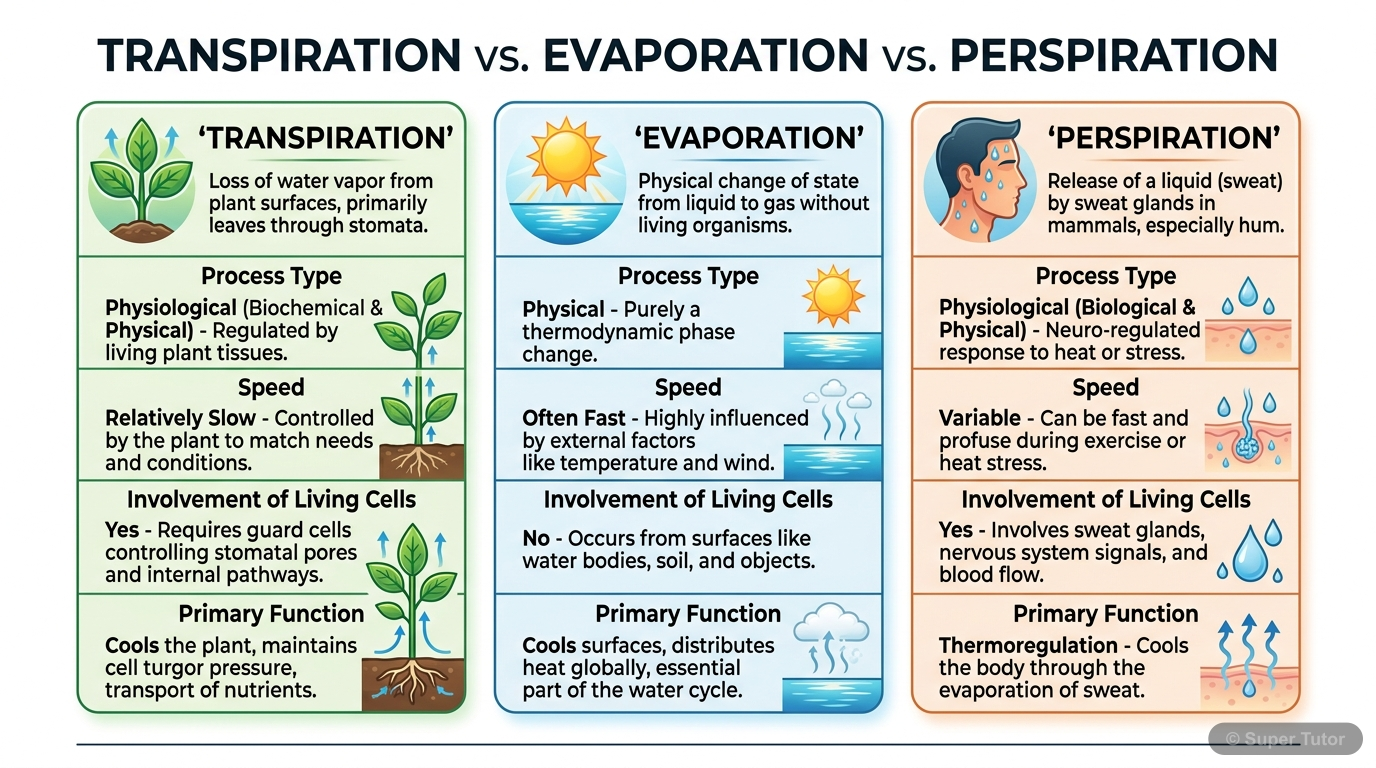
Learn better with visuals Super Tutor pairs illustrations like this with notes and quizzes for Transpiration.
Get startedWhat is transpiration?
Answer
Transpiration is the loss of water vapours from aerial parts of a plant. It happens mainly through leaves, but also through stems, buds, and flowers. It is a physiological process carried out by livin…
Why do leaves participate most actively in transpiration?
Answer
Leaves participate most actively in transpiration because they have many stomata, large surface area, and mesophyll cells with air spaces that allow water vapour to move out easily.
How is transpiration different from evaporation?
Answer
Evaporation is a physical process in which water from water bodies changes into vapour. Transpiration is a physiological process in which water from a plant diffuses out as vapour through aerial parts…
How is transpiration different from perspiration?
Answer
Transpiration occurs from plant parts and helps in the distribution of water and minerals. Perspiration occurs from the skin of mammals and causes a cooling effect. Transpiration is a physiological pr…
What is stomatal transpiration?
Answer
Stomatal transpiration is the transpiration that occurs through stomata. Stomata are minute pores found in the epidermis of leaves and herbaceous stems, and they are more numerous on leaves.
What is the stomatal apparatus?
Answer
The stomatal aperture, guard cells, and subsidiary cells together constitute the stomatal apparatus. This structure controls the opening and closing of the stoma and helps regulate transpiration.
What are guard cells?
Answer
Guard cells are two bean-shaped or kidney-shaped specialized epidermal cells surrounding each stoma. They contain chloroplasts, can carry out photosynthesis, and control the opening and closing of the…
How does a stoma open?
Answer
During daytime, guard cells carry out photosynthesis and produce sugars. This increases their osmotic pressure, so water enters by endosmosis and the guard cells become turgid. The outer wall is pushe…
+32 more flashcards
Practise AllFrequently Asked Questions
What are the important topics in Transpiration for ICSE Class 10 Biology?
How many flashcards are available for Transpiration?
How should I revise Transpiration for the ICSE Class 10 board exam?
Sources & Official References
Content is aligned to the official syllabus. Refer to the board website for the latest curriculum.
More resources for Transpiration
Practice Quiz
Test yourself with a quick quiz
Important Questions
Exam-style questions with answers
Revision Notes
Key points for last-minute revision
Chapter Summary
Understand the chapter at a glance
Concept Maps
See how topics connect
Study Plan
Step-by-step plan for this chapter
Syllabus
What topics to cover
For serious students
Get the full Transpiration chapter — start free.
Quizzes, flashcards, an AI doubt solver and a study plan for ICSE Class 10 Biology. Free to start, no card needed.