Cell Division
ICSE · Class 10 · Biology
Flashcards for Cell Division — ICSE Class 10 Biology. Quick Q&A cards covering key concepts, definitions, and formulas.
Interactive on Super Tutor
Studying Cell Division? Get the full interactive chapter.
Quizzes, flashcards, AI doubt-solver and a step-by-step study plan — built for flashcards and more.
1,000+ Class 10 students started this chapter today
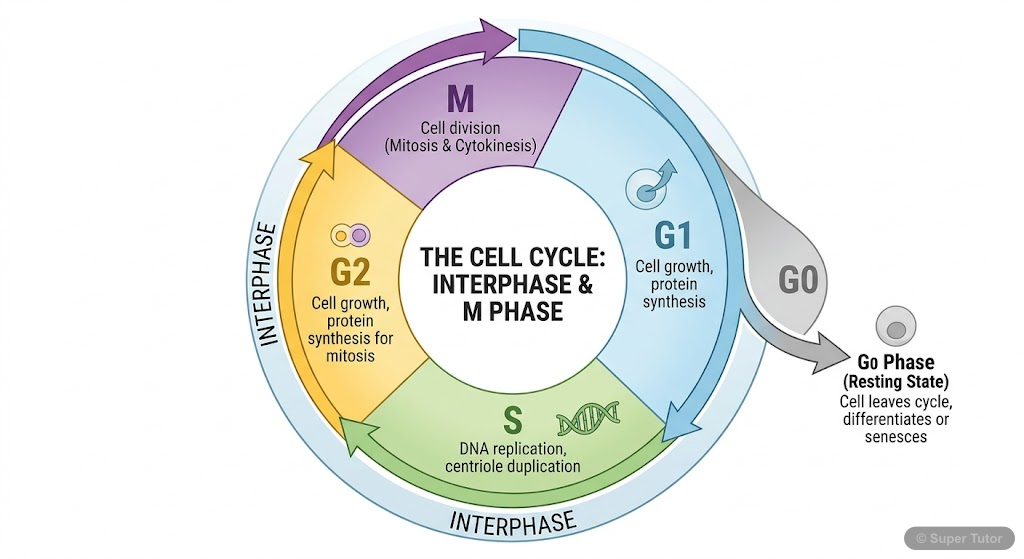
Super Tutor has 6+ illustrations like this for Cell Division alone — flashcards, concept maps, and step-by-step visuals.
See them allWhy is cell division necessary in living organisms?
Answer
Cell division is necessary because growth increases cell size and disturbs the normal ratio between cytoplasm and nucleus, as well as the surface area to volume ratio. Division restores balance, helps…
What is the cell cycle?
Answer
The cell cycle is the period from the end of one division of a cell to the end of the next division. It includes interphase and the division phase.
What are the main phases of the cell cycle?
Answer
The cell cycle is divided into two main phases: interphase and division phase or M-phase. Interphase is the growth period, while M-phase is the division phase.
What happens in G1 phase?
Answer
G1 is the first phase of interphase. RNA and protein are synthesized, chromosomes remain uncoiled and thin, and this phase makes up about 30-40% of the cell cycle.
What happens in S phase?
Answer
S is the second phase of interphase. DNA is replicated, histone proteins are synthesized, and each chromosome becomes made of two chromatids. This phase forms about 30-50% of the cell cycle.
What happens in G2 phase?
Answer
G2 is the third phase of interphase. RNA and protein are synthesized, organelles are duplicated, and spindle proteins are made. This phase forms about 10-20% of the cell cycle.
Why is interphase called the growth period?
Answer
Interphase is called the growth period because the cell prepares for division by synthesizing RNA, proteins, DNA, organelles, and spindle-related materials. It is the stage between two successive divi…
What is karyokinesis?
Answer
Karyokinesis is the division of the nucleus. It includes all the changes that result in nuclear division and occurs in four phases: prophase, metaphase, anaphase, and telophase.
+28 more flashcards available
Practice AllFrequently Asked Questions
What are the important topics in Cell Division for ICSE Class 10 Biology?
How to score full marks in Cell Division — ICSE Class 10 Biology?
How many flashcards are available for Cell Division?
Sources & Official References
Content is aligned to the official syllabus. Refer to the board website for the latest curriculum.
More resources for Cell Division
Practice Quiz
Test yourself with a quick quiz
Important Questions
Practice with board exam-style questions
Revision Notes
Key points for last-minute revision
Formula Sheet
All formulas in one place
Chapter Summary
Understand the chapter at a glance
Concept Maps
See how topics connect visually
Study Plan
Step-by-step plan to ace this chapter
Syllabus
What topics to cover
NCERT Solutions
Every textbook question solved step by step
For serious students
Get the full Cell Division chapter — for free.
Quizzes, flashcards, AI doubt-solver and a step-by-step study plan for ICSE Class 10 Biology.