Organic Chemistry I — Chapter Summary
ICSE · Class 10 · Chemistry
Summary of Organic Chemistry I for ICSE Class 10 Chemistry. Part of the ICSE Class 10 Chemistry syllabus. Organic chemistry is the branch of chemistry.
Interactive on Super Tutor
Studying Organic Chemistry I? Get the full interactive chapter.
Quizzes, flashcards, AI doubt-solver and a step-by-step study plan — built for chapter summary and more.
Free trial, no card needed.
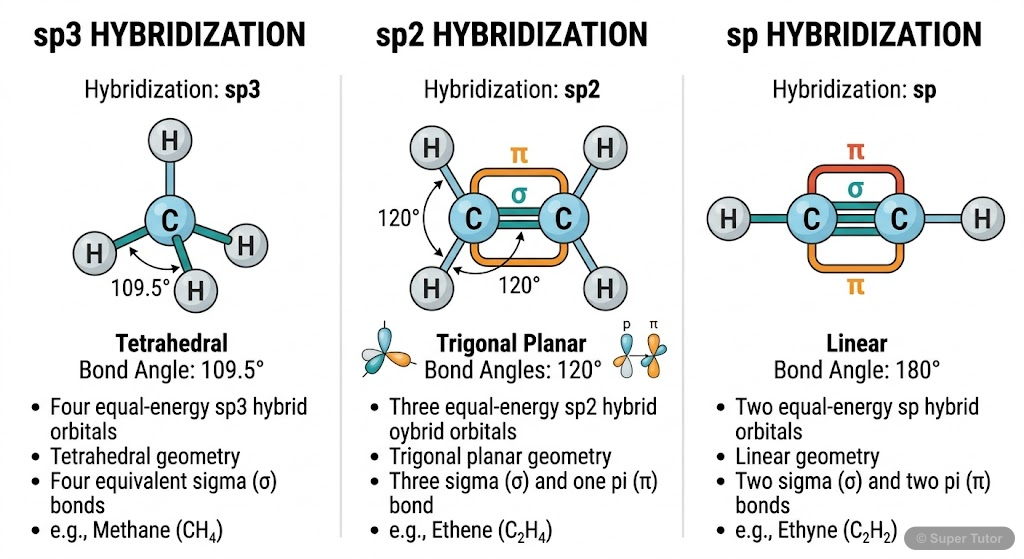
One of 12 illustrations for Organic Chemistry I in Super Tutor — alongside flashcards, concept maps and practice questions.
See them allOverview
Organic chemistry is the branch of chemistry that deals with hydrocarbons and the compounds that can be seen as their derivatives. Carbon forms an exceptionally large number of compounds because of tetravalency, catenation, and the ability to form single, double, and triple bonds. Organic compounds
Key Concepts
Early organic compounds were first isolated
Early organic compounds were first isolated from natural sources such as grapes, lemons, human urine, and opium. Berzelius named these substances orga
Carbon has atomic number 6
Carbon has atomic number 6 and four electrons in its valence shell. It forms four covalent bonds to complete its octet. Carbon also shows catenation,
Organic compounds may be open chain
Organic compounds may be open chain or cyclic. Open chain compounds are also called aliphatic compounds. Cyclic compounds include alicyclic compounds
Hydrocarbons are compounds made only
Hydrocarbons are compounds made only of carbon and hydrogen. Saturated hydrocarbons contain only single C-C bonds and are called alkanes. Unsaturated
Alkanes follow the general formula C_nH_{2n+2}
Alkanes follow the general formula C_nH_{2n+2}. Alkenes follow C_nH_{2n}. Alkynes follow C_nH_{2n-2}.
Learning Objectives
- Understand the meaning of organic chemistry and organic compounds
- Explain why carbon forms such a large number of compounds
- Distinguish between saturated and unsaturated hydrocarbons
- Classify organic compounds into straight chain, branched chain, cyclic, alicyclic, aromatic, and heterocyclic types
- Understand functional groups and homologous series
Frequently Asked Questions
What are the important topics in Organic Chemistry I for ICSE Class 10 Chemistry?
How should I revise Organic Chemistry I for the ICSE Class 10 board exam?
Sources & Official References
Content is aligned to the official syllabus. Refer to the board website for the latest curriculum.
More resources for Organic Chemistry I
Practice Quiz
Test yourself with a quick quiz
Important Questions
Exam-style questions with answers
Revision Notes
Key points for last-minute revision
Formula Sheet
The chapter's formulas in one place
Concept Maps
See how topics connect
Study Plan
Step-by-step plan for this chapter
Flashcards
Quick-fire cards for active recall
Syllabus
What topics to cover
For serious students
Get the full Organic Chemistry I chapter — start free.
Quizzes, flashcards, an AI doubt solver and a study plan for ICSE Class 10 Chemistry. Free to start, no card needed.