Organic Chemistry I — Flashcards
ICSE · Class 10 · Chemistry
39 flashcards for Organic Chemistry I (ICSE Class 10 Chemistry) to test yourself on key terms and facts. Sample: "Why does carbon form such a large number"
Interactive on Super Tutor
Studying Organic Chemistry I? Get the full interactive chapter.
Quizzes, flashcards, AI doubt-solver and a step-by-step study plan — built for flashcards and more.
Free trial, no card needed.
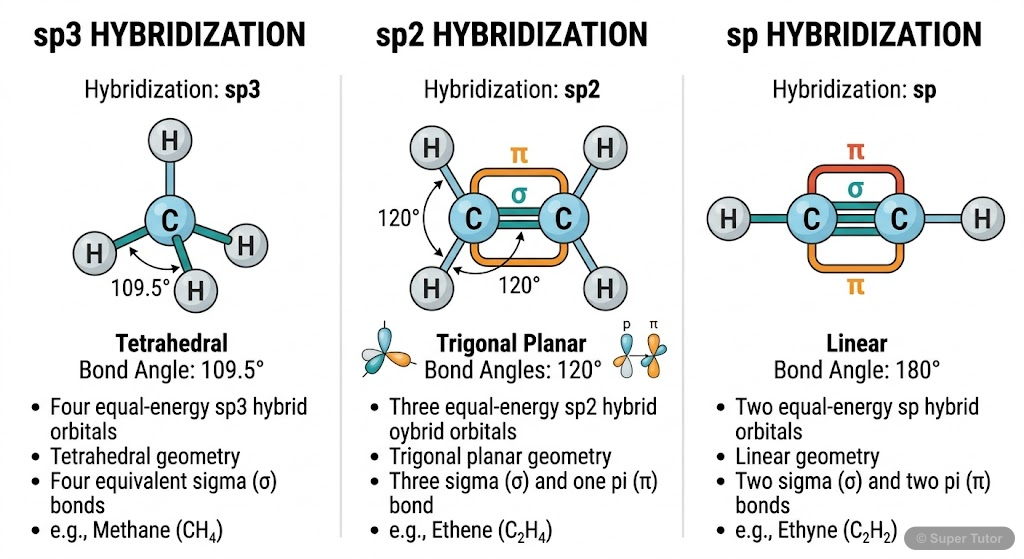
One of 12 illustrations for Organic Chemistry I in Super Tutor — alongside flashcards, concept maps and practice questions.
See them allWhy does carbon form such a large number of compounds?
Answer
Carbon has atomic number 6 and four electrons in its valence shell. It forms four covalent bonds to complete its octet. Carbon also shows catenation, can form single, double, and triple bonds, and sho…
What is catenation?
Answer
Catenation is the property of atoms of an element to link with one another by stable covalent bonds to form straight chains, branched chains, or rings. Carbon shows this property to the maximum extent…
What is tetravalency of carbon?
Answer
Carbon has four electrons in its valence shell and forms four covalent bonds to achieve a stable octet. This is called tetravalency. Example: methane, CH4, has four single covalent bonds around carbon…
What is the modern definition of organic chemistry?
Answer
Organic chemistry is the branch of chemistry dealing with the study of hydrocarbons and the compounds which could be thought of as the derivatives of hydrocarbons.
Are all carbon compounds organic?
Answer
No. Carbon compounds such as CO, CO2, COCl2, and SiC are of different nature and are not regarded as organic compounds.
What are hydrocarbons?
Answer
Hydrocarbons are organic compounds made up of carbon and hydrogen atoms only. They are considered the parent compounds of many other organic compounds.
Classify hydrocarbons based on bonding.
Answer
Saturated hydrocarbons contain only single bonds and include alkanes. Unsaturated hydrocarbons contain double bonds or triple bonds and include alkenes and alkynes.
What is the general formula of alkanes?
Answer
General formula of alkanes: C_nH_{2n+2} [n = number of carbon atoms (integer 1,2,3,...)]…
+31 more flashcards
Practise AllFrequently Asked Questions
What are the important topics in Organic Chemistry I for ICSE Class 10 Chemistry?
How many flashcards are available for Organic Chemistry I?
How should I revise Organic Chemistry I for the ICSE Class 10 board exam?
Sources & Official References
Content is aligned to the official syllabus. Refer to the board website for the latest curriculum.
More resources for Organic Chemistry I
Practice Quiz
Test yourself with a quick quiz
Important Questions
Exam-style questions with answers
Revision Notes
Key points for last-minute revision
Formula Sheet
The chapter's formulas in one place
Chapter Summary
Understand the chapter at a glance
Concept Maps
See how topics connect
Study Plan
Step-by-step plan for this chapter
Syllabus
What topics to cover
For serious students
Get the full Organic Chemistry I chapter — start free.
Quizzes, flashcards, an AI doubt solver and a study plan for ICSE Class 10 Chemistry. Free to start, no card needed.