Organic Chemistry II — Chapter Summary
ICSE · Class 10 · Chemistry
Summary of Organic Chemistry II for ICSE Class 10 Chemistry. Key concepts: Alkanes are saturated, Methane is a colourless and Methane and ethane undergo.
Interactive on Super Tutor
Studying Organic Chemistry II? Get the full interactive chapter.
Quizzes, flashcards, AI doubt-solver and a step-by-step study plan — built for chapter summary and more.
Free trial, no card needed.
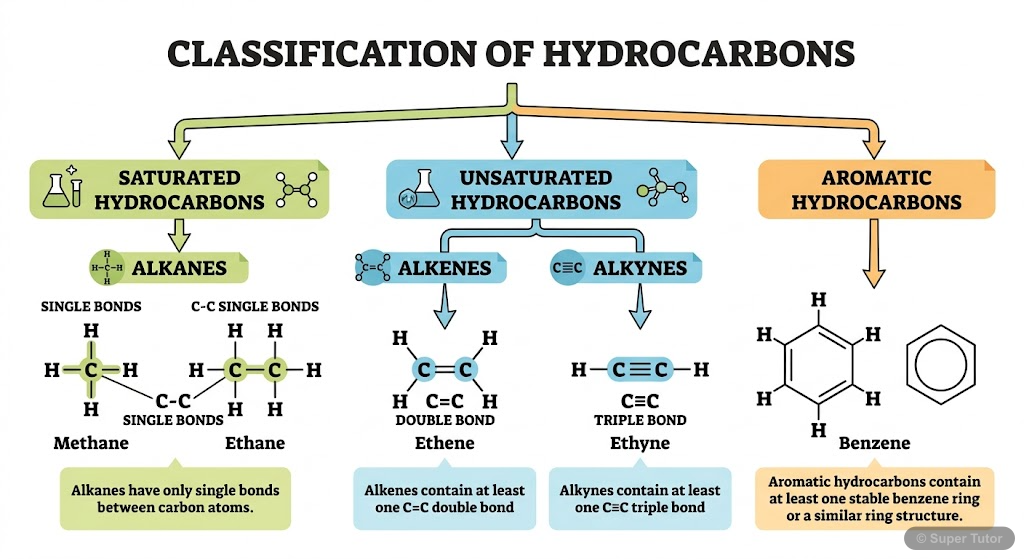
One of 24 illustrations for Organic Chemistry II in Super Tutor — alongside flashcards, concept maps and practice questions.
See them allOverview
Organic compounds containing only carbon and hydrogen are called hydrocarbons. The main families covered are alkanes, alkenes and alkynes. Alkanes are saturated hydrocarbons with only single bonds, alkenes contain a carbon-carbon double bond, and alkynes contain a carbon-carbon triple bond. Alcohols
Key Concepts
Alkanes are saturated hydrocarbons and
Alkanes are saturated hydrocarbons and are also referred to as paraffins. Their general formula is C_nH_{2n+2}. They contain only single covalent bond
Methane is a colourless
Methane is a colourless, odourless and tasteless gas. Natural gas contains about 85% methane, and its density at STP is 0.71 g/L. It has tetrahedral s
Methane and ethane undergo substitution reactions
Methane and ethane undergo substitution reactions where hydrogen atoms are replaced by halogen atoms. Methane reacts slowly with iodine and the reacti
Alkenes are unsaturated hydrocarbons containing one
Alkenes are unsaturated hydrocarbons containing one or more carbon-carbon double bonds. Their general formula for one double bond is C_nH_{2n}. Ethyle
Ethene undergoes addition reactions because
Ethene undergoes addition reactions because the double bond can break and allow new atoms to attach. It adds hydrogen to form ethane, halogens to form
Learning Objectives
- Identify alkanes, alkenes, alkynes, alcohols and carboxylic acids by their functional groups and general formulas.
- Explain the special properties of methane, ethane, ethene, ethyne, methanol, ethanol and acetic acid.
- Write balanced equations for important preparations, combustion, addition, substitution, oxidation, esterification and fermentation reactions.
- Understand why unsaturated compounds undergo addition reactions more easily than saturated compounds.
- Relate laboratory preparations to industrial and daily-life uses of common organic compounds.
Frequently Asked Questions
What are the important topics in Organic Chemistry II for ICSE Class 10 Chemistry?
How should I revise Organic Chemistry II for the ICSE Class 10 board exam?
Sources & Official References
Content is aligned to the official syllabus. Refer to the board website for the latest curriculum.
More resources for Organic Chemistry II
Practice Quiz
Test yourself with a quick quiz
Important Questions
Exam-style questions with answers
Revision Notes
Key points for last-minute revision
Formula Sheet
The chapter's formulas in one place
Concept Maps
See how topics connect
Study Plan
Step-by-step plan for this chapter
Flashcards
Quick-fire cards for active recall
Syllabus
What topics to cover
For serious students
Get the full Organic Chemistry II chapter — start free.
Quizzes, flashcards, an AI doubt solver and a study plan for ICSE Class 10 Chemistry. Free to start, no card needed.