Organic Chemistry II — Flashcards
ICSE · Class 10 · Chemistry
44 flashcards for Organic Chemistry II (ICSE Class 10 Chemistry) to test yourself on key terms and facts. Sample: "What are alkanes?"
Interactive on Super Tutor
Studying Organic Chemistry II? Get the full interactive chapter.
Quizzes, flashcards, AI doubt-solver and a step-by-step study plan — built for flashcards and more.
Free trial, no card needed.
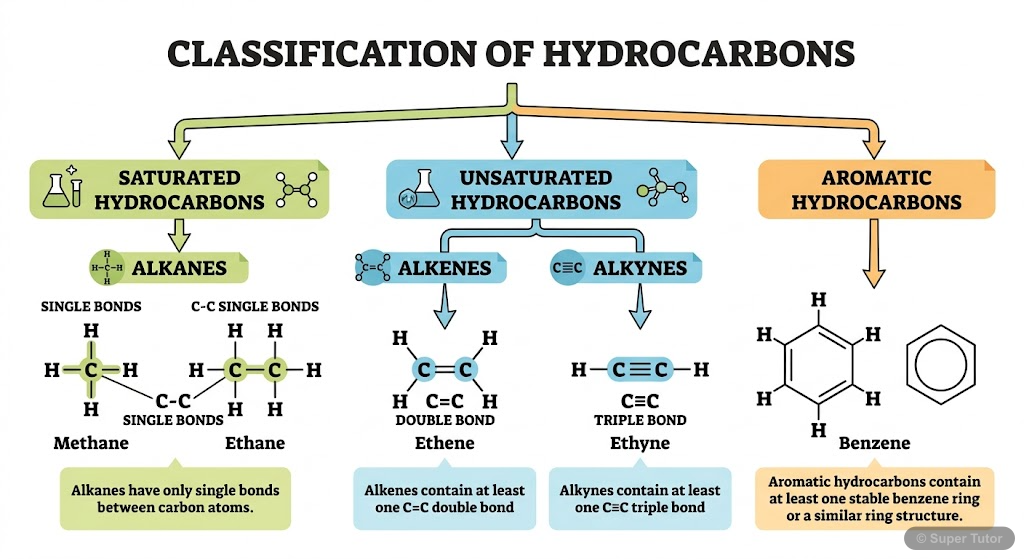
One of 24 illustrations for Organic Chemistry II in Super Tutor — alongside flashcards, concept maps and practice questions.
See them allWhat are alkanes?
Answer
Alkanes are saturated hydrocarbons and are also referred to as paraffins. General formula: C_nH_{2n+2} [n = number of carbon atoms]. Example: methane (CH4), ethane (C2H6).
Why are alkanes called saturated hydrocarbons?
Answer
Alkanes contain only single covalent bonds between carbon atoms and hydrogen atoms. Because of this, they contain the maximum possible number of hydrogen atoms and are called saturated hydrocarbons.
Write the laboratory preparation of methane from sodium ethanoate.
Answer
Balanced equation: CH3COONa + NaOH --(CaO, heat)--> CH4 + Na2CO3 This is decarboxylation. Soda lime helps remove carbon dioxide from the sodium salt and gives methane.
Write the combustion equation of methane.
Answer
Balanced equation: CH4 + 2O2(excess) -> CO2 + 2H2O + 890.4 kJ mol^-1 This is an exothermic reaction. Methane burns in air to form carbon dioxide and water.
What is the shape of methane molecule?
Answer
Methane has a tetrahedral shape. Each H-C-H bond angle is 109°28' (approx 109.5°). The carbon atom lies at the centre and the four hydrogen atoms are at the corners of a tetrahedron.
Why is methane called marsh gas and fire damp?
Answer
Methane is called marsh gas because it is formed by bacterial decomposition of dead vegetable matter in marshy places. Coal miners call it fire damp because it forms an explosive mixture with air.
How is methane prepared from methyl iodide?
Answer
Balanced equation: CH3I + 2[H] -> CH4 + HI This reduction is carried out with zinc-copper couple and ethyl alcohol.
What happens when methane reacts with chlorine in excess methane?
Answer
Balanced equation: CH4 + Cl2 --(diffused sunlight)--> CH3Cl + HCl When excess methane is used, the main product is methyl chloride. This is a substitution reaction.
+36 more flashcards
Practise AllFrequently Asked Questions
What are the important topics in Organic Chemistry II for ICSE Class 10 Chemistry?
How many flashcards are available for Organic Chemistry II?
How should I revise Organic Chemistry II for the ICSE Class 10 board exam?
Sources & Official References
Content is aligned to the official syllabus. Refer to the board website for the latest curriculum.
More resources for Organic Chemistry II
Practice Quiz
Test yourself with a quick quiz
Important Questions
Exam-style questions with answers
Revision Notes
Key points for last-minute revision
Formula Sheet
The chapter's formulas in one place
Chapter Summary
Understand the chapter at a glance
Concept Maps
See how topics connect
Study Plan
Step-by-step plan for this chapter
Syllabus
What topics to cover
For serious students
Get the full Organic Chemistry II chapter — start free.
Quizzes, flashcards, an AI doubt solver and a study plan for ICSE Class 10 Chemistry. Free to start, no card needed.