The National Movement (During the First World War)
ICSE · Class 10 · History & Civics
Most important questions from The National Movement (During the First World War) for ICSE Class 10 History & Civics board exam 2026. MCQs, short answer, and long answer questions with marks.
Interactive on Super Tutor
Studying The National Movement (During the First World War)? Get the full interactive chapter.
Quizzes, flashcards, AI doubt-solver and a step-by-step study plan — built for important questions and more.
1,000+ Class 10 students started this chapter today
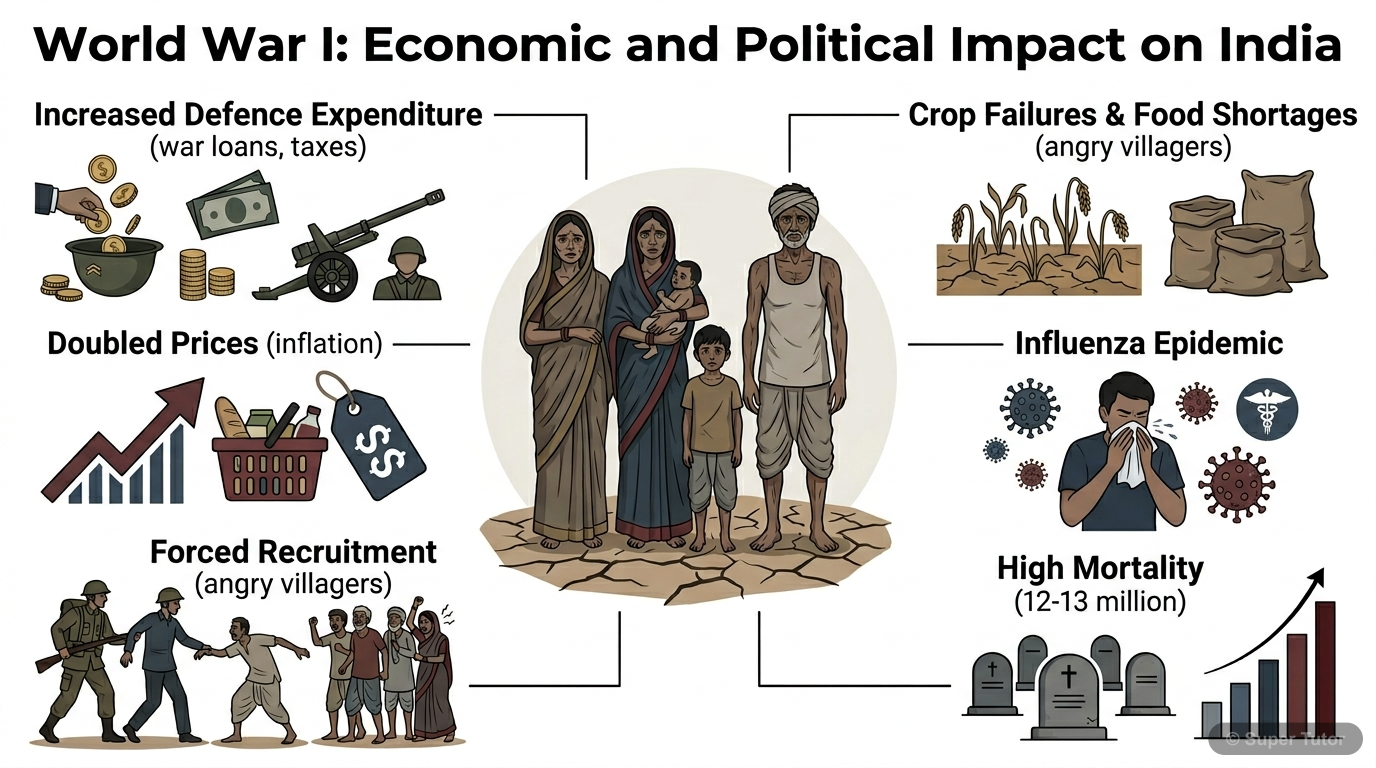
Learn better with visuals Super Tutor has hundreds of illustrations like this across every chapter — all free to try.
Get startedSample Questions
What was the slogan popularized by Tilak during the Home Rule Movement?
Show answer
Swaraj is my birthright and I shall have it
Tilak popularized the famous slogan 'Swaraj is my birthright and I shall have it' during the Home Rule Movement. This slogan emphasized the natural right of Indians to self-government. 'Quit India' was the slogan of the 1942 movement led by Gandhi. 'Vande Mataram' was associated with the Swadeshi Movement and earlier nationalist activities. 'Do or Die' was Gandhi's call during the Quit India Movement. Tilak's slogan specifically related to the concept of Home Rule or self-government within the British Empire.
Which newspapers did Annie Besant use to spread the message of Home Rule?
Show answer
New India and The Commonweal
Annie Besant used the newspapers 'New India' and 'The Commonweal' to spread propaganda in favor of Home Rule. These were her main media tools for reaching the Indian public. 'Kesari' and 'Mahratta' were Tilak's newspapers that he used for similar purposes. 'Young India' and 'Navjivan' were Gandhi's publications used later. 'The Hindu' and 'Indian Express' were established newspapers but not specifically associated with Annie Besant's Home Rule campaign.
The Government of India Act of 1919 was based on which reforms?
Show answer
Montagu-Chelmsford Reforms
The Government of India Act of 1919 was based on the Montagu-Chelmsford Reforms announced in 1918. These reforms were introduced as constitutional concessions to appease nationalist leaders after the Home Rule Movement and wartime pressures. The Morley-Minto Reforms led to the Act of 1909, which was earlier. The Simon Commission came in 1928 and led to different constitutional changes. The Cripps Mission was during World War II (1942) and dealt with different constitutional proposals. The Montagu-Chelmsford Reforms specifically addressed the demands raised during the Home Rule Movement period.
What was the system introduced in provinces under the Government of India Act 1919?
Show answer
Dyarchy
The Act of 1919 introduced the system of 'Dyarchy' in the provinces. Under this system, provincial subjects were divided into two categories: 'Reserved subjects' (like finance, law and order) controlled by the Governor with nominated Executive Council, and 'Transferred subjects' (like education, public health) administered by the Governor with elected ministers. This was a dual system of governance, hence called dyarchy. Federal system came later with the Act of 1935. Unitary and Presidential systems were not introduced by this Act. Dyarchy was a compromise between British control and Indian p
+40 more questions available
Practice AllFrequently Asked Questions
What are the important topics in The National Movement (During the First World War) for ICSE Class 10 History & Civics?
How to score full marks in The National Movement (During the First World War) — ICSE Class 10 History & Civics?
How many important questions are there in The National Movement (During the First World War)?
Sources & Official References
Content is aligned to the official syllabus. Refer to the board website for the latest curriculum.
More resources for The National Movement (During the First World War)
Practice Quiz
Test yourself with a quick quiz
Revision Notes
Key points for last-minute revision
Formula Sheet
All formulas in one place
Chapter Summary
Understand the chapter at a glance
Concept Maps
See how topics connect visually
Study Plan
Step-by-step plan to ace this chapter
Flashcards
Quick-fire cards for active recall
Syllabus
What topics to cover
NCERT Solutions
Every textbook question solved step by step
For serious students
Get the full The National Movement (During the First World War) chapter — for free.
Quizzes, flashcards, AI doubt-solver and a step-by-step study plan for ICSE Class 10 History & Civics.