The State Judiciary The High Courts
ICSE · Class 10 · History & Civics
Most important questions from The State Judiciary The High Courts for ICSE Class 10 History & Civics board exam 2026. MCQs, short answer, and long answer questions with marks.
Interactive on Super Tutor
Studying The State Judiciary The High Courts? Get the full interactive chapter.
Quizzes, flashcards, AI doubt-solver and a step-by-step study plan — built for important questions and more.
1,000+ Class 10 students started this chapter today
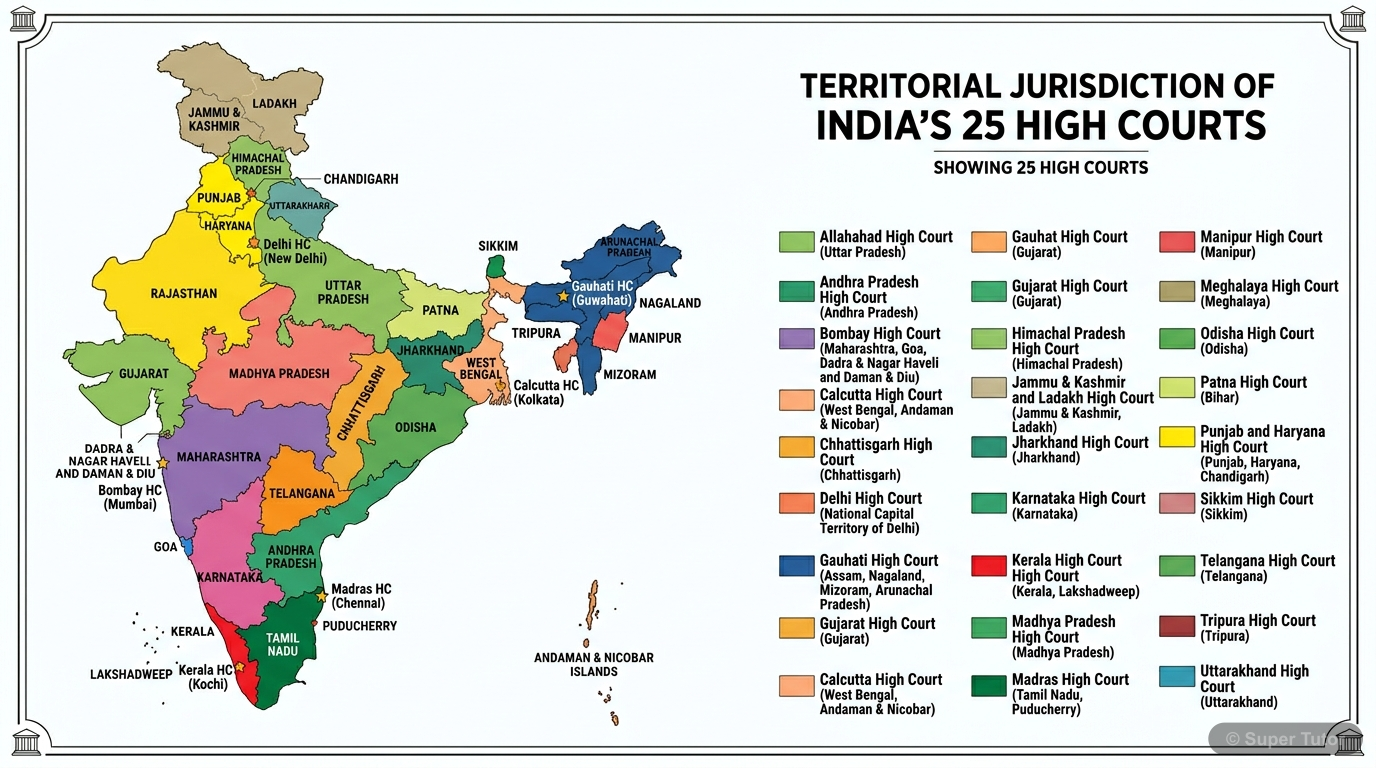
Learn better with visuals Super Tutor has hundreds of illustrations like this across every chapter — all free to try.
Get startedSample Questions
Which High Court has jurisdiction over both West Bengal and Andaman & Nicobar Islands?
Show answer
Calcutta High Court
The Calcutta High Court, located in Kolkata, has jurisdiction over West Bengal and the Andaman & Nicobar Islands. Madras High Court serves Tamil Nadu and Puducherry, Delhi High Court serves only Delhi, and Bombay High Court serves Maharashtra, Goa, and the union territories of Dadra & Nagar Haveli and Daman & Diu. This shows how some High Courts serve both states and union territories.
In which type of cases does a High Court have original jurisdiction?
Show answer
State revenue and Fundamental Rights cases
High Courts have original jurisdiction in matters relating to state revenue collection and cases involving Fundamental Rights, divorce, wills, and marriage laws. They don't have original jurisdiction in all criminal or civil cases - most of these start in subordinate courts and come to High Courts through appeals. Property disputes usually start in lower courts unless they involve Fundamental Rights violations.
What is the procedure for removing a High Court judge?
Show answer
President removes on Parliament's joint address
High Court judges can only be removed by the President upon a joint address by both Houses of Parliament, passed by a majority of total membership and two-thirds of members present and voting. This is the same difficult procedure as for Supreme Court judges, ensuring judicial independence. The Governor, Chief Justice of India, or Chief Minister cannot remove judges independently - this protects judges from political pressure.
Which power allows High Courts to review state laws for constitutionality?
Show answer
Judicial Review
The power of Judicial Review allows High Courts to examine state laws, executive orders, and ordinances to determine if they are consistent with the Constitution. If found unconstitutional, they can declare them null and void. Administrative power deals with court management, appellate jurisdiction handles appeals, and advisory jurisdiction provides legal advice - none of these specifically address constitutional review of laws.
+34 more questions available
Practice AllFrequently Asked Questions
What are the important topics in The State Judiciary The High Courts for ICSE Class 10 History & Civics?
How to score full marks in The State Judiciary The High Courts — ICSE Class 10 History & Civics?
How many important questions are there in The State Judiciary The High Courts?
Sources & Official References
Content is aligned to the official syllabus. Refer to the board website for the latest curriculum.
More resources for The State Judiciary The High Courts
Practice Quiz
Test yourself with a quick quiz
Revision Notes
Key points for last-minute revision
Formula Sheet
All formulas in one place
Chapter Summary
Understand the chapter at a glance
Concept Maps
See how topics connect visually
Study Plan
Step-by-step plan to ace this chapter
Flashcards
Quick-fire cards for active recall
Syllabus
What topics to cover
NCERT Solutions
Every textbook question solved step by step
For serious students
Get the full The State Judiciary The High Courts chapter — for free.
Quizzes, flashcards, AI doubt-solver and a step-by-step study plan for ICSE Class 10 History & Civics.