The Prime Minister, Council of Ministers and The Cabinet
ICSE · Class 10 · History & Civics
Most important questions from The Prime Minister, Council of Ministers and The Cabinet for ICSE Class 10 History & Civics board exam 2026. MCQs, short answer, and long answer questions with marks.
Interactive on Super Tutor
Studying The Prime Minister, Council of Ministers and The Cabinet? Get the full interactive chapter.
Quizzes, flashcards, AI doubt-solver and a step-by-step study plan — built for important questions and more.
1,000+ Class 10 students started this chapter today
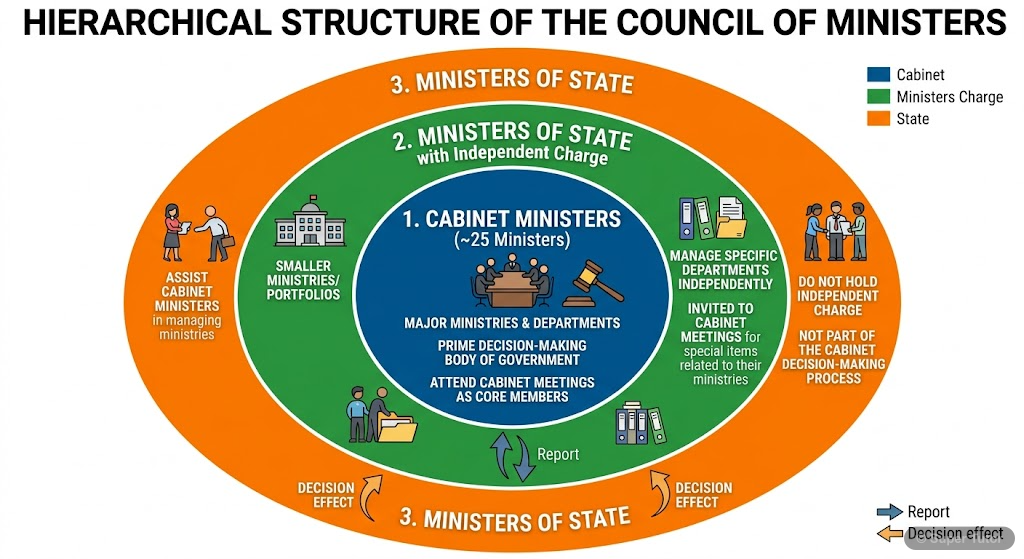
Super Tutor has 5+ illustrations like this for The Prime Minister, Council of Ministers and The Cabinet alone — flashcards, concept maps, and step-by-step visuals.
See them allSample Questions
How long can a non-member of Parliament serve as a Minister?
Show answer
Six months
According to the Constitution, if a non-member of Parliament is appointed as a Minister, they must be elected to either House of Parliament within six months from the date of appointment. If they fail to get elected within this period, they must resign from their ministerial position. This provision ensures that ministers remain accountable to Parliament, which is a fundamental principle of parliamentary democracy. Three months is too short, one year is too long, and indefinite tenure would violate the principle of parliamentary accountability.
Which principle states that all ministers are responsible together for government decisions?
Show answer
Collective responsibility
The principle of collective responsibility, enshrined in Article 75(3), states that the Council of Ministers shall be collectively responsible to the House of People (Lok Sabha). This means all ministers stand together and are jointly accountable for all government decisions and policies. If one minister's policy fails, the entire ministry takes responsibility. A vote of no-confidence against one minister affects the whole government. Individual responsibility refers to each minister being answerable for their specific department. Joint and shared responsibility are not constitutional terms us
What is the highest category of ministers in the Council of Ministers?
Show answer
Cabinet Ministers
Cabinet Ministers are the highest category of ministers in the Council of Ministers. They are the most important members who hold significant portfolios like Home, Defence, Finance, External Affairs, etc. They are full-fledged ministers who participate in all major policy decisions and form the inner core of the government. Ministers of State are the second category, Deputy Ministers are the third category who assist other ministers, and Parliamentary Secretaries help ministers in their duties but are not part of the ministerial hierarchy. Cabinet Ministers are typically 15-18 in number and ar
Under which article is the collective responsibility of ministers mentioned?
Show answer
Article 75(3)
Article 75(3) of the Indian Constitution clearly states that 'The Council of Ministers shall be collectively responsible to the House of the People.' This article establishes the principle of collective responsibility, which is fundamental to the parliamentary system. Article 74 deals with the Council of Ministers aiding and advising the President. Article 76 deals with the Attorney General of India. Article 77 deals with the conduct of business of the Government of India. Only Article 75(3) specifically mentions the collective responsibility of ministers to the Lok Sabha.
+37 more questions available
Practice AllFrequently Asked Questions
What are the important topics in The Prime Minister, Council of Ministers and The Cabinet for ICSE Class 10 History & Civics?
How to score full marks in The Prime Minister, Council of Ministers and The Cabinet — ICSE Class 10 History & Civics?
How many important questions are there in The Prime Minister, Council of Ministers and The Cabinet?
Sources & Official References
Content is aligned to the official syllabus. Refer to the board website for the latest curriculum.
More resources for The Prime Minister, Council of Ministers and The Cabinet
Practice Quiz
Test yourself with a quick quiz
Revision Notes
Key points for last-minute revision
Formula Sheet
All formulas in one place
Chapter Summary
Understand the chapter at a glance
Concept Maps
See how topics connect visually
Study Plan
Step-by-step plan to ace this chapter
Flashcards
Quick-fire cards for active recall
Syllabus
What topics to cover
NCERT Solutions
Every textbook question solved step by step
For serious students
Get the full The Prime Minister, Council of Ministers and The Cabinet chapter — for free.
Quizzes, flashcards, AI doubt-solver and a step-by-step study plan for ICSE Class 10 History & Civics.