Programme and Achievements of the Early Nationalists (Moderates)
ICSE · Class 10 · History & Civics
Most important questions from Programme and Achievements of the Early Nationalists (Moderates) for ICSE Class 10 History & Civics board exam 2026. MCQs, short answer, and long answer questions with marks.
Interactive on Super Tutor
Studying Programme and Achievements of the Early Nationalists (Moderates)? Get the full interactive chapter.
Quizzes, flashcards, AI doubt-solver and a step-by-step study plan — built for important questions and more.
1,000+ Class 10 students started this chapter today
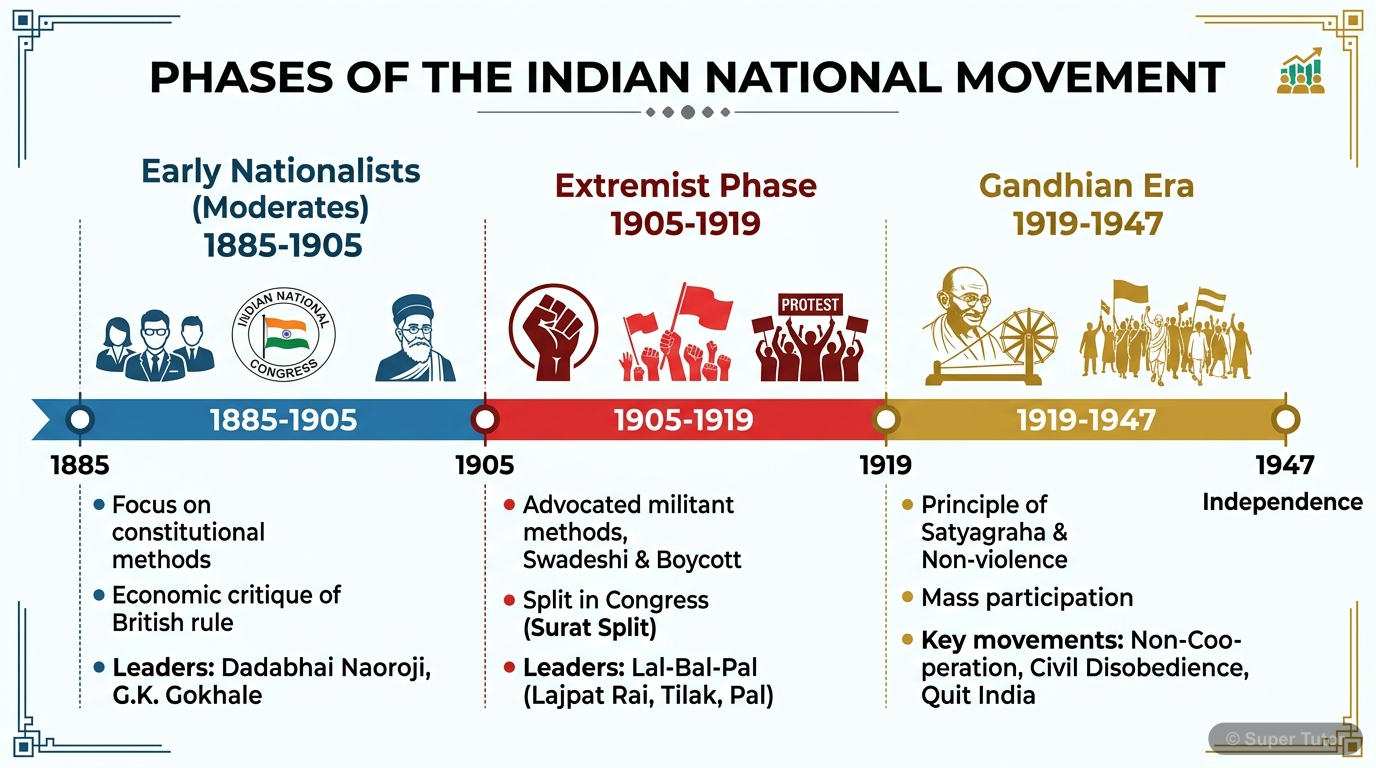
Super Tutor has 5+ illustrations like this for Programme and Achievements of the Early Nationalists (Moderates) alone — flashcards, concept maps, and step-by-step visuals.
See them allSample Questions
Who was known as the 'Political Guru of Gandhi'?
Show answer
Gopal Krishna Gokhale
Gopal Krishna Gokhale is called the 'Political Guru of Gandhi' because he mentored and deeply influenced Gandhi's political outlook and methods of constitutional struggle. Naoroji, Banerjea and Ranade were respected leaders but did not hold this specific title in relation to Gandhi.
What was the main method adopted by Early Nationalists to achieve their goals?
Show answer
Constitutional and peaceful methods
Early Nationalists believed in constitutional and peaceful methods to achieve their objectives. They drafted petitions, held meetings, sent deputations to England, and used press to create public opinion. They were opposed to violence and believed in patience and gradual reform. Armed rebellion and terrorist activities were methods of extremists, not moderates. Mass civil disobedience was Gandhi's method during the later phase of the freedom struggle.
In which year did Dadabhai Naoroji first demand 'Swaraj' from the Congress platform?
Show answer
1906
Dadabhai Naoroji demanded Swaraj from the Congress platform in his presidential address at the Calcutta session in 1906, making it a landmark moment in the nationalist demand for self-government. While Gokhale had spoken of self-government in 1905, the explicit demand from the Congress platform by Naoroji is dated to 1906.
Which British policy did the Early Nationalists particularly oppose regarding press freedom?
Show answer
Vernacular Press Act
The Early Nationalists particularly opposed the Vernacular Press Act as it restricted freedom of press and speech. This act was specifically targeted at Indian language newspapers and was seen as an attack on civil liberties. While they also opposed the Arms Act (which prohibited Indians from carrying arms), Licence Act, and Salt Tax, the Vernacular Press Act was specifically related to press freedom which was crucial for their political work and public opinion building.
+34 more questions available
Practice AllFrequently Asked Questions
What are the important topics in Programme and Achievements of the Early Nationalists (Moderates) for ICSE Class 10 History & Civics?
How to score full marks in Programme and Achievements of the Early Nationalists (Moderates) — ICSE Class 10 History & Civics?
How many important questions are there in Programme and Achievements of the Early Nationalists (Moderates)?
Sources & Official References
Content is aligned to the official syllabus. Refer to the board website for the latest curriculum.
More resources for Programme and Achievements of the Early Nationalists (Moderates)
Practice Quiz
Test yourself with a quick quiz
Revision Notes
Key points for last-minute revision
Formula Sheet
All formulas in one place
Chapter Summary
Understand the chapter at a glance
Concept Maps
See how topics connect visually
Study Plan
Step-by-step plan to ace this chapter
Flashcards
Quick-fire cards for active recall
Syllabus
What topics to cover
NCERT Solutions
Every textbook question solved step by step
For serious students
Get the full Programme and Achievements of the Early Nationalists (Moderates) chapter — for free.
Quizzes, flashcards, AI doubt-solver and a step-by-step study plan for ICSE Class 10 History & Civics.