The National Movement (During the First World War)
ICSE · Class 10 · History & Civics
Summary of The National Movement (During the First World War) for ICSE Class 10 History & Civics. Key concepts, important points, and chapter overview.
Interactive on Super Tutor
Studying The National Movement (During the First World War)? Get the full interactive chapter.
Quizzes, flashcards, AI doubt-solver and a step-by-step study plan — built for chapter summary and more.
1,000+ Class 10 students started this chapter today
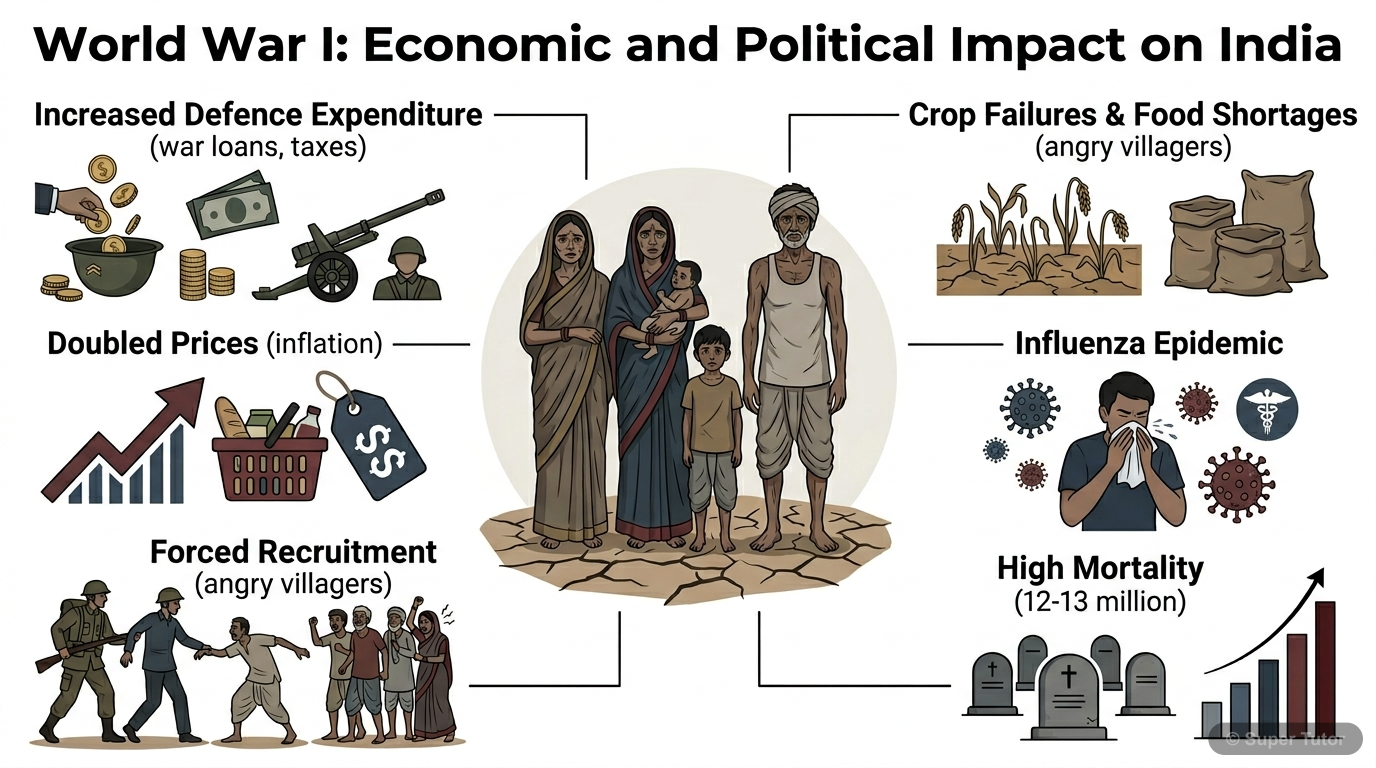
Learn better with visuals Super Tutor has hundreds of illustrations like this across every chapter — all free to try.
Get startedOverview
The First World War created a new political and economic situation in India. National feeling became stronger because India was drawn into a war fought mainly for imperial interests. During this period, the Home Rule Movement, the Lucknow Pact, and the Montagu-Chelmsford Reforms became major turning
Key Concepts
The First World War lasted from
The First World War lasted from 1914 to 1918. India was drawn into it to safeguard British interests. The war increased nationalist feeling because ma
Two separate Home Rule Leagues
Two separate Home Rule Leagues were started in 1916. One was led by Tilak and the other by Annie Besant and S Subramanya Iyer. Both aimed at Home Rule
Tilak was freed from jail
Tilak was freed from jail in June 1914 and became a leading force in the national movement again. He set up the Home Rule League at the Bombay Provinc
Annie Besant was an Irish lady
Annie Besant was an Irish lady who had settled in India since 1893. She started a Home Rule League in September 1916 with headquarters at Adyar near M
The Lucknow Pact was an agreement
The Lucknow Pact was an agreement between Congress and the Muslim League at the Lucknow session. Both groups presented joint demands before the Govern
Learning Objectives
- Understand the impact of the First World War on Indian nationalism
- Explain the rise of the Home Rule Leagues led by Tilak and Annie Besant
- Describe the main features and significance of the Lucknow Pact
- Identify the causes of unity between Congress and Muslim League in 1916
- Explain the main provisions of the Montagu-Chelmsford Reforms and the Government of India Act, 1919
Frequently Asked Questions
What are the important topics in The National Movement (During the First World War) for ICSE Class 10 History & Civics?
How to score full marks in The National Movement (During the First World War) — ICSE Class 10 History & Civics?
Sources & Official References
Content is aligned to the official syllabus. Refer to the board website for the latest curriculum.
More resources for The National Movement (During the First World War)
Practice Quiz
Test yourself with a quick quiz
Important Questions
Practice with board exam-style questions
Revision Notes
Key points for last-minute revision
Formula Sheet
All formulas in one place
Concept Maps
See how topics connect visually
Study Plan
Step-by-step plan to ace this chapter
Flashcards
Quick-fire cards for active recall
Syllabus
What topics to cover
NCERT Solutions
Every textbook question solved step by step
For serious students
Get the full The National Movement (During the First World War) chapter — for free.
Quizzes, flashcards, AI doubt-solver and a step-by-step study plan for ICSE Class 10 History & Civics.