The Prime Minister, Council of Ministers and The Cabinet
ICSE · Class 10 · History & Civics
Flashcards for The Prime Minister, Council of Ministers and The Cabinet — ICSE Class 10 History & Civics. Quick Q&A cards covering key concepts, definitions, and formulas.
Interactive on Super Tutor
Studying The Prime Minister, Council of Ministers and The Cabinet? Get the full interactive chapter.
Quizzes, flashcards, AI doubt-solver and a step-by-step study plan — built for flashcards and more.
1,000+ Class 10 students started this chapter today
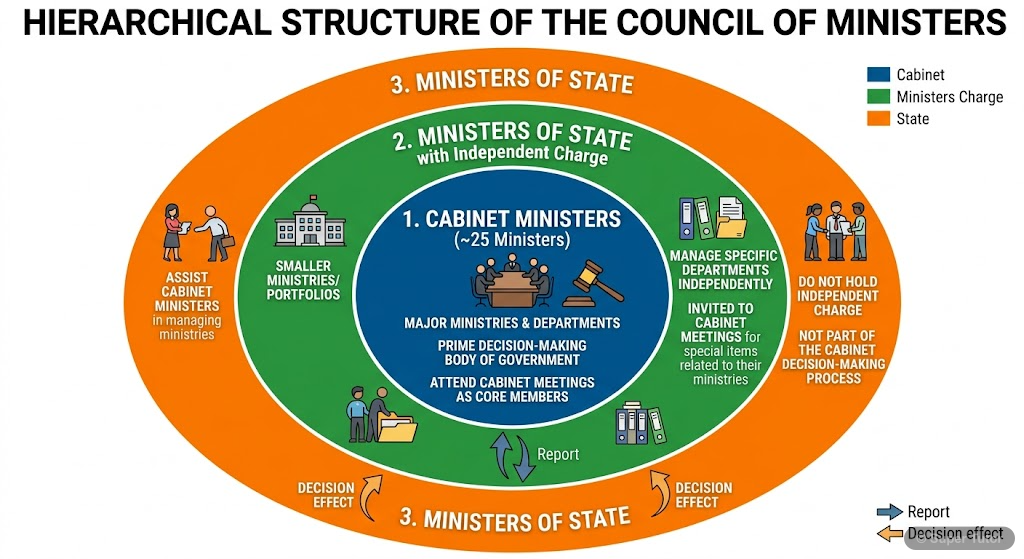
Super Tutor has 5+ illustrations like this for The Prime Minister, Council of Ministers and The Cabinet alone — flashcards, concept maps, and step-by-step visuals.
See them allWhat is the role of the Council of Ministers in relation to the President?
Answer
The Council of Ministers with the Prime Minister at its head aids and advises the President. In a parliamentary system, the President acts on this advice in the exercise of executive functions.
What does Article 74 say about the Council of Ministers?
Answer
Article 74 states that there shall be a Council of Ministers with a Prime Minister at its head to aid and advise the President, and the President shall act according to such advice. The binding part o…
What change did the 44th Amendment make in the President’s power regarding advice?
Answer
The 44th Amendment in 1978 gave the President the right to send the advice of the Council of Ministers back for reconsideration only once. If the same advice is sent again, the President must accept i…
Why is the President called the nominal head of the State?
Answer
The President is the formal constitutional head, but real executive powers are exercised by the Council of Ministers. This is why the President is called the nominal head in a parliamentary form of go…
Who is the real head of the executive in India?
Answer
The Prime Minister is the real head of the executive. He leads the Council of Ministers, leads the Lok Sabha from the government side, and is also the leader of the nation.
Why is the Prime Minister called the 'Keystone of the Cabinet Arch'?
Answer
The Prime Minister is called the 'Keystone of the Cabinet Arch' because he has the central role in forming, leading, and coordinating the Council of Ministers. Without the Prime Minister, the cabinet …
How is the Prime Minister appointed when a party has an absolute majority in the Lok Sabha?
Answer
The leader of the political party that secures an absolute majority in the Lok Sabha is appointed by the President as Prime Minister. In this situation, the President has no discretion.
When does the President have discretion in appointing the Prime Minister?
Answer
The President has discretion only when no single political party secures an absolute majority in the Lok Sabha. Even then, the President must appoint the person who can prove majority support in the H…
+24 more flashcards available
Practice AllFrequently Asked Questions
What are the important topics in The Prime Minister, Council of Ministers and The Cabinet for ICSE Class 10 History & Civics?
How to score full marks in The Prime Minister, Council of Ministers and The Cabinet — ICSE Class 10 History & Civics?
How many flashcards are available for The Prime Minister, Council of Ministers and The Cabinet?
Sources & Official References
Content is aligned to the official syllabus. Refer to the board website for the latest curriculum.
More resources for The Prime Minister, Council of Ministers and The Cabinet
Practice Quiz
Test yourself with a quick quiz
Important Questions
Practice with board exam-style questions
Revision Notes
Key points for last-minute revision
Formula Sheet
All formulas in one place
Chapter Summary
Understand the chapter at a glance
Concept Maps
See how topics connect visually
Study Plan
Step-by-step plan to ace this chapter
Syllabus
What topics to cover
NCERT Solutions
Every textbook question solved step by step
For serious students
Get the full The Prime Minister, Council of Ministers and The Cabinet chapter — for free.
Quizzes, flashcards, AI doubt-solver and a step-by-step study plan for ICSE Class 10 History & Civics.