The Prime Minister, Council of Ministers and The Cabinet
ICSE · Class 10 · History & Civics
Summary of The Prime Minister, Council of Ministers and The Cabinet for ICSE Class 10 History & Civics. Key concepts, important points, and chapter overview.
Interactive on Super Tutor
Studying The Prime Minister, Council of Ministers and The Cabinet? Get the full interactive chapter.
Quizzes, flashcards, AI doubt-solver and a step-by-step study plan — built for chapter summary and more.
1,000+ Class 10 students started this chapter today
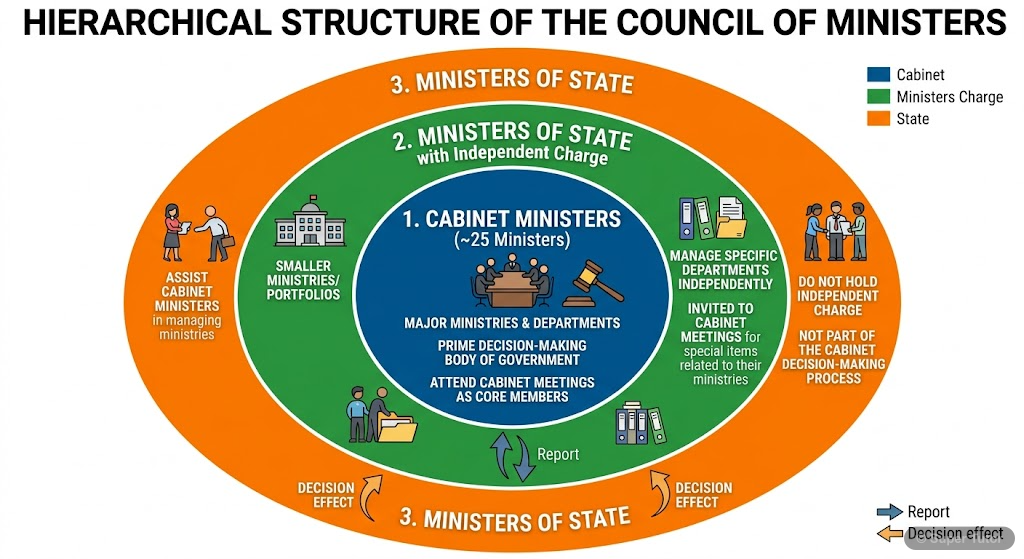
Super Tutor has 5+ illustrations like this for The Prime Minister, Council of Ministers and The Cabinet alone — flashcards, concept maps, and step-by-step visuals.
See them allOverview
The parliamentary system of India places real executive power in the hands of the Council of Ministers, headed by the Prime Minister. The President is the nominal head of the state, while the Prime Minister leads the government, the majority party, the Lok Sabha, and the nation. Article 74 lays down
Key Concepts
All executive powers are formally
All executive powers are formally in the name of the President, but in practice they are exercised by the Council of Ministers. The President acts as
The Prime Minister is the real
The Prime Minister is the real head of the executive, the leader of the ruling party, the leader of the Lok Sabha, and the leader of the nation. He is
The Council of Ministers is
The Council of Ministers is the body headed by the Prime Minister and includes Cabinet Ministers, Ministers of State, and Deputy Ministers. It is coll
The Cabinet is a small inner
The Cabinet is a small inner group within the Council of Ministers. It usually consists of about 15 to 18 ministers holding important portfolios such
Cabinet Ministers are the most important
Cabinet Ministers are the most important members of the Council of Ministers. They are full-fledged ministers and hold important portfolios.
Learning Objectives
- To understand the roles of the Prime Minister, Council of Ministers, and Cabinet
- To explain the constitutional position of the President and the real position of the executive
- To describe the appointment and composition of the Council of Ministers
- To understand the difference between Cabinet, Cabinet Ministers, Ministers of State, and Deputy Ministers
- To explain the meaning of collective responsibility and individual responsibility
Frequently Asked Questions
What are the important topics in The Prime Minister, Council of Ministers and The Cabinet for ICSE Class 10 History & Civics?
How to score full marks in The Prime Minister, Council of Ministers and The Cabinet — ICSE Class 10 History & Civics?
Sources & Official References
Content is aligned to the official syllabus. Refer to the board website for the latest curriculum.
More resources for The Prime Minister, Council of Ministers and The Cabinet
Practice Quiz
Test yourself with a quick quiz
Important Questions
Practice with board exam-style questions
Revision Notes
Key points for last-minute revision
Formula Sheet
All formulas in one place
Concept Maps
See how topics connect visually
Study Plan
Step-by-step plan to ace this chapter
Flashcards
Quick-fire cards for active recall
Syllabus
What topics to cover
NCERT Solutions
Every textbook question solved step by step
For serious students
Get the full The Prime Minister, Council of Ministers and The Cabinet chapter — for free.
Quizzes, flashcards, AI doubt-solver and a step-by-step study plan for ICSE Class 10 History & Civics.