The Prime Minister, Council of Ministers and The Cabinet
ICSE · Class 10 · History & Civics
Complete topic list for The Prime Minister, Council of Ministers and The Cabinet in ICSE Class 10 History & Civics. Key concepts, sub-topics, and what to focus on for board exams.
Interactive on Super Tutor
Studying The Prime Minister, Council of Ministers and The Cabinet? Get the full interactive chapter.
Quizzes, flashcards, AI doubt-solver and a step-by-step study plan — built for syllabus and more.
1,000+ Class 10 students started this chapter today
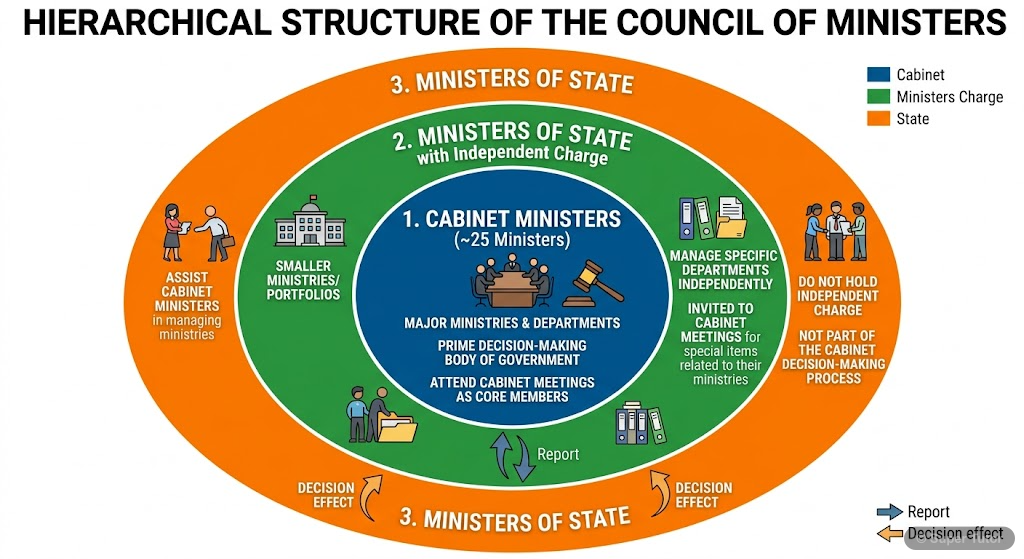
Super Tutor has 5+ illustrations like this for The Prime Minister, Council of Ministers and The Cabinet alone — flashcards, concept maps, and step-by-step visuals.
See them allTopics in The Prime Minister, Council of Ministers and The Cabinet
Constitutional Position and Role of the President
- Article 74 provides for a Council of Ministers with a Prime Minister at its head to aid and advise the President.
- The italicised portion of Article 74 was added through the 42nd Amendment in 1976.
- The 44th Amendment in 1978 gave the President the right to send the advice back for reconsideration only once; if the same advice is sent again, the President must accept it.
Prime Minister: Position, Appointment and Powers
- The Prime Minister is the real head of the executive.
- The Prime Minister is the leader of the Council of Ministers, the leader of the Lok Sabha, the leader of the nation, and the leader of the party.
- The Prime Minister is called the 'Keystone of the Cabinet Arch'.
Council of Ministers and Collective Responsibility
- Article 75(1) states that the Prime Minister is appointed by the President and other Ministers are appointed by the President on the advice of the Prime Minister.
- Article 75(2) states that the Ministers shall hold office during the pleasure of the President.
- Article 75(3) states that the Council of Ministers shall be collectively responsible to the House of the people.
Categories of Ministers
- The Council of Ministers has three categories besides the Prime Minister: Cabinet Ministers, Ministers of State, and Deputy Ministers.
- Cabinet Ministers are the most important members of the Council of Ministers.
- Cabinet Ministers are full-fledged ministers who hold important portfolios.
Key Concepts
Central concept: Parliamentary executive system in India with the Prime Minister as the real head and the Cabinet as the policy-making inner body
Frequently Asked Questions
What are the important topics in The Prime Minister, Council of Ministers and The Cabinet for ICSE Class 10 History & Civics?
How to score full marks in The Prime Minister, Council of Ministers and The Cabinet — ICSE Class 10 History & Civics?
Sources & Official References
Content is aligned to the official syllabus. Refer to the board website for the latest curriculum.
More resources for The Prime Minister, Council of Ministers and The Cabinet
Practice Quiz
Test yourself with a quick quiz
Important Questions
Practice with board exam-style questions
Revision Notes
Key points for last-minute revision
Formula Sheet
All formulas in one place
Chapter Summary
Understand the chapter at a glance
Concept Maps
See how topics connect visually
Study Plan
Step-by-step plan to ace this chapter
Flashcards
Quick-fire cards for active recall
NCERT Solutions
Every textbook question solved step by step
For serious students
Get the full The Prime Minister, Council of Ministers and The Cabinet chapter — for free.
Quizzes, flashcards, AI doubt-solver and a step-by-step study plan for ICSE Class 10 History & Civics.