The State Judiciary The High Courts
ICSE · Class 10 · History & Civics
Flashcards for The State Judiciary The High Courts — ICSE Class 10 History & Civics. Quick Q&A cards covering key concepts, definitions, and formulas.
Interactive on Super Tutor
Studying The State Judiciary The High Courts? Get the full interactive chapter.
Quizzes, flashcards, AI doubt-solver and a step-by-step study plan — built for flashcards and more.
1,000+ Class 10 students started this chapter today
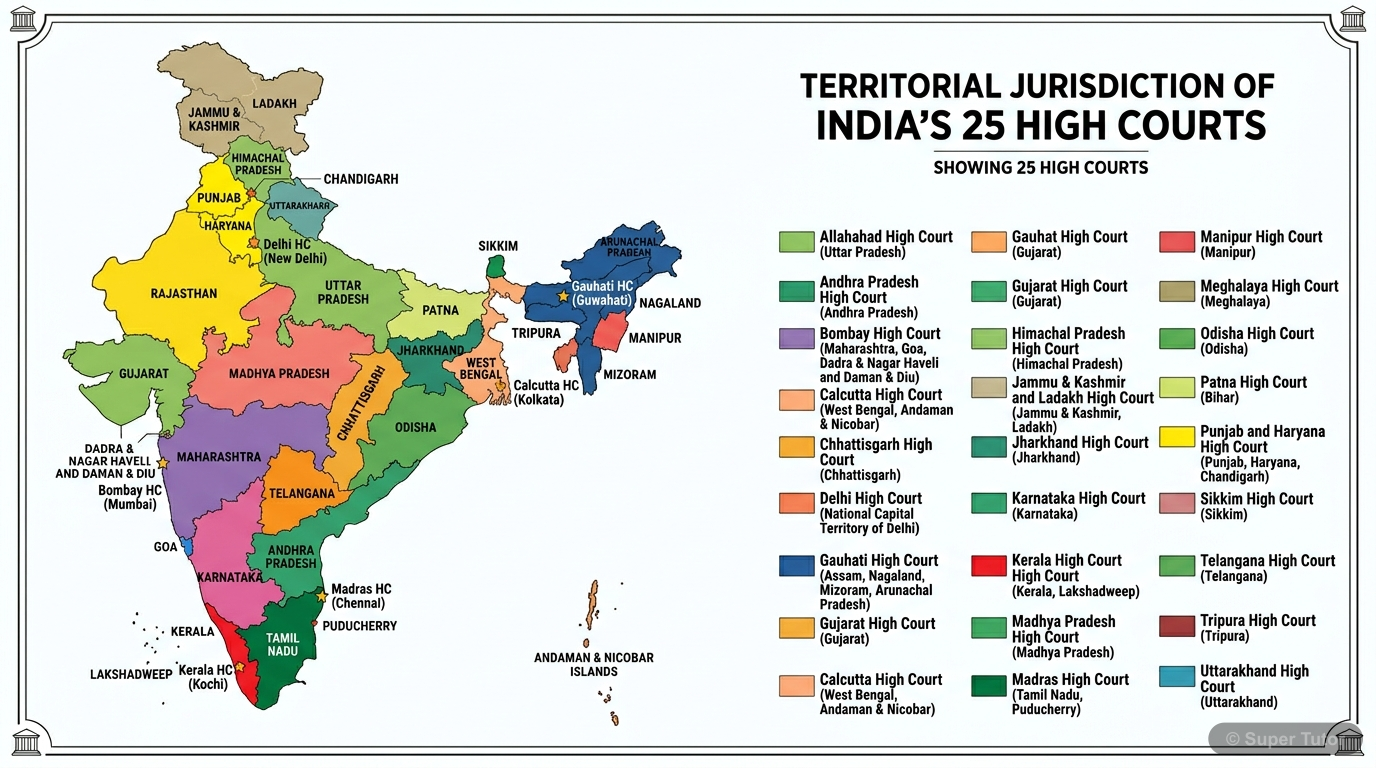
Learn better with visuals Super Tutor has hundreds of illustrations like this across every chapter — all free to try.
Get startedWhat is a High Court in India?
Answer
A High Court is the highest judicial body at the State level. It has a Chief Justice and other judges fixed by Parliament. It works as the top court in a State and performs judicial as well as adminis…
How many States and Union Territories are in India, and how many High Courts are there currently?
Answer
India comprises 28 States and 8 Union Territories. At present, there are 25 High Courts in India. Some States or Union Territories share one High Court because Parliament can place more than one State…
State the composition of a High Court.
Answer
A High Court consists of one Chief Justice and as many other judges as Parliament may fix from time to time. A temporary judge from a Subordinate Court can also be called by the Chief Justice to serve…
Who appoints the Chief Justice of a High Court?
Answer
The Chief Justice of a High Court is appointed by the President in consultation with the Chief Justice of the Supreme Court and the Governor of the State concerned. This helps keep the appointment pro…
Who appoints the other judges of a High Court?
Answer
Other judges of a High Court are appointed by the President. In making the appointment, the President consults the Chief Justice of India, the Governor of the State, and the Chief Justice of the High …
What qualifications must a High Court judge have?
Answer
A High Court judge must be a citizen of India. The judge must also have worked as a judge in any court in India for not less than ten years, or as an advocate in the High Court or High Courts in India…
Who administers the oath of office to High Court judges?
Answer
The Governor administers the oath of office to the High Court Judges. This is part of the formal appointment process.
What is the retirement age of a High Court judge?
Answer
The retirement age of a High Court judge is 62 years. A judge also continues in office until resignation or removal through the special constitutional procedure.
+22 more flashcards available
Practice AllFrequently Asked Questions
What are the important topics in The State Judiciary The High Courts for ICSE Class 10 History & Civics?
How to score full marks in The State Judiciary The High Courts — ICSE Class 10 History & Civics?
How many flashcards are available for The State Judiciary The High Courts?
Sources & Official References
Content is aligned to the official syllabus. Refer to the board website for the latest curriculum.
More resources for The State Judiciary The High Courts
Practice Quiz
Test yourself with a quick quiz
Important Questions
Practice with board exam-style questions
Revision Notes
Key points for last-minute revision
Formula Sheet
All formulas in one place
Chapter Summary
Understand the chapter at a glance
Concept Maps
See how topics connect visually
Study Plan
Step-by-step plan to ace this chapter
Syllabus
What topics to cover
NCERT Solutions
Every textbook question solved step by step
For serious students
Get the full The State Judiciary The High Courts chapter — for free.
Quizzes, flashcards, AI doubt-solver and a step-by-step study plan for ICSE Class 10 History & Civics.