The National Movement (1935-42)-The Quit India Movement and the INA
ICSE · Class 10 · History & Civics
Complete topic list for The National Movement (1935-42)-The Quit India Movement and the INA in ICSE Class 10 History & Civics. Key concepts, sub-topics, and what to focus on for board exams.
Interactive on Super Tutor
Studying The National Movement (1935-42)-The Quit India Movement and the INA? Get the full interactive chapter.
Quizzes, flashcards, AI doubt-solver and a step-by-step study plan — built for syllabus and more.
1,000+ Class 10 students started this chapter today
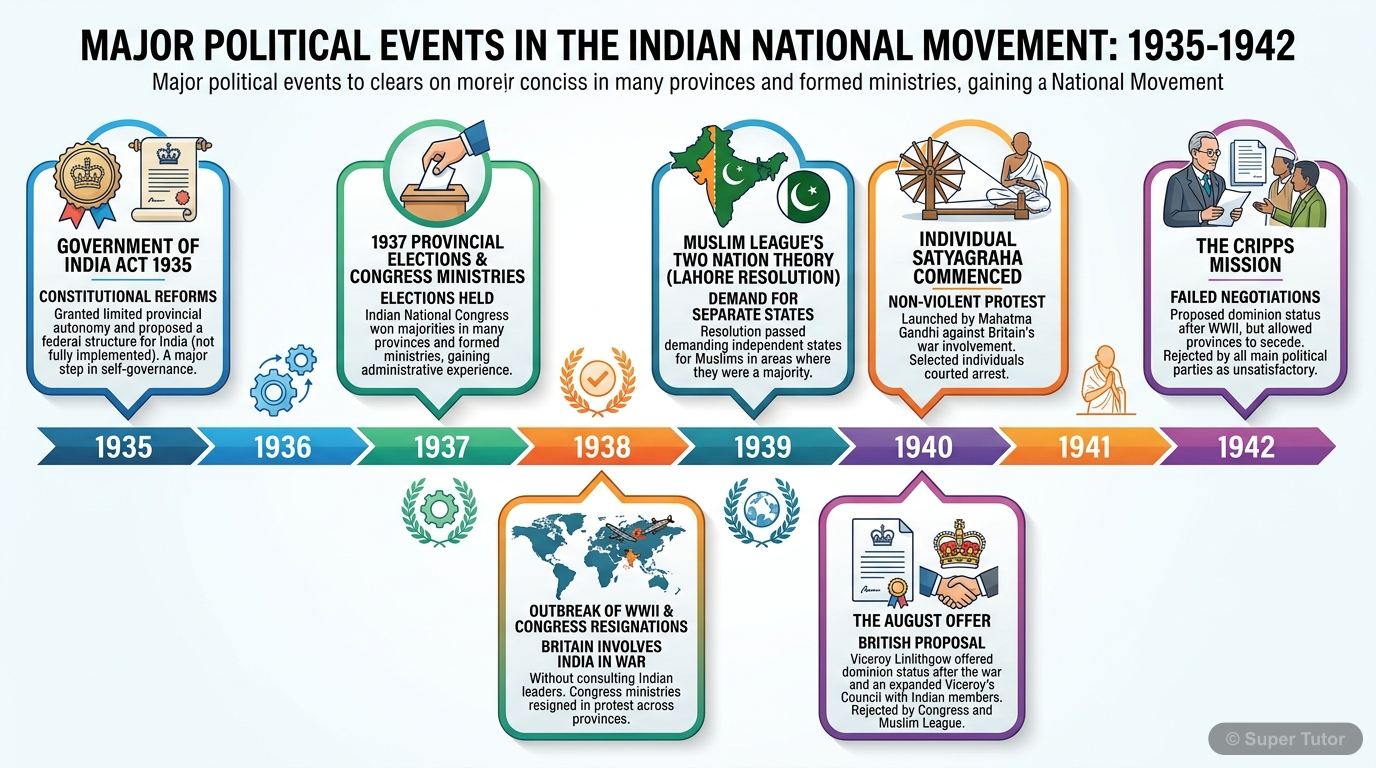
This is just one of 5+ visuals inside Super Tutor's The National Movement (1935-42)-The Quit India Movement and the INA chapter
Explore the full setTopics in The National Movement (1935-42)-The Quit India Movement and the INA
Political Changes from 1935 to 1939
- The Government of India Act 1935 was the result of the Third Round Table Conference discussions.
- Elections were held in February 1937.
- Congress ministries were formed in July 1937 in seven out of eleven provinces.
World War II, August Offer, and Cripps Mission
- The Second World War broke out in 1939.
- The British involved India in the war without consulting the Provincial or Central Legislatures.
- The Congress ministries resigned in protest.
The Quit India Movement
- The Quit India Movement started in 1942 after the failure of the Cripps Mission and growing fear of Japanese invasion.
- The AICC met at Bombay on August 8, 1942 and passed the Quit India resolution.
- Gandhiji gave the call of Do or Die.
Subhas Chandra Bose and the Forward Bloc
- Subhas Chandra Bose was born on January 23, 1897 in a Bengali family settled at Cuttack in Orissa.
- He passed the ICS Examination in 1920 and got 4th position, but resigned his job.
- He became a strong leader of the younger Congressmen and supported socialist ideas.
Key Concepts
Central concept: National Movement between 1935 and 1942: political change, wartime crisis, mass protest, and armed struggle
Frequently Asked Questions
What are the important topics in The National Movement (1935-42)-The Quit India Movement and the INA for ICSE Class 10 History & Civics?
How to score full marks in The National Movement (1935-42)-The Quit India Movement and the INA — ICSE Class 10 History & Civics?
Sources & Official References
Content is aligned to the official syllabus. Refer to the board website for the latest curriculum.
More resources for The National Movement (1935-42)-The Quit India Movement and the INA
Practice Quiz
Test yourself with a quick quiz
Important Questions
Practice with board exam-style questions
Revision Notes
Key points for last-minute revision
Formula Sheet
All formulas in one place
Chapter Summary
Understand the chapter at a glance
Concept Maps
See how topics connect visually
Study Plan
Step-by-step plan to ace this chapter
Flashcards
Quick-fire cards for active recall
NCERT Solutions
Every textbook question solved step by step
For serious students
Get the full The National Movement (1935-42)-The Quit India Movement and the INA chapter — for free.
Quizzes, flashcards, AI doubt-solver and a step-by-step study plan for ICSE Class 10 History & Civics.