The National Movement (1935-42)-The Quit India Movement and the INA
ICSE · Class 10 · History & Civics
Summary of The National Movement (1935-42)-The Quit India Movement and the INA for ICSE Class 10 History & Civics. Key concepts, important points, and chapter overview.
Interactive on Super Tutor
Studying The National Movement (1935-42)-The Quit India Movement and the INA? Get the full interactive chapter.
Quizzes, flashcards, AI doubt-solver and a step-by-step study plan — built for chapter summary and more.
1,000+ Class 10 students started this chapter today
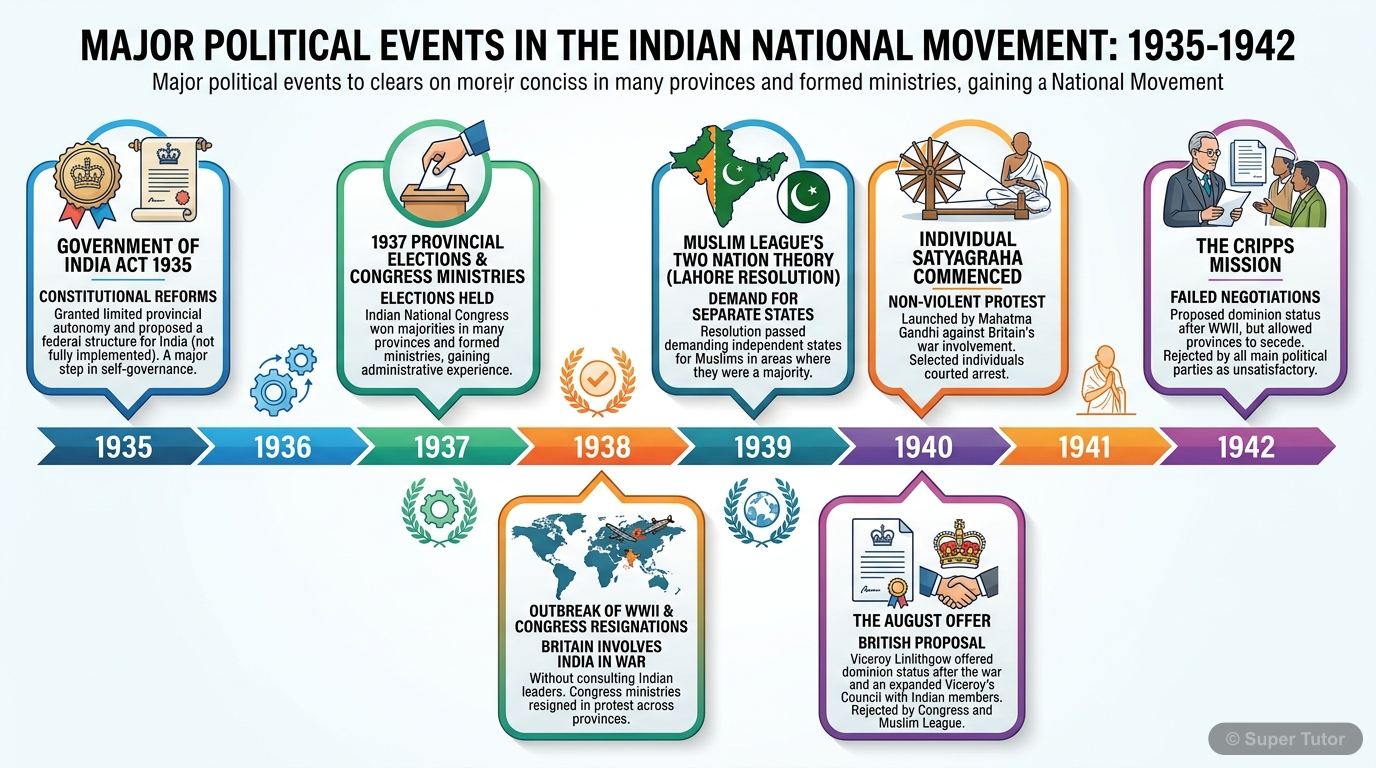
This is just one of 5+ visuals inside Super Tutor's The National Movement (1935-42)-The Quit India Movement and the INA chapter
Explore the full setOverview
The period from 1935 to 1942 brought major political changes in India. The Government of India Act 1935 did not satisfy nationalist leaders, and the elections of 1937 led to Congress ministries in most provinces. Relations with the Muslim League became tense, especially as Jinnah promoted the Two Na
Key Concepts
This Act was the result
This Act was the result of the Third Round Table Conference discussions. It brought changes in the administration of India, but nationalist leaders we
Elections were held in February 1937
Elections were held in February 1937, and Congress ministries were formed in July 1937 in seven out of eleven provinces. Only Bengal and Punjab had no
Muhammad Ali Jinnah criticised the Congress
Muhammad Ali Jinnah criticised the Congress and propagated the Two Nation Theory, which increased communal feelings among Muslims.
The Muslim League celebrated the resignation
The Muslim League celebrated the resignation of the Congress ministries as the Day of Deliverance.
Lord Linlithgow announced the August Offer
Lord Linlithgow announced the August Offer on 8th August 1940. It was a British policy declaration, but it did not satisfy either the Congress or the
Learning Objectives
- Understand the political situation in India between 1935 and 1942
- Explain the rise of tensions between the Congress and the Muslim League
- Describe the causes, course, and impact of the Quit India Movement
- Learn about the Cripps Mission and why it failed
- Study the life, ideas, and role of Subhas Chandra Bose
Frequently Asked Questions
What are the important topics in The National Movement (1935-42)-The Quit India Movement and the INA for ICSE Class 10 History & Civics?
How to score full marks in The National Movement (1935-42)-The Quit India Movement and the INA — ICSE Class 10 History & Civics?
Sources & Official References
Content is aligned to the official syllabus. Refer to the board website for the latest curriculum.
More resources for The National Movement (1935-42)-The Quit India Movement and the INA
Practice Quiz
Test yourself with a quick quiz
Important Questions
Practice with board exam-style questions
Revision Notes
Key points for last-minute revision
Formula Sheet
All formulas in one place
Concept Maps
See how topics connect visually
Study Plan
Step-by-step plan to ace this chapter
Flashcards
Quick-fire cards for active recall
Syllabus
What topics to cover
NCERT Solutions
Every textbook question solved step by step
For serious students
Get the full The National Movement (1935-42)-The Quit India Movement and the INA chapter — for free.
Quizzes, flashcards, AI doubt-solver and a step-by-step study plan for ICSE Class 10 History & Civics.