Chemical Coordination and Integration — Chapter Summary
ICSE · Class 11 · Biology
Summary of Chemical Coordination and Integration for ICSE Class 11 Biology. Part of the ICSE Class 11 Biology syllabus.
Interactive on Super Tutor
Studying Chemical Coordination and Integration? Get the full interactive chapter.
Quizzes, flashcards, AI doubt-solver and a step-by-step study plan — built for chapter summary and more.
Free trial, no card needed.
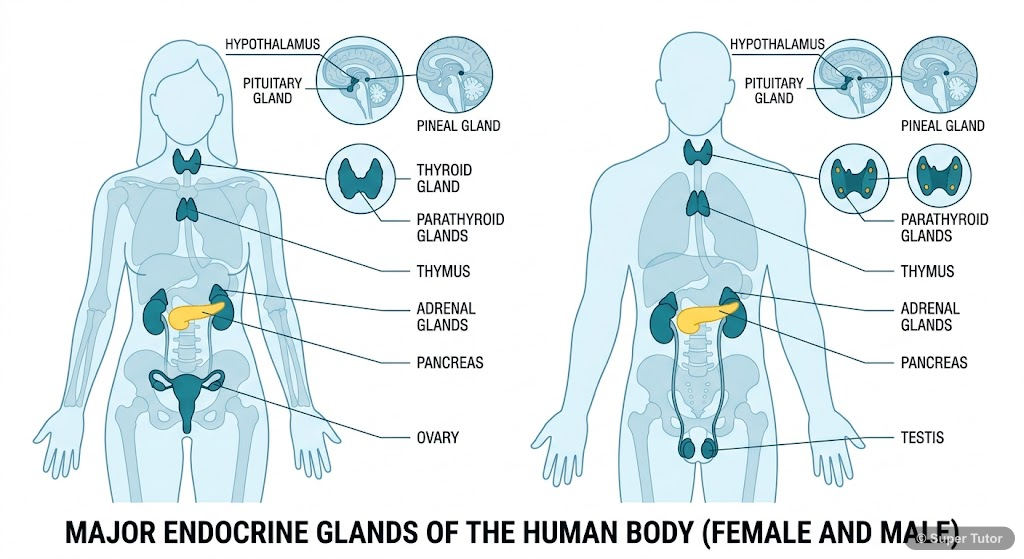
Learn better with visuals Super Tutor pairs illustrations like this with notes and quizzes for Chemical Coordination and Integration.
Overview
Chemical coordination keeps body functions organised and balanced through hormones. Hormones are non-nutrient chemical messengers produced in trace amounts and carried through the blood to target organs. The endocrine system works with the nervous system to regulate growth, metabolism, reproduction,
Key Concepts
Hormones are chemical messengers that act
Hormones are chemical messengers that act in very small amounts and travel through blood to specific target organs. They regulate long-term changes su
Exocrine glands send their secretions through
Exocrine glands send their secretions through ducts to the outside of the body or into body cavities. Endocrine glands have no ducts and release hormo
The hypothalamus contains neurosecretory nuclei
The hypothalamus contains neurosecretory nuclei that release factors controlling the anterior pituitary. It also synthesizes vasopressin and oxytocin,
The anterior pituitary secretes six hormones
The anterior pituitary secretes six hormones: GH, prolactin, ACTH, TSH, FSH, and LH. Acidophils secrete GH and prolactin, while basophils secrete ACTH
The posterior pituitary stores and releases
The posterior pituitary stores and releases vasopressin and oxytocin, but these hormones are synthesized in the hypothalamus. Vasopressin conserves wa
Learning Objectives
- Understand the difference between exocrine and endocrine glands
- Identify the main endocrine glands of the human body and their hormones
- Explain the role of the hypothalamus and pituitary gland in control of other endocrine glands
- Describe the functions of thyroid, parathyroids, pancreas, adrenals, gonads, pineal gland, thymus, and placenta
- Explain the cAMP-based mechanism of hormone action and the steroid hormone mechanism
Frequently Asked Questions
What are the important topics in Chemical Coordination and Integration for ICSE Class 11 Biology?
How should I revise Chemical Coordination and Integration for Class 11 exams?
Sources & Official References
Content is aligned to the official syllabus. Refer to the board website for the latest curriculum.
More resources for Chemical Coordination and Integration
For serious students
Get the full Chemical Coordination and Integration chapter — start free.
Quizzes, flashcards, an AI doubt solver and a study plan for ICSE Class 11 Biology. Free to start, no card needed.