Heat Engine : Second Law of Thermodynamics — Practice Quiz
ICSE · Class 11 · Physics
Try a 4-question quiz on Heat Engine : Second Law of Thermodynamics for ICSE Class 11 Physics: tap an answer to check it and see why.
Interactive on Super Tutor
Studying Heat Engine : Second Law of Thermodynamics? Get the full interactive chapter.
Quizzes, flashcards, AI doubt-solver and a step-by-step study plan — built for practice quiz and more.
Free trial, no card needed.
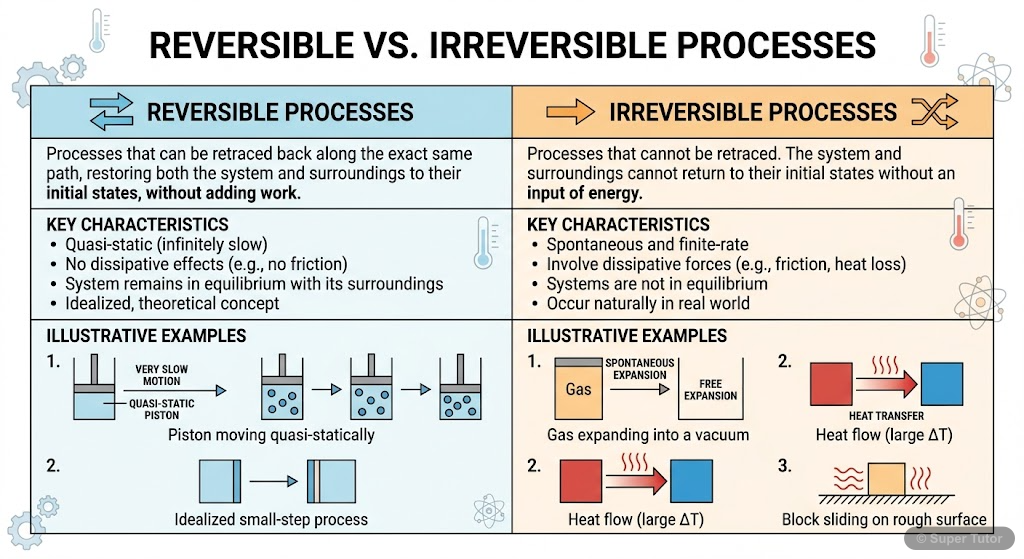
One of 3 illustrations for Heat Engine : Second Law of Thermodynamics in Super Tutor — alongside flashcards, concept maps and practice questions.
Quick Quiz: Heat Engine : Second Law of Thermodynamics
0/4Tap an answer to check it instantly. No sign-up needed for these 4.
Which of the following is the correct statement of the Kelvin-Planck statement of the Second Law of Thermodynamics?
The efficiency of a heat engine is defined as the ratio of:
A heat engine absorbs 500 J of heat from the source and rejects 300 J to the sink. What is the efficiency of the engine?
For a Carnot engine working between source temperature T₁ and sink temperature T₂, the efficiency is given by:
Sample Questions
A Carnot engine operates between a source at 500 K and a sink at 250 K. What is its efficiency?
Show answer
50%
Step 1: Given: T₁ = 500 K (source temperature), T₂ = 250 K (sink temperature). Step 2: Using the Carnot efficiency formula: η = 1 - T₂/T₁. Step 3: η = 1 - 250/500 = 1 - 0.5 = 0.5. Step 4: Converting to percentage: η = 0.5 × 100 = 50%. Step 5: Option A (25%) is incorrect. Option B (75%) might come from wrong subtraction. Option D (100%) is impossible since T₂ ≠ 0 K. Only 50% is correct.
In a Carnot cycle, which of the following pairs of processes are involved?
Show answer
Two isothermal and two adiabatic processes
Step 1: The Carnot cycle consists of exactly four processes in sequence. Step 2: Process 1 (A→B): Isothermal expansion at temperature T₁ (heat Q₁ absorbed from source). Step 3: Process 2 (B→C): Adiabatic expansion (temperature drops from T₁ to T₂, no heat exchange). Step 4: Process 3 (C→D): Isothermal compression at temperature T₂ (heat Q₂ rejected to sink). Step 5: Process 4 (D→A): Adiabatic compression (temperature rises back from T₂ to T₁). So the cycle has 2 isothermal + 2 adiabatic processes. All other options are incorrect.
For a Carnot engine to have 100% efficiency, which condition must be satisfied?
Show answer
The sink temperature T₂ must be 0 K or source temperature T₁ must be infinite.
Step 1: The efficiency formula is η = 1 - T₂/T₁. Step 2: For η = 1 (100%), we need T₂/T₁ = 0. Step 3: This is possible only if T₂ = 0 K (absolute zero) OR T₁ → ∞. Step 4: Both conditions are practically impossible — we cannot achieve absolute zero temperature, and no source can be at infinite temperature. Step 5: Therefore, 100% efficiency is a practical impossibility. Option B is wrong (T₁ = 0 K would give η = 1 - T₂/0, which is undefined and means no work). Option C (T₁ = T₂) gives η = 0, not 100%.
A steam engine delivers 5.4 × 10⁸ J of work per minute and receives 3.6 × 10⁹ J of heat per minute from its boiler. What is the efficiency of the engine?
Show answer
15%
Step 1: Given: Work done W = 5.4 × 10⁸ J/min, Heat absorbed Q₁ = 3.6 × 10⁹ J/min. Step 2: Efficiency formula: η = W/Q₁. Step 3: η = (5.4 × 10⁸) / (3.6 × 10⁹) = 5.4/36 = 0.15. Step 4: η = 0.15 × 100 = 15%. Step 5: Option A (10%) is too low. Option C (20%) and D (25%) are too high. The calculation clearly gives 15%. This is close to the real efficiency of steam engines (10-17%).
+40 more questions on Heat Engine : Second Law of Thermodynamics (ICSE Class 11 Physics)
Practise AllFrequently Asked Questions
What are the important topics in Heat Engine : Second Law of Thermodynamics for ICSE Class 11 Physics?
How many practice questions are there for Heat Engine : Second Law of Thermodynamics?
Sources & Official References
Content is aligned to the official syllabus. Refer to the board website for the latest curriculum.
More resources for Heat Engine : Second Law of Thermodynamics
Important Questions
Exam-style questions with answers
Revision Notes
Key points for last-minute revision
Formula Sheet
The chapter's formulas in one place
Chapter Summary
Understand the chapter at a glance
Concept Maps
See how topics connect
Study Plan
Step-by-step plan for this chapter
Flashcards
Quick-fire cards for active recall
Syllabus
What topics to cover
For serious students
Get the full Heat Engine : Second Law of Thermodynamics chapter — start free.
Quizzes, flashcards, an AI doubt solver and a study plan for ICSE Class 11 Physics. Free to start, no card needed.