Heat Engine : Second Law of Thermodynamics — Syllabus
ICSE · Class 11 · Physics
What Heat Engine : Second Law of Thermodynamics covers in ICSE Class 11 Physics: 4 topics, for the 2026-27 session.
Interactive on Super Tutor
Studying Heat Engine : Second Law of Thermodynamics? Get the full interactive chapter.
Quizzes, flashcards, AI doubt-solver and a step-by-step study plan — built for syllabus and more.
Free trial, no card needed.
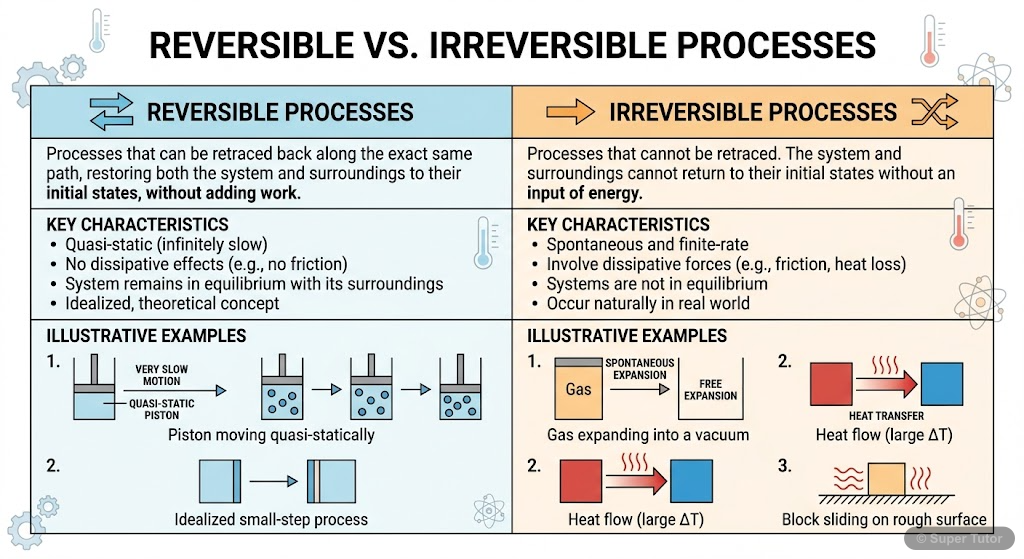
One of 3 illustrations for Heat Engine : Second Law of Thermodynamics in Super Tutor — alongside flashcards, concept maps and practice questions.
Topics in Heat Engine : Second Law of Thermodynamics
Limitations of the First Law
- The first law of thermodynamics gives the relation between heat, work, and internal energy, but it does not tell the direction of heat flow.
- It does not show whether a process is possible or impossible.
- When two bodies at different temperatures are kept in contact, heat flows from the hotter body to the colder body, but the first law does not explain why the reverse does not occur by itself.
Second Law of Thermodynamics
- The second law has two equivalent statements: Kelvin-Planck and Clausius.
- The Kelvin-Planck statement says it is impossible to convert all the heat extracted from a hot body into work.
- The Clausius statement says heat cannot be transferred from a cold body to a hot body without external work.
Reversible and Irreversible Processes
- A reversible process can be reversed so that all changes are exactly repeated in reverse order and no change is left in the system or surroundings.
- A reversible process requires absence of dissipative forces and infinitely slow execution.
- All practical processes are irreversible.
Heat Engine and Efficiency
- A heat engine is a cyclic device that converts heat into mechanical work.
- A heat engine has three main parts: source, working substance, and sink.
- The working substance takes heat Q1 from the source, does work W, and gives heat Q2 to the sink.
Key Concepts
Central concept: Second law of thermodynamics applied to heat engines and refrigerators
Work through every topic in Heat Engine : Second Law of Thermodynamics with notes and quizzes
Start This ChapterFrequently Asked Questions
What are the important topics in Heat Engine : Second Law of Thermodynamics for ICSE Class 11 Physics?
How should I revise Heat Engine : Second Law of Thermodynamics for Class 11 exams?
Sources & Official References
Content is aligned to the official syllabus. Refer to the board website for the latest curriculum.
More resources for Heat Engine : Second Law of Thermodynamics
Practice Quiz
Test yourself with a quick quiz
Important Questions
Exam-style questions with answers
Revision Notes
Key points for last-minute revision
Formula Sheet
The chapter's formulas in one place
Chapter Summary
Understand the chapter at a glance
Concept Maps
See how topics connect
Study Plan
Step-by-step plan for this chapter
Flashcards
Quick-fire cards for active recall
For serious students
Get the full Heat Engine : Second Law of Thermodynamics chapter — start free.
Quizzes, flashcards, an AI doubt solver and a study plan for ICSE Class 11 Physics. Free to start, no card needed.