Heat Engine : Second Law of Thermodynamics — Chapter Summary
ICSE · Class 11 · Physics
Summary of Heat Engine : Second Law of Thermodynamics for ICSE Class 11 Physics. Part of the ICSE Class 11 Physics syllabus.
Interactive on Super Tutor
Studying Heat Engine : Second Law of Thermodynamics? Get the full interactive chapter.
Quizzes, flashcards, AI doubt-solver and a step-by-step study plan — built for chapter summary and more.
Free trial, no card needed.
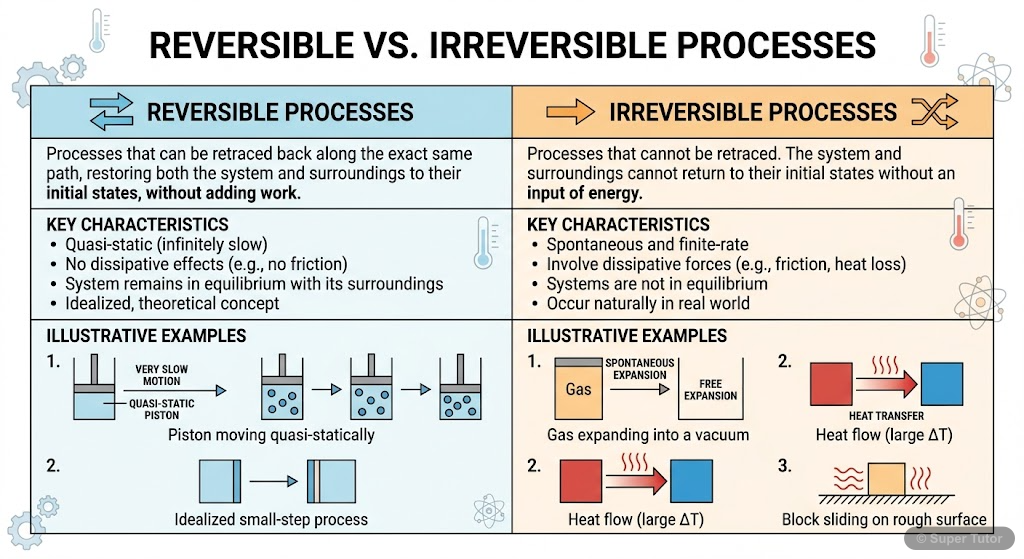
One of 3 illustrations for Heat Engine : Second Law of Thermodynamics in Super Tutor — alongside flashcards, concept maps and practice questions.
Overview
The second law of thermodynamics explains the direction of heat flow and the limits of converting heat into work. The first law only shows that heat and work are forms of energy and that energy is conserved, but it does not tell whether a process can happen spontaneously. The second law removes this
Key Concepts
The first law of thermodynamics states
The first law of thermodynamics states energy conservation, but it does not indicate the direction of heat flow or whether a process is possible on it
It is impossible to convert all
It is impossible to convert all the heat extracted from a hot body into work. A heat engine must reject some heat to a sink for continuous operation.
Heat cannot be transferred from
Heat cannot be transferred from a cold body to a hot body without expenditure of external work.
The Kelvin
The Kelvin-Planck and Clausius statements are two equivalent ways of expressing the same law. Violation of one means violation of the other.
A reversible process can be reversed
A reversible process can be reversed exactly so that all changes in the system and surroundings are fully restored. It requires absence of dissipative
Learning Objectives
- Explain the limitations of the first law of thermodynamics.
- State and interpret the Kelvin-Planck and Clausius statements of the second law.
- Distinguish between reversible and irreversible processes.
- Describe Carnot’s heat engine and the four processes of Carnot’s cycle.
- Derive the efficiency of Carnot’s engine in terms of source and sink temperatures.
Frequently Asked Questions
What are the important topics in Heat Engine : Second Law of Thermodynamics for ICSE Class 11 Physics?
How should I revise Heat Engine : Second Law of Thermodynamics for Class 11 exams?
Sources & Official References
Content is aligned to the official syllabus. Refer to the board website for the latest curriculum.
More resources for Heat Engine : Second Law of Thermodynamics
Practice Quiz
Test yourself with a quick quiz
Important Questions
Exam-style questions with answers
Revision Notes
Key points for last-minute revision
Formula Sheet
The chapter's formulas in one place
Concept Maps
See how topics connect
Study Plan
Step-by-step plan for this chapter
Flashcards
Quick-fire cards for active recall
Syllabus
What topics to cover
For serious students
Get the full Heat Engine : Second Law of Thermodynamics chapter — start free.
Quizzes, flashcards, an AI doubt solver and a study plan for ICSE Class 11 Physics. Free to start, no card needed.