Chapter 3 of 25
Revision Notes
Relief — Revision Notes
ICSE · Class 12 · Geography
Relief revision notes for ICSE Class 12 Geography: 4 topics in quick points. Part of the ICSE Class 12 Geography syllabus.
45 questions50 flashcards5 concepts
Interactive on Super Tutor
Studying Relief? Get the full interactive chapter.
Quizzes, flashcards, AI doubt-solver and a step-by-step study plan — built for revision notes and more.
Free trial, no card needed.
Super Tutor
An illustration from Super Tutor's Relief chapter — alongside flashcards, concept maps and practice questions.
Key Topics to Revise
1
1. Major Relief Divisions of India
- India is generally divided into five major relief divisions: the Himalayan Mountain Complex, the Indus-Ganga-Brahmaputra Plain, the Peninsular Plateau, the Coastal Plains, and the Islands.
- India has great diversity of relief features, including lofty young fold mountains, flat plains, and one of the oldest plateaus of the world.
- A rough estimate shows that 10.7 per cent of India is mountainous, 18.6 per cent is hilly, 27.7 per cent is plateau, and 43 per cent is plain.
2
2. The Himalayan Mountain Complex
- The Himalayan ranges run about 2,400 km from the Indus in the west to the Brahmaputra in the east.
- The average width of the Himalayas is 160 to 400 km.
- The Himalayas are not one range but a group of three parallel ranges.
3
3. Relief Features of the Great Plain of North India
- The Indus-Ganga-Brahmaputra Plain was formed mainly by depositional work of rivers.
- The plain extends for 2,400 km from Satluj to the Ganga delta and has a width varying from 150 to 300 km.
- It is narrowest in Assam, where the width is about 90 to 100 km.
4
4. The Peninsular Plateau
- The Peninsular Plateau forms an irregular triangle with its base between Delhi Ridge and the Rajmahal Hills and apex at Kanniyakumari.
- It is the oldest landmass of India and has a general elevation of 600 to 900 metres.
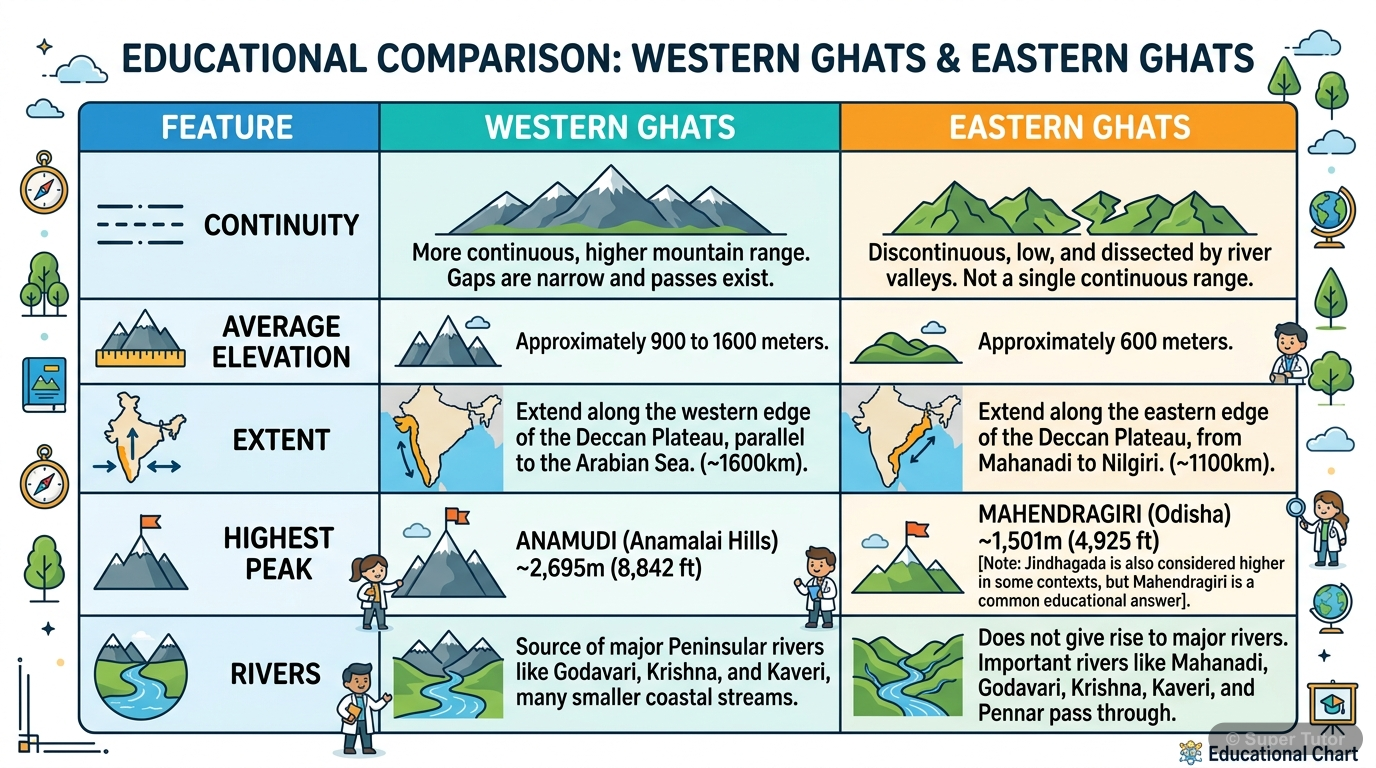
- The plateau is surrounded by hills on all three sides: Aravalis, Vindhyachal, and Rajmahal Hills in the north, Western Ghats in the west, and Eastern Ghats in the east.
Get complete notes with diagrams and examples
Full NotesKey Concepts
The Himalayas stretch for about 2The Great Himalayas are the highestThis range lies south ofThe southernmost Himalayan range isThe Karakoram Range lies to
Frequently Asked Questions
What are the important topics in Relief for ICSE Class 12 Geography?
Key topics in Relief include Major Relief Divisions of India, The Himalayan Mountain Complex, Relief Features of the Great Plain of North India, The Peninsular Plateau. Study these first, then practise questions on each for the ICSE Class 12 board exam.
How should I revise Relief for the ICSE Class 12 board exam?
Learn the core ideas first, then work through the 45 practice questions on Relief. Revise definitions regularly and use flashcards for quick recall before the exam.
Sources & Official References
Content is aligned to the official syllabus. Refer to the board website for the latest curriculum.
More resources for Relief
For serious students
Get the full Relief chapter — start free.
Quizzes, flashcards, an AI doubt solver and a study plan for ICSE Class 12 Geography. Free to start, no card needed.