Nuclear Fission and Nuclear Fusion: Source of Energy — Revision Notes
ICSE · Class 12 · Physics
Nuclear Fission and Nuclear Fusion: Source of Energy revision notes for ICSE Class 12 Physics: 4 topics in quick points.
Interactive on Super Tutor
Studying Nuclear Fission and Nuclear Fusion: Source of Energy? Get the full interactive chapter.
Quizzes, flashcards, AI doubt-solver and a step-by-step study plan — built for revision notes and more.
Free trial, no card needed.
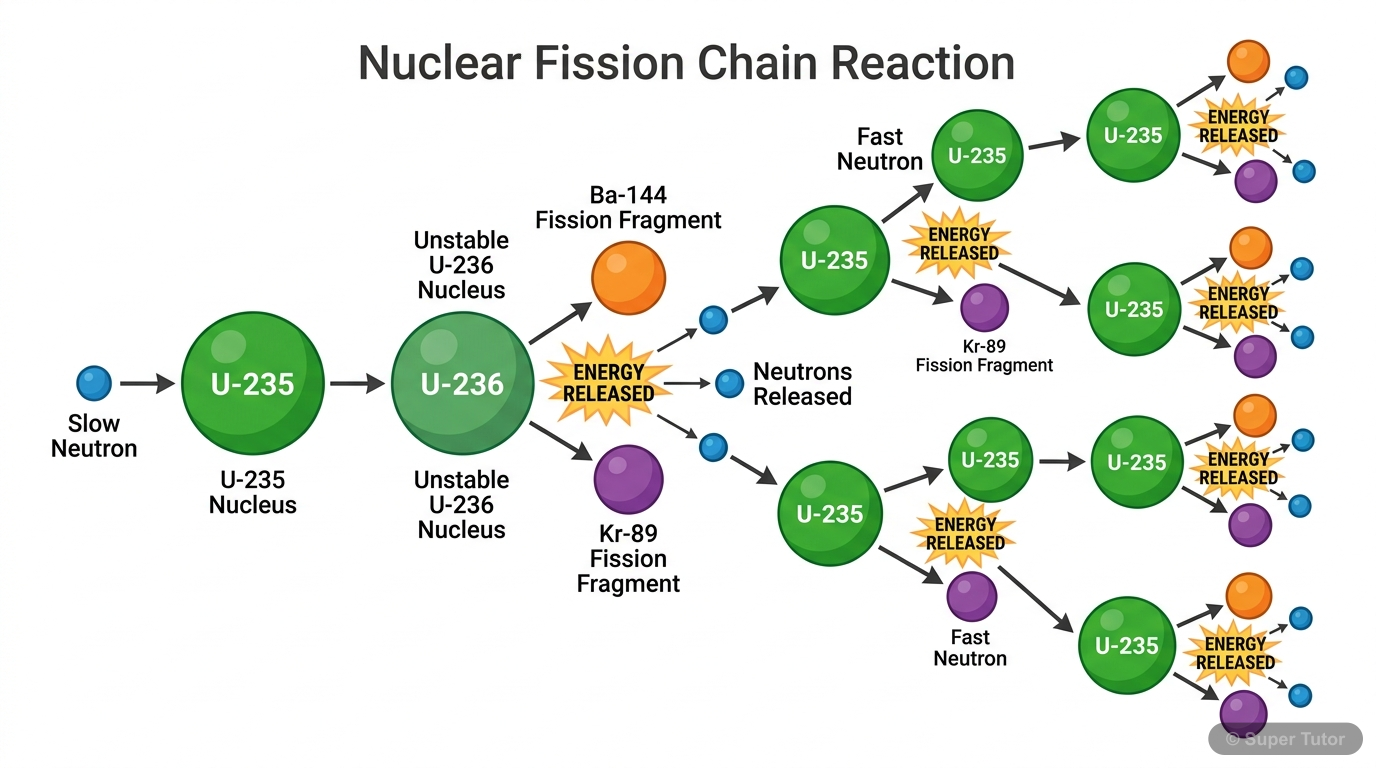
An illustration from Super Tutor's Nuclear Fission and Nuclear Fusion: Source of Energy chapter — alongside flashcards, concept maps and practice questions.
Key Topics to Revise
1. Nuclear Fission
- In 1939, Hahn and Strassmann observed that when uranium nucleus with atomic number 92 was bombarded with neutrons, it split into isotopes of barium and krypton.
- Meitner and Frisch named this phenomenon nuclear fission.
- Nuclear fission is a process in which a heavy nucleus, after capturing a thermal neutron of energy 0.027 eV, splits up into two lighter nuclei of comparable masses.
2. Chain Reaction, Critical Size, and Multiplication Factor
- A chain reaction starts when neutrons produced in one fission cause further fissions.
- If more than one emitted neutron causes further fission, the reaction grows rapidly and becomes uncontrolled.
- If the reaction is controlled so that, on average, only one neutron continues the chain, the reaction remains steady.
3. Nuclear Reactor and Its Parts
- A nuclear reactor is a device in which a self-sustaining controlled chain reaction is produced in a fissionable material.
- The main fuel used is uranium enriched with U-235 or Pu-239.
- A moderator slows fast neutrons to thermal energies by elastic collisions.
4. Production of Plutonium-239 and Reactor Types
- In a reactor, neutrons not used in the fission chain reaction can be absorbed by U-238 to form U-239.
- U-239 is unstable and beta decays into Np-239.
- Np-239 also beta decays into Pu-239.
Get complete notes with diagrams and examples
Full NotesKey Concepts
Frequently Asked Questions
What are the important topics in Nuclear Fission and Nuclear Fusion: Source of Energy for ICSE Class 12 Physics?
How should I revise Nuclear Fission and Nuclear Fusion: Source of Energy for the ICSE Class 12 board exam?
Sources & Official References
Content is aligned to the official syllabus. Refer to the board website for the latest curriculum.
More resources for Nuclear Fission and Nuclear Fusion: Source of Energy
Practice Quiz
Test yourself with a quick quiz
Important Questions
Exam-style questions with answers
Formula Sheet
The chapter's formulas in one place
Chapter Summary
Understand the chapter at a glance
Concept Maps
See how topics connect
Study Plan
Step-by-step plan for this chapter
Flashcards
Quick-fire cards for active recall
Syllabus
What topics to cover
For serious students
Get the full Nuclear Fission and Nuclear Fusion: Source of Energy chapter — start free.
Quizzes, flashcards, an AI doubt solver and a study plan for ICSE Class 12 Physics. Free to start, no card needed.