Nuclear Fission and Nuclear Fusion: Source of Energy — Flashcards
ICSE · Class 12 · Physics
36 flashcards for Nuclear Fission and Nuclear Fusion: Source of Energy (ICSE Class 12 Physics) to test yourself on key terms and facts.
Interactive on Super Tutor
Studying Nuclear Fission and Nuclear Fusion: Source of Energy? Get the full interactive chapter.
Quizzes, flashcards, AI doubt-solver and a step-by-step study plan — built for flashcards and more.
Free trial, no card needed.
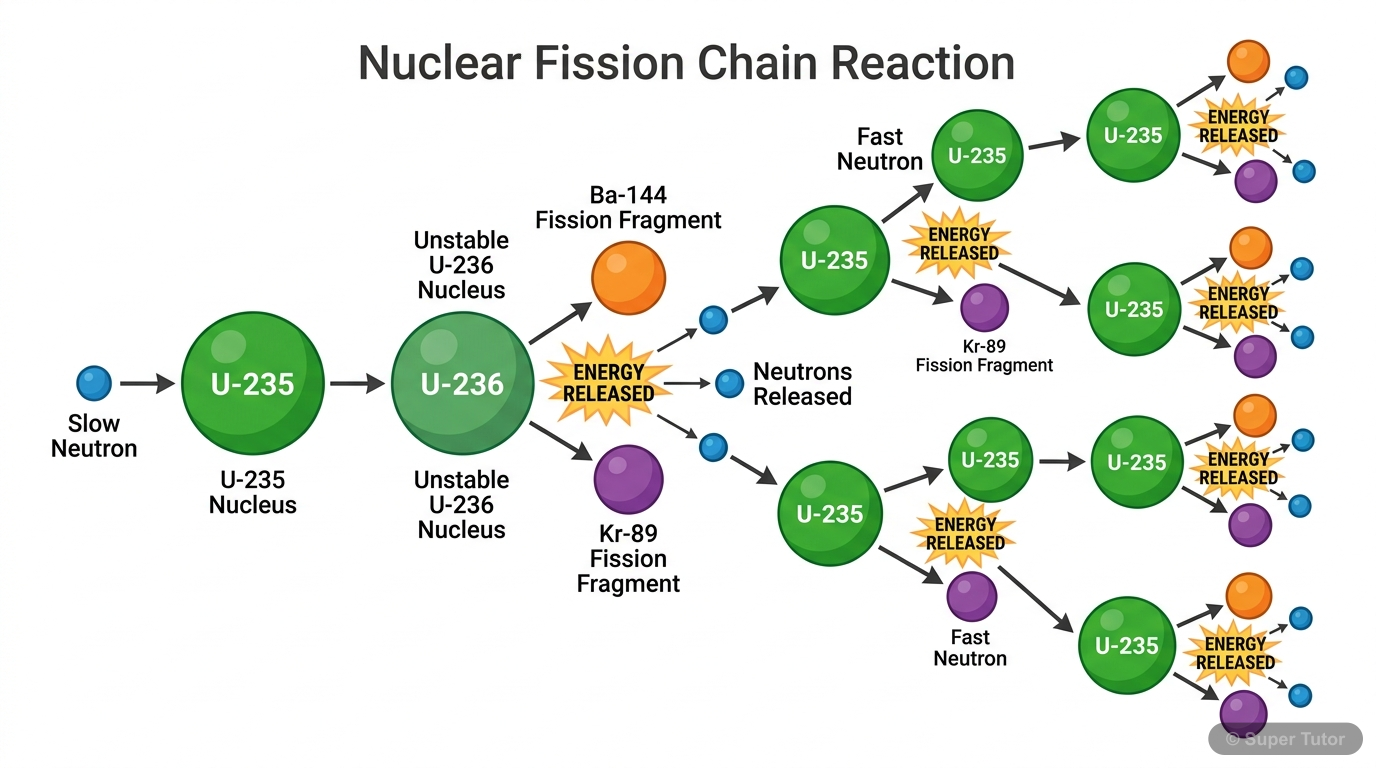
An illustration from Super Tutor's Nuclear Fission and Nuclear Fusion: Source of Energy chapter — alongside flashcards, concept maps and practice questions.
State the definition of nuclear fission.
Answer
Nuclear fission is a process in which a heavy nucleus, after capturing a thermal neutron having energy 0.027 eV, splits up into two lighter nuclei of comparable masses. The product nuclei are called f…
Who observed the splitting of uranium nucleus when it was bombarded with neutrons, and who named the process nuclear fission?
Answer
Hahn and Strassmann observed that uranium nucleus with Z = 92, when bombarded with neutrons, split into isotopes of barium and krypton. Meitner and Frisch named the phenomenon nuclear fission.
Why can U-235 sustain a chain reaction more easily than U-238?
Answer
U-235 can be fissioned by slow or thermal neutrons of about 0.03 eV. U-238 can only be fissioned by fast neutrons above 1 MeV, and below 1 MeV it absorbs neutrons without fission. This makes U-235 muc…
A slow neutron strikes U-235. What are the main steps of the fission process?
Answer
Step 1: U-235 captures a slow neutron and forms unstable U-236. Step 2: U-236 splits into two lighter nuclei. Step 3: Two or three fast neutrons are emitted. Step 4: A large amount of energy is releas…
What is the typical mass-number range of fission fragments?
Answer
The fission fragments are radioactive isotopes of elements lying in the mass-number range roughly from 70 to 160. They undergo several beta decays until they reach stable end-products.
A U-235 nucleus releases about 200 MeV per fission. Convert this into joules.
Answer
Given: Energy per fission = 200 MeV Formula: 1 MeV = 1.6 × 10^-13 J Calculation: 200 × 1.6 × 10^-13 J = 3.2 × 10^-11 J Answer: 3.2 × 10^-11 J per fission…
Calculate the energy released if 1 g of U-235 is fully fissioned.
Answer
Given: 1 g of U-235 = 2.56 × 10^21 atoms Energy per fission = 200 MeV = 3.2 × 10^-11 J Step 1: Total energy in joules = (2.56 × 10^21) × (3.2 × 10^-11 J) Step 2: E = 8.19 × 10^10 J approximately Answe…
State the formula for multiplication or reproduction factor K.
Answer
K = (Number of neutrons present at the beginning of present generation) / (Number of neutrons in the beginning of previous generation) Meaning: K tells whether a chain reaction is steady, increasing, …
+28 more flashcards
Practise AllFrequently Asked Questions
What are the important topics in Nuclear Fission and Nuclear Fusion: Source of Energy for ICSE Class 12 Physics?
How many flashcards are available for Nuclear Fission and Nuclear Fusion: Source of Energy?
How should I revise Nuclear Fission and Nuclear Fusion: Source of Energy for the ICSE Class 12 board exam?
Sources & Official References
Content is aligned to the official syllabus. Refer to the board website for the latest curriculum.
More resources for Nuclear Fission and Nuclear Fusion: Source of Energy
Practice Quiz
Test yourself with a quick quiz
Important Questions
Exam-style questions with answers
Revision Notes
Key points for last-minute revision
Formula Sheet
The chapter's formulas in one place
Chapter Summary
Understand the chapter at a glance
Concept Maps
See how topics connect
Study Plan
Step-by-step plan for this chapter
Syllabus
What topics to cover
For serious students
Get the full Nuclear Fission and Nuclear Fusion: Source of Energy chapter — start free.
Quizzes, flashcards, an AI doubt solver and a study plan for ICSE Class 12 Physics. Free to start, no card needed.