Five Kingdom Classification — Chapter Summary
ICSE · Class 9 · Biology
Summary of Five Kingdom Classification for ICSE Class 9 Biology. Part of the ICSE Class 9 Biology syllabus. Living organisms show a huge range of size.
Interactive on Super Tutor
Studying Five Kingdom Classification? Get the full interactive chapter.
Quizzes, flashcards, AI doubt-solver and a step-by-step study plan — built for chapter summary and more.
Free trial, no card needed.
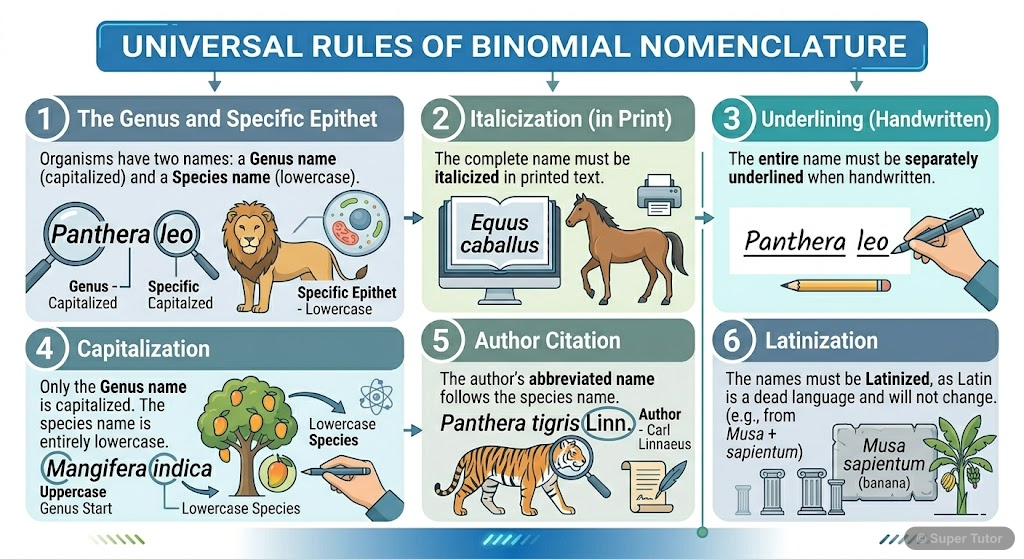
One of 28 illustrations for Five Kingdom Classification in Super Tutor — alongside flashcards, concept maps and practice questions.
Overview
Living organisms show a huge range of size and complexity, from single-celled bacteria to large plants and animals. A useful way to study this diversity is by grouping organisms from the simplest to the more complex. The five-kingdom classification divides living beings into Monera, Protista, Fungi,
Key Concepts
Species is the lowest basic category
Species is the lowest basic category. Members of the same species can normally interbreed among themselves and produce fertile young ones. House cat i
The category levels of diversity
The category levels of diversity are species, genus, family, order, class, phylum, and kingdom. Similar species form a genus, related genera form a fa
Linnaeus divided living organisms into Plantae
Linnaeus divided living organisms into Plantae and Animalia. This system was simple, but it could not properly place bacteria, fungi, and some unicell
Monera includes unicellular prokaryotic organisms
Monera includes unicellular prokaryotic organisms. They have no organized nucleus and lack membrane-bound organelles. Bacteria are a major example.
Protista includes unicellular eukaryotic organisms
Protista includes unicellular eukaryotic organisms. Some are autotrophic, like Chlamydomonas, and some are heterotrophic, like Euglena, Amoeba, and Pa
Learning Objectives
- Understand the need for classification in living organisms
- Learn the taxonomic hierarchy from species to kingdom
- Explain the old two-kingdom classification and its drawbacks
- Describe the five kingdoms and their main features
- Differentiate between major plant groups and animal groups
Frequently Asked Questions
What are the important topics in Five Kingdom Classification for ICSE Class 9 Biology?
How should I revise Five Kingdom Classification for Class 9 exams?
Sources & Official References
Content is aligned to the official syllabus. Refer to the board website for the latest curriculum.
More resources for Five Kingdom Classification
For serious students
Get the full Five Kingdom Classification chapter — start free.
Quizzes, flashcards, an AI doubt solver and a study plan for ICSE Class 9 Biology. Free to start, no card needed.