The Flower — Chapter Summary
ICSE · Class 9 · Biology
Summary of The Flower for ICSE Class 9 Biology. Key concepts: A flower is a specialized, The floral parts are arranged and Sepals form the calyx and.
Interactive on Super Tutor
Studying The Flower? Get the full interactive chapter.
Quizzes, flashcards, AI doubt-solver and a step-by-step study plan — built for chapter summary and more.
Free trial, no card needed.
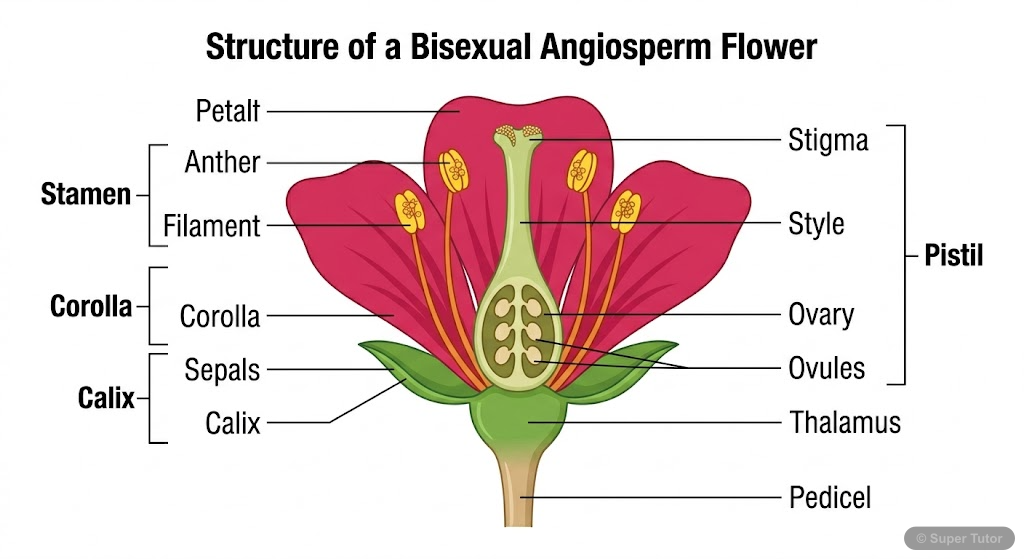
Learn better with visuals Super Tutor pairs illustrations like this with notes and quizzes for The Flower.
Overview
Flower is a specialized shoot in which leaves are modified into floral structures. In flowering plants, the flower carries out reproduction and is often the most beautiful and conspicuous part of the plant. Its parts are arranged on a cup-shaped thalamus in four whorls: calyx, corolla, androecium, a
Key Concepts
A flower is a specialized shoot
A flower is a specialized shoot in which leaves are modified into floral structures. The flower stalk is called the pedicel, and some flowers have no
The floral parts are arranged
The floral parts are arranged in four whorls on the thalamus. The first whorl is the calyx made of sepals, the second is the corolla made of petals, t
Sepals form the calyx and
Sepals form the calyx and are usually green. They protect the young flower bud and may also perform photosynthesis when green. Petals form the corolla
The androecium is the male reproductive
The androecium is the male reproductive whorl. Each stamen has a threadlike filament and a bilobed anther. The anther is usually two-lobed with two po
The gynoecium is also called
The gynoecium is also called the pistil. It is made of one or more carpels. Each carpel has three parts: stigma, style, and ovary. The stigma receives
Learning Objectives
- Understand the basic structure of a bisexual flower
- Identify the four floral whorls and their functions
- Distinguish between complete, incomplete, bisexual, unisexual, and neuter flowers
- Describe the roles of sepals, petals, stamens, and carpels
- Recognize special terms such as bract, nectary, perianth, epicalyx, inflorescence, and placentation
Frequently Asked Questions
What are the important topics in The Flower for ICSE Class 9 Biology?
How should I revise The Flower for Class 9 exams?
Sources & Official References
Content is aligned to the official syllabus. Refer to the board website for the latest curriculum.
More resources for The Flower
For serious students
Get the full The Flower chapter — start free.
Quizzes, flashcards, an AI doubt solver and a study plan for ICSE Class 9 Biology. Free to start, no card needed.