Pollination and Fertilization — Chapter Summary
ICSE · Class 9 · Biology
Summary of Pollination and Fertilization for ICSE Class 9 Biology. Key concepts: Pollination is the transfer, Self and Cross.
Interactive on Super Tutor
Studying Pollination and Fertilization? Get the full interactive chapter.
Quizzes, flashcards, AI doubt-solver and a step-by-step study plan — built for chapter summary and more.
Free trial, no card needed.
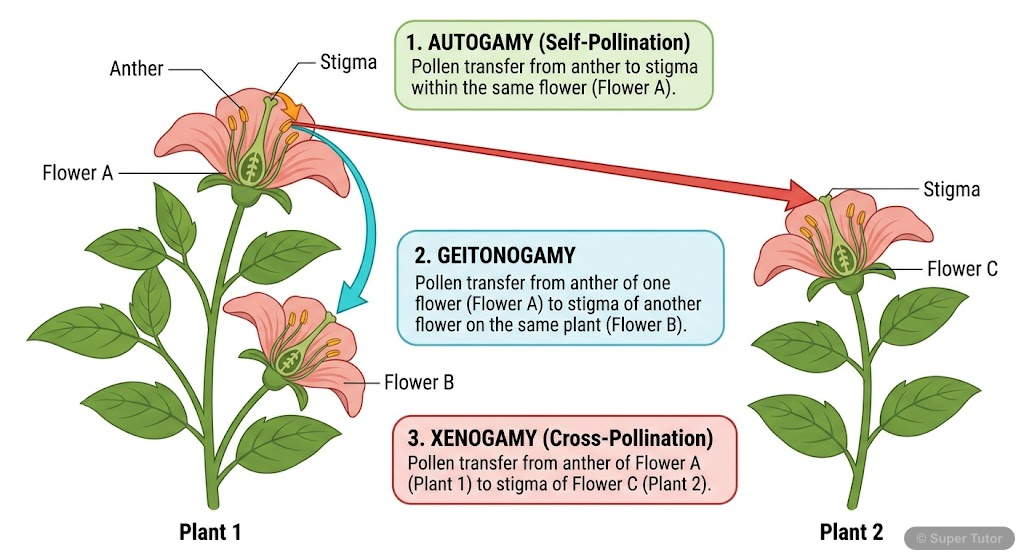
One of 6 illustrations for Pollination and Fertilization in Super Tutor — alongside flashcards, concept maps and practice questions.
Overview
Pollination is the transfer of pollen grains from the anther to the stigma. Fertilisation is the fusion of the nuclei of the male and female gametes. These two events lead to seed and fruit formation in flowering plants. Pollination may happen within the same flower, between flowers of the same plan
Key Concepts
Pollination is the transfer of pollen
Pollination is the transfer of pollen grains from the anther to the stigma. It occurs only between plants of the same species for successful reproduct
Self
Self-pollination is the transfer of pollen to the stigma of the same flower or another flower of the same plant. Autogamy and geitonogamy are both inc
Cross
Cross-pollination is the transfer of pollen from a flower of one plant to the stigma of a flower of another plant of the same species. Allogamy is cro
The commonest agents of cross
The commonest agents of cross-pollination are insects and wind. Water, birds, and elephants can also act as agents in some plants.
These flowers are large
These flowers are large, brightly coloured, scented, nectar-producing, and have sticky or spiny pollen and sticky stigma. Dahlia and sweet pea are exa
Learning Objectives
- Understand the meaning of pollination and fertilisation
- Distinguish between self-pollination and cross-pollination
- Recognise the main agents of cross-pollination
- Describe the structure of pollen grain and ovule
- Explain pollen germination and pollen tube growth
Frequently Asked Questions
What are the important topics in Pollination and Fertilization for ICSE Class 9 Biology?
How should I revise Pollination and Fertilization for Class 9 exams?
Sources & Official References
Content is aligned to the official syllabus. Refer to the board website for the latest curriculum.
More resources for Pollination and Fertilization
For serious students
Get the full Pollination and Fertilization chapter — start free.
Quizzes, flashcards, an AI doubt solver and a study plan for ICSE Class 9 Biology. Free to start, no card needed.